This transcript of Raising the Bar with RebuttalPR was generated using AI transcription and lightly edited for readability. It may contain errors, and speaker labels are approximate. The audio recording is the authoritative version.
Welcome to Raising the Bar with RebuttalPR, the podcast where we elevate the stories of the plaintiff's bar and dive into the key trends shaping the civil justice system today. I'm your host, Ray DeLorenzi, and in each episode, we'll bring you insightful interviews with leading attorneys, expert perspectives on current legal events, and in-depth discussions on the issues that matter most. Now, let's jump in.
I will never stand in front of a judge and stretch or overstate. And if a motion is not meritorious, I'm never going to support filing it. So some of that, I hope that credibility comes along with the experience. And that's because that's the way I practice.
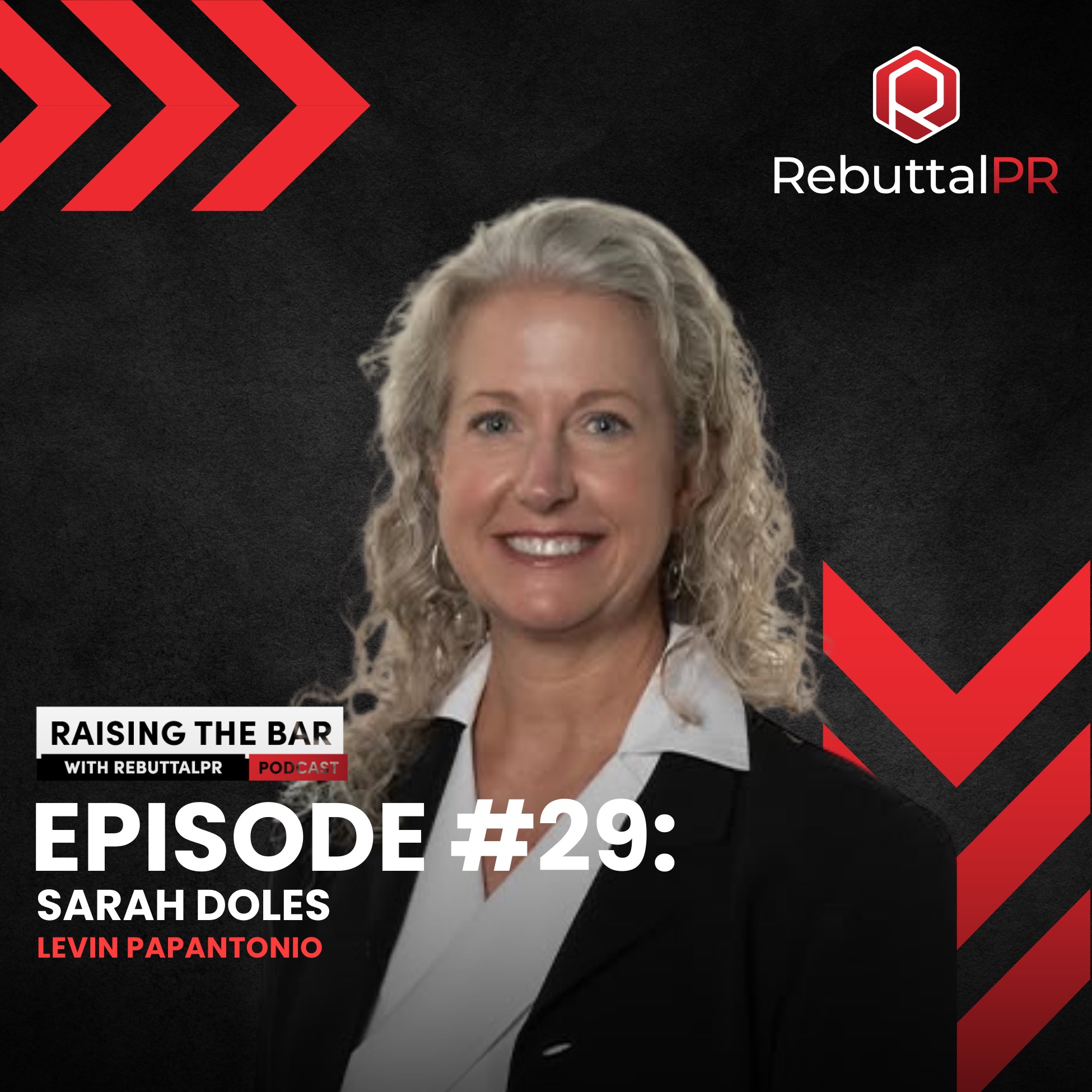
Ray: Hey, everyone, welcome to a new episode of Raising the Bar with RebuttalPR. I'm your host, Ray DeLorenzi, and today I'm honored to be joined by Sarah Doles of Levin Papantonio from Pensacola, Florida, although Sarah is in Missouri. And we're excited to have her today. For those who are not familiar with Sarah, she has worked on really interesting cases affecting farmers in the agricultural community, and she also has had what I think is a bit of an unconventional path to becoming a plaintiff's lawyer. So, we're really glad to have Sarah here today. Sarah, thanks for joining the podcast.
Sarah: Thanks so much for having me.
Ray: All right, so, Sarah. You know, these podcasts, I always like to sort of figure out what makes people tick and the person behind a lot of these big cases. So tell me, did you know growing up, since you were a young kid, hey, I'm going to be a lawyer? Or what was your path to getting there?
Sarah: So, actually, my father was a lawyer. And so I knew what the life was. I watched him growing up, and I wanted to be a clinical psychologist. So that was my path in undergrad. I had a double major, one of them was psychology. I figured I would need to go to graduate school. Actually, I can back up before that — I wanted to go to medical school. And then the science and math didn't agree with me. And so I promptly switched gears and wanted to be a clinical psychologist.
I was on that path until I had the wonderful experience of going to Washington, D.C., spring break of my junior year in college. And my dad was arguing a case in front of the U.S. Supreme Court. And that was how my sisters and my mom and I all went to DC and watched. And sitting there, it clicked. I listened, and I had watched him prep in the hotel room, and while we were sightseeing, we'd check in with dad — what's dad doing? And dad can't join us, and off we'd go. And then just listening a little bit about the case. And when I sat in the Supreme Court, it was such an awesome experience, watching and listening, and it made sense to me. And immediately I fell in love, and that's what I wanted to do.
Ray: What kind of law did he practice?
Sarah: He practiced everything. I think part of it was that generation, but he had more of a boutique law practice, and he had his core clients that if they were sued, he would defend them. If they needed to sue someone, he would represent them. If they needed estate planning, he had someone in his office who would do their estate planning. He was kind of a jack of all trades, and he did it very well.
Ray: So you wanted to be a clinical psychologist when you were younger. Was that because you had a lawyer in the house and you were like, that's not for me? Or, you know, I guess I'm curious about what it was like being raised by a lawyer and how much of that infected the household, for better or worse.
Sarah: Yeah, I knew from a very early age that was him. That's what he did. It required a ton of time, and it was nights and weekends. And he did a great job prioritizing his family as he could. But I knew what that life was like, and I wasn't deterred from law because of that lifestyle. It was just something that — yes, I'd been exposed to him, but I think when I was in college, the psychology classes I found so interesting. And fast forward to law school, probably the most enjoyable and fascinating class that I took was called Psychology and the Law. A visiting professor came in and taught that, and it was fascinating. So it was just something that interested me. And I really, oddly, hadn't thought about being a lawyer until that experience of sitting in the Supreme Court.
Ray: Do you remember what that Supreme Court case was about?
Sarah: I do. I do. My dad was asked to represent the judges in the state of Missouri. So he was brought in only for the Supreme Court argument. He hadn't handled the case before that, but he was brought in. And it was quite an honor for the judges to ask him to take that case. And it was about the mandatory retirement age for the state court judges. And he argued that there should not be a mandatory retirement age, that it violated the law. And he lost five to four. It was very close, but he did lose.
Ray: Did you appreciate at the time the gravity of that, in the sense of it's not every day a lawyer argues at the U.S. Supreme Court? Did it sink in then, or not until later?
Sarah: It sunk in as I sat there and watched. And it was just the experience of a lifetime, and it changed my life.
Ray: So you go to law school. You went to St. Louis University. And from there, I'm curious: what did you want to gravitate towards after law school? You know, usually that's the time where you're like, I'm going to go be a defense lawyer, or I'm going to do bankruptcy. What was it that interested you there? You mentioned the psychology work, but did you have a plan?
Sarah: It was developing. I didn't really have a plan. I fortunately was able to clerk out of law school, and I used those opportunities to figure out what were my strengths, what were my weaknesses, what did I really want to do, what was my passion. And I went to law school to fight for individuals' rights, to do what my dad was doing in front of the Supreme Court, to uphold those standards that we have. And that's why I went to law school, to fight the good fight. And I knew that. I just didn't know how I would fight the good fight and what that would look like.
Ray: So, after graduating from law school, how soon thereafter — was it immediately that you became a clerk?
Sarah: I did. So, right out of law school, I was so fortunate to clerk on the Eighth Circuit Court of Appeals for a judge that was an absolute legend — Ted McMillian, Theodore McMillian. He truly was a legend. The rumor was that had there been a Democratic president in office when Thurgood Marshall retired, then Judge McMillian would have been the nomination. And he taught me so much because of his view on the world. I was able to spend a little more than a year with him.
But the way that he looked at the law and cases and life in general — because he had overcome so much. He was the first black judge ever in the state of Missouri, and that was back in the 50s. And when he went to his first judicial conference, they had to move the conference because the hotel would not allow him inside. And he went through life and he was never bitter. He was always kind. He would be pulled over when he was driving his very nice car in a very nice neighborhood, when he was a federal circuit court judge — it happened. And he just had such a true heart and a true vision to make things better. And it was very inspiring. And so I think that also then propelled me to want to be better and make the world better.
Ray: So, after that experience at the Eighth Circuit, where'd you head to from there?
Sarah: I went to the district court. So I went a little bit backwards. And that was one of the things that the district court judge pointed out when I interviewed. When he was nominated, he wasn't supposed to interview for the positions until he was confirmed, but he was not particularly patient — Patrick Murphy in the Southern District of Illinois. He was a former Marine, and he was very efficient. I learned so much from him as well. And he pointed out in the interview process that a lot of times clerks would go from the district court to the court of appeals. And I was doing it backwards. And what I liked about that was the benefit of hindsight and what I had learned at the Court of Appeals — the things to be watching out for in the trial court. I could make sure that I was paying attention to that while I was clerking in the district court.
Ray: Were you itching at any point to be like, I want to go be at a law firm and be an advocate, versus having to be a neutral?
Sarah: I did. And when I interviewed in the district court, Judge Murphy asked me if I wanted to look for a permanent position or a term position. And I asked that he consider me for a two-year term position, because that was what I wanted — I did not envision myself staying there. I wanted to advocate. And a year into my clerkship, he told me that I was welcome to stay as long as I wanted, that if I wanted to convert my term — that was at a time when judges were still able to have more than one law clerk, which they can't do anymore. And so I jumped at the chance because I was learning so much and I loved it. It was a fantastic experience.
But I have such tremendous respect for all judges, because we get to know our cases and know every in and out of our cases, but judges jump in 30-minute increments from case to case to case, civil to criminal to sentencing to something different. I just gained such respect. And in doing so, being able to shadow that, I learned so much.
Ray: So how long did you end up staying there?
Sarah: I guess it was a little over 13 years. 13 and a half years.
Ray: Would you have guessed that, once you accepted the offer to stay there quote unquote permanently?
Sarah: Never. I never would have guessed that. But then life also happened for me. And so it was a good spot for me to be.
Ray: Was the itch there at any point during that time, being like, I want to go into private practice? Or was it just sort of an evolution over time?
Sarah: It was an evolution, and I was very happy there. And then it came time for me to start my family. And it was a good place to be. And thank goodness I was there, because I had twins born extremely, extremely premature. And so that was a very good spot for me to be when that happened.
Ray: So in 2011, you entered private practice. What was that like, and why then?
Sarah: I had applied for a magistrate judgeship that came open in the court. So I was clerking, and my kids were miracles. And they were doing fantastic. And I finally got to the point where I said, okay, it's time for me to think about the next step. And so I applied for a magistrate judgeship. And I didn't get it. And I think that was all part of a greater plan, because it enabled me to then move into private practice.
But when I applied — and I thought a lot about applying and whether that was what I wanted to do — in that process, I thought about how I would set up my chambers, how I would handle motions, how I would handle hearings, different discovery motions and briefing, and all of the things about how I would do it. And then when I didn't get the position, I realized: okay, I've been thinking now about my next step and my next plan. So clearly, I'm ready to move on.
Ray: As you're thinking about setting up your chambers and how you could be a judge, were you essentially hanging up that idea of being an advocate for good? What was that like, how'd you process that? You know, I'm sort of playing therapist here, but I'm just curious.
Sarah: Yeah, it's a great question, because I think I had found a place where I was very comfortable and I felt very confident in doing what I was doing and working within the courts. And I think whether it was maybe safer to stay within those confines, or just continue to build on what I'd been doing because I'd already been doing it for so long, that it just kind of seemed like a natural progression. But in hindsight, I'm very happy how things worked out and what I'm doing now.
Ray: So let's talk about your first days in private practice. What is that transition like — from looking at both sides of an issue, or how it's presented by both sides, and then essentially putting on your war hat as a practicing lawyer and advocate?
Sarah: It's different. And it took a little bit at a time. I'm not a particularly negative person, but I felt like I was always the naysayer in every conference and every meeting, because I would point out a weakness here, or I would point out the other side. And because I had been doing that, as you said, as a neutral for so long, I would see the other side or know what to expect. And that's not uncommon. I mean, lawyers do that. But my specific memory is the day I started in private practice, I didn't even go to the office, I went to a meeting, because the Yaz MDL was actually pending in front of a different judge in the Southern District of Illinois where I had been clerking. And so I immediately switched gears to help on some of the last pre-trial briefing and motions in limine and getting ready. It was two months away from the trial date. I started in November, and the trial was set for January. And so I immediately got thrown into that, which was a blast and just helped me learn while running full steam ahead.
Ray: Did people appreciate the knowledge you had from having over a decade in that court? Or was your expertise viewed skeptically by others, saying she's never advocated for anyone before? What was the reception like?
Sarah: I'm sure both. I did have someone tell me that I needed to be more forceful in a brief. And then I also have had people tell me that it was really helpful to see the other side and know what was coming — not that I would ever presume to know what a judge is thinking, but I could at least say, well, here's how I think a law clerk would view it.
Ray: Do you think judges or magistrates — probably closer to that period — had a greater appreciation for your journey and maybe would give you those extra few minutes to explain an issue? Or did you feel like they just treated you like any other lawyer, or maybe even worse. I don't know.
Sarah: Well, I hope so. And that has always been my hope. And I think they know from my journey that I will never stand in front of a judge and stretch or overstate, and if a motion is not meritorious, I'm never going to support filing it. So some of that, I hope that credibility comes along with the experience. And that's because that's the way I practice.
Ray: So you get thrown into Yaz. I'm curious, what was the first litigation that you sort of took on, sort of owned in a way that you felt like, okay, I've arrived now. Now I'm an advocate.
Sarah: It would be birth defect litigation. So that was at the firm where I was. We went kind of right from working on Yaz — they had been working on birth defect litigation cases and I jumped into that, and that was both the most heart-wrenching yet professionally and personally satisfying litigation that I could have worked on at the time.
Ray: And what product was this?
Sarah: So it was SSRIs.
Ray: Got it. Okay. And now you are face to face, not just with other lawyers, but with the clients. What was that pivot like for you, interacting with them and hearing directly from them instead of through their counsel?
Sarah: Right. That, I think, goes back to that love of psychology and all of those classes, and sociology, and all of those things that I had back in undergrad, and having that human touch and feeling like I can try and make a difference. I can never make it better. I can never make it all go away. I can never put them back in the position they were in before. But I can try and hold someone accountable, which I think makes them feel a little bit better.
Ray: So I know you've sort of carved out a niche in the agricultural space. How did that come to be?
Sarah: So I think part of it is that litigations are evolving. Yes, there are still pharmaceutical cases, plenty of pharmaceutical cases out there. But I think that the practice has expanded — where it was focused on pharmaceuticals, now you've got your environmental cases and these herbicide cases. And I think we are starting to understand just how many harms there are, just in the world we live in. And with all of the social media litigation and those kinds of things, I think there are so many more areas than maybe we focused on 10 years ago.
Ray: Can you tell me about your first AG case that you worked on, and talk a little bit about that work? I know it was sort of a milestone case, so I'm interested to hear more about it.
Sarah: On the Roundup cases that I worked on?
Ray: Oh, I'm sorry. I was referring to — it was against Syngenta, if I recall correctly, involving, I guess it was corn pricing.
Sarah: Yes, yes. So that was a very different litigation as well, because that was not a personal injury case. And that is what I respect plaintiffs' lawyers so much for — the creativity, finding all of the wrongs that are being committed and creating a legal theory. It's inspiring to work side by side with just the greatest, most brilliant lawyers. But yeah, there were several litigations for that. There was an MDL in Kansas, and then there was a mass litigation in the southern district that Judge Herndon had as well. And that had to do with genetically modified corn.
Ray: And so something like that comes across your desk. How do you start getting your arms around what is a case here, when you're involving economic damages, the science of how things are genetically modified, and pricing power? Where do you start on something like that?
Sarah: I think it's where you start in every case. You just learn, you just educate yourself. And the case that I'm predominantly working on right now, the Paraquat case, which primarily affects farmers — you learn everything you can about how a product is used, what is done. Back with the genetically modified corn, learning all about that process of how it came to be that things are being genetically modified, which kind of rolls into the Roundup litigation, and you learn that seeds are now genetically modified so that they can stand up to Roundup, and people can actually spray Roundup on the fields. And with everything, one thing just leads to another, and you learn as much as you can about the particular subject matter.
Ray: What's been unique about the farming community and working with them, versus, let's say, a parent who is fighting for a child that has a birth defect? The farming community has its own intricacies. And I was curious how you worked your way into that community so they could trust you as their advocate.
Sarah: Yeah, a really good question. And I'm glad that I worked and talked to clients in the Syngenta corn cases, because I learned very quickly they are not litigious. They generally don't like plaintiffs' lawyers. And they want nothing to do with a class action, which is interesting. And so having those conversations, explaining the difference between a class action and a mass action, and just understanding where they come from — they're not fully supportive of, hey, let's fight whatever fight we can find. They only want to fight the fight that's affecting them. And that has helped me understand the demographics of plaintiffs that we have in the Paraquat litigation.
Ray: You know, taking the pricing issues, or Roundup, which is alleged to cause certain types of cancer, and then Paraquat, alleged to have caused Parkinson's — how has your view changed of America's farming community and also of how we get our food? I know it's such a complicated question, but when you see farmers having such a difficult livelihood and also putting their lives at risk, I'm just curious how your thoughts have evolved over time doing those sorts of cases.
Sarah: I can give you a very specific example, and that is in my neighborhood, there's a wine bar, and for a while they would do kind of pop-up wine tastings. And I started learning about organic wine production. And so many of the Paraquat plaintiffs were exposed, whether in wineries and orchards. And now I am drawn to organic — to wines that are made organically — so that I know I am not consuming a wine that someone had to spray a pesticide on that could harm them.
Ray: To zigzag a little bit, I know you've joined Levin Papantonio. It's probably, what, two years ago now?
Sarah: It's been three and a half.
Ray: Oh, three and a half. Okay, wow. Time flies, I guess. And obviously, they're one of the big players in the plaintiffs' bar. What drew you to want to join that firm?
Sarah: The creativity of the founding partners and the leadership at the firm right now. I have wonderful memories and learned so much at the firm where I was — I was exposed to everything and every facet of a case, and I appreciate that. But looking forward to what the next stage of my career looks like, and thinking about the volatility, really, of what we do — you know, the Supreme Court has just taken a case on FIFRA preemption, and things can change quickly. And unfortunately, I never worked with Fred Levin. He had passed before I joined the firm. But I've heard plenty of stories and have a huge respect for all that he did.
And the leadership there — Mike Papantonio, and Mark Proctor, and Brian Barr is leading the ship now. And it's their ability to think ahead and think outside the box and continue to be open to looking at new avenues of ways to make things better. Looking at what these harms are out there, and what we need to do to stop some of these things that are happening, and challenging each one of us to find a theory, find a way to make it better. And that's what drew me.
Ray: I know you all are — and this is up publicly on the docket, the Paraquat MDL looking to resolve those claims. And I know there's still a lot of your attention tied up in that. But what are you looking towards next, without spilling any sort of secrets or investigations? What are the things out there that interest you or worry you that you may want to be tackling in the near future?
Sarah: A lot worries me. A lot worries me. And that's kind of the million-dollar question right now. There's a lot, and there's a lot we can do, but I've got some ideas. They're just a little underdeveloped to probably share at this point.
Ray: Fair enough. We'll have to have you back.
Sarah: And I've got some pretty big ideas.
Ray: So we'll have to have you back whenever they hatch.
Sarah: Yes.
Ray: Well, Sarah Doles with Levin Papantonio, thanks so much for joining the podcast and sharing your really interesting path to becoming a plaintiff's lawyer. We really appreciate the time.
Sarah: Well, I appreciate you having me. Thanks so much.
Thanks for listening to this episode of Raising the Bar with RebuttalPR. Don't forget to subscribe and follow to join us next time. See you then.