
- September 21st, 2026
- 5 minutes
- Ryan Litner
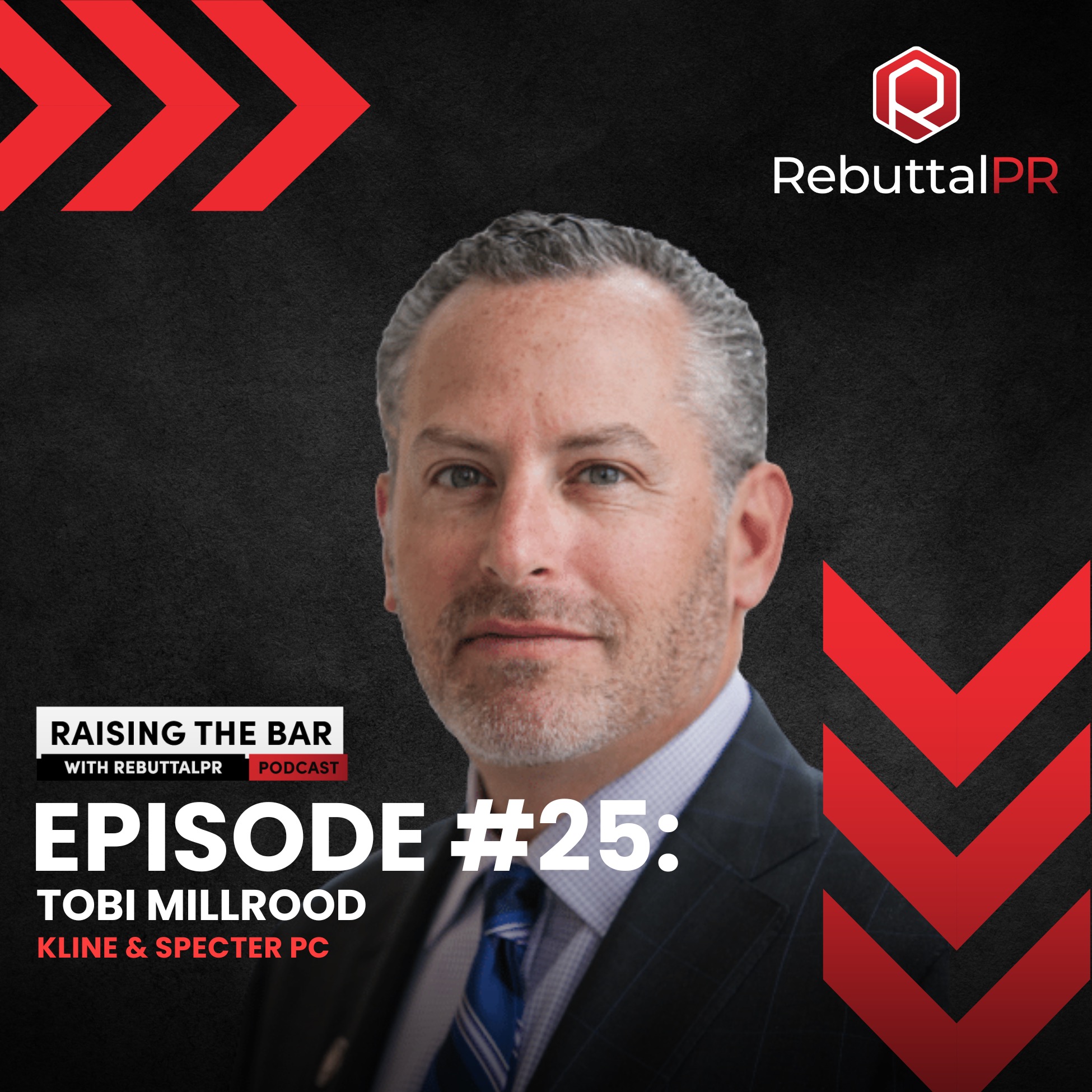
In this episode of Raising the Bar with RebuttalPR, host Ray DeLorenzi sits down with Tobi Millrood, partner at Kline & Specter and chair of the firm’s Mass Tort Department. A national leader in complex litigation, Tobi has spent 25 years trying high stakes pharmaceutical and medical device cases, including a recent $175 million Roundup verdict in Philadelphia.
Tobi talks about growing up as the sixth of seven children, sharpening his debate skills around the dinner table, and performing on stage long before he entered a courtroom. He shares how those early experiences, along with an unexpected path through the University of Tulsa College of Law, set him on a trajectory toward the plaintiff’s bar and helped shape his approach to storytelling at trial.
He walks Ray through his first trials, what it was like to go up against some of Philadelphia’s most seasoned defense lawyers, and the mentors who taught him to use being underestimated to his advantage. Tobi also explains how mass tort trials differ from single event cases, the years of preparation behind the Roundup verdict for client Ernie Karanchi, and why authenticity resonates more deeply with juries than performance ever could. He closes by reflecting on his time as AAJ president during COVID and the work involved in keeping the civil justice community connected during a period of national uncertainty.
Learn more about Tobi Millrood and Kline & Specter:
https://www.klinespecter.com/tobi-millrood/
Read the transcript
This transcript of Raising the Bar with RebuttalPR was generated using AI transcription and lightly edited for readability. It may contain errors, and speaker labels are approximate. The audio recording is the authoritative version.
Welcome to Raising the Bar with RebuttalPR, the podcast where we elevate the stories of the plaintiff's bar and dive into the key trends shaping the civil justice system today. I'm your host, Ray DeLorenzi, and in each episode, we'll bring you insightful interviews with leading attorneys, expert perspectives on current legal events, and in-depth discussions on the issues that matter most. Now, let's jump in.
You can embrace being underestimated. If you don't have the facts on your side, if you don't have the venue on your side, if you don't have the experience on your side, embrace it. Because your over-preparation is going to catch the other side by surprise, and it's either going to get you the result that you want from the jury, or maybe even get the case resolved.
Ray: Hey, everyone, welcome to a new episode of Raising the Bar with RebuttalPR. I'm your host, Ray DeLorenzi. Today I'm honored to be joined by Tobi Millrod of Kline & Specter in Philadelphia. I've known Tobi a long time through the American Association for Justice. He was president there, which we'll get into, and he's also tried more than a handful of cases in his day. Tobi, thanks so much for joining the podcast.
Tobi: Thanks for having me, Ray.
Ray: So I always like to start these out with how people like you become a lawyer in the first place. Walk me through growing up and, you know, is there something that you can pinpoint of like, that environment made me want to be a lawyer?
Tobi: Yeah, I mean, I think there were a couple of things growing up that made me want to be a lawyer. First of all, I grew up in a household of seven kids where I was the sixth of seven. And literally debating, arguing to get your food, to get some attention, you quickly learn negotiation, quickly learn debate. I didn't appreciate then that that was making me want to be a lawyer, but it was definitely steeling me for the task down the road. And then from a pretty early age, around four years old — I mean, really, as soon as I was able to read — I got on stage. And that background of being on stage definitely led me to wanting to be in some venue where I could feel applause for what I had just done. And I knew it wasn't going to be on the stage where I wanted the applause from. And what was the natural transfer from that was the courtroom.
Ray: What age was it? Was it when you were going to undergrad? Was it in undergrad where you're like, okay, I can translate being on stage to being a lawyer?
Tobi: Definitely before undergrad, even in high school. I think when I was in high school, I was watching that old show, L.A. Law, and I just loved the glamour of the skyscraper and the lawyers meeting Monday morning and sitting around a grand conference room table and going over all the cases and brown bagging it, and then going into the courtroom and being warriors. I just felt like what I was doing on stage and what I was watching on TV — I thought, this is going to be the right fit for me.
Ray: So obviously, being a lawyer doesn't involve a heck of a ton of time in the courtroom. When did you first appreciate that? But also, when did you discover, you know, I want to be a plaintiff's lawyer?
Tobi: Well, when I went to law school, I really didn't know exactly what I wanted to do with the law. I thought maybe I was going to become a sports agent — Jerry Maguire and that whole thing. But I walked into torts class. I went to the University of Tulsa College of Law in Tulsa, Oklahoma. There were not a lot of kids from Philly at the University of Tulsa College of Law, and there were even fewer Jewish kids at the University of Tulsa.
Ray: How'd you end up in Tulsa?
Tobi: It's such a long story, but the short version is: one of those seven, my older sister, Rachel, had gone to Sweet Briar College and she went to a reunion. And she ran into someone at the reunion who just so happened to have gone to Tulane Law. And I had kind of sat around on my applications and just thought it was automatic that my undergrad degree from Tulane University got me into Tulane Law. I was a little late to that game. My sister said, like, what gives? He should be going to Tulane Law. And her friend said, well, I know this is crazy, but I'm now the Dean of Students at the University of Tulsa — tell him to put in an application. My sister came home and said that. I said, no way, I am not going to Tulsa. And my father said, well, tell me what your other options are right now. And I did have some other applications out. And I've got to tell you, it was some of the best time of my life. I was able to be a really big fish in a small pond. I loved the University of Tulsa College of Law. I loved the educators there. I loved the way they bring along law students.
But when I went there and I went to torts class, Professor Ray Yasser said, today we're going to go over assault and battery. And I like to think of assault and battery as kind of going hand in hand, like peanut butter and jelly, or maybe bacon and eggs, or I kind of think of it as like bagels and lox. And I had this big light bulb go over my head, and I was like, okay, I'm not the only Jew in Tulsa, Oklahoma — my professor of torts is one too. So I had this affinity for him, and then just the subject matter made a lot of sense to me. And I knew once torts was coming naturally to me that I was going to be on the plaintiff side of tort law. I just knew it. I've never spent a day on the defense side. I have so many friends that I admire so much for the work that they do on the defense side, but I've been a plaintiff's lawyer since the first week of law school.
Ray: I'm curious if you could take us through your first trial and what that was like as a young lawyer, and if you even remember who the plaintiff was, what the injury was.
Tobi: Yeah, no, I remember my first trial. As you might expect, when you're a baby lawyer and you're in a firm that handles trials, you're not getting the eight-figure potential verdict case as your first trial. You're getting the, I know we're going to lose, someone's probably going to have to handle this, the defendants aren't making an offer, why don't we send somebody in and see how they do in the frying pan? And I represented Harold Burgess in a case. Harold was in his mid-80s and had gone legally blind from LASIK surgery. And I was suing a LASIK doctor. And my roll of the dice was going against probably the very best defense trial lawyer in Philadelphia at that time. He's still practicing law — he does a lot of ADR work at this point, too. But Peter Hoffman was my opponent. And I just knew I was a lamb to the slaughter when I came in. But I was excited. I knew that there was nothing to lose. And we did jury selection and then we opened the case. I got an offer and I was able to resolve it. And it was a no-brainer. The client wanted it. The powers that be at the firm thought it was a good outcome, given the fact that there was zero offer and there was no chance. And it was a great experience.
Ray: So that offer comes in. You're not making the call as a junior lawyer whether to take the deal. Was part of you deflated by it, or were you almost emboldened by it, thinking, you know, I gave such a powerful opening, it led to that?
Tobi: For that first one, I was a little relieved, I confess. I mean, I had a lot of energy to get into it, and I thought I was relatively toe to toe in the opening. I felt like I knew what I was doing. I knew how to give a speech. I'm a good storyteller — I told a good story. Then Peter told a good story. I'm like, okay, I'm in this thing. But I was very fearful once we got to cross-examination — his cross-examination of my expert and my cross-examination of his expert. Was I still going to be able to go toe-to-toe? So I was a little relieved on that one. But it got my feet wet, and I was definitely ready to roll for the second one.
Ray: So I understand that the Philadelphia bar is very — I don't know if close-knit's the right word, but it is a community in a way that is different than other areas. And there is sort of a level of brotherhood and sisterhood amongst those who try cases in that area. I'm curious if you had any mentors, particularly on the defense side, that gave you counsel or advice when you were first trying cases?
Tobi: Well, yeah, I was very, very fortunate both on the plaintiff and defense side. You've nailed it. Philadelphia is a big town, it is a city, of course — I guess we're number five or six — but it doesn't feel like that physically when you're here in the city, and certainly in the legal community and the trial lawyer community, it doesn't feel like that. And it so happens that, you know, like sometimes all the coaches come from a certain coaching tree. Really, most trial lawyers, if you run back the trial lawyer genealogy, come from a couple of lawyers — going all the way back to a guy named Nate Richter and a guy named Jim Beasley. A lot of the lawyers graduated from those two. And I found myself at a firm as a young lawyer which is now called Anapol Weiss, but then it was called Anapol Schwartz. And at that time, it was filled with just warriors that wanted to go in and try cases. So there was always this energy in the building. Always somebody coming back from a trial, telling a war story. And Alan Schwartz was one of the great trial lawyers in Philadelphia. He came from that pedigree of Nate Richter and Jim Beasley. And Alan trained my boss at that time, Howard Levin. And I got some great mentorship, some great lessons, some great courage, some great tips on how to really be a great storyteller, a great leader in the courtroom on cross-examination, fearless. But then also, going against folks like Peter Hoffman. I mean, Peter gave me some great tips when I went up against him. And there were a number of other lawyers that I went up against early on in my career. And it's exactly as you described — it was a very collegial bar at that point in time. You know, these days — look, marketing has changed a lot in the law. There was a time where you went into a courtroom, everybody knew what their job was: to advocate for their client. Now you're going against lawyers who literally have up on their website, you know, "bet the company." And there's so much pressure on them, so much pressure to succeed, because after all, what they have said is you can bet the whole company on me. That changes the dynamic and the civility and the adversarial nature in the courtroom these days. Then it was different. I'm lucky. Timing is everything. I'm lucky to have gotten my first strokes in that courtroom at the time of the development of trials in Philadelphia.
Ray: So you're a young lawyer in your first trial. Peter Hoffman is on the defense side, and he comes up to you and says, hey, can I give you some pointers? You're prepared to go to battle. Were you expecting that? What was your reaction in that moment? Was it shock?
Tobi: It's distrust. I really was like, okay, this very nice guy, is he holding a knife behind his back and about to stab me? Is he just kind of patting me with the left hand while the right hand is holding a blade? And I have to tell you, I think it was definitely not that at all. It was from a place of confidence. He knew a lot more about what his client was willing to do in that case, and what his skills were, and what his outcomes are. You know, sometimes I watch these videos — again, you'll forgive me, but I make everything a sports metaphor, I'm a sports crazy head — I watch these videos sometimes about coaches talking to one another before a game, football coaches. And I watched somebody like Bill Parcells talk to Andy Reid just before the Giants are going to face the Eagles in a game, and he's giving him tips before the game because Bill Parcells knows that that tip at that moment is not going to decide the winner or loser of the game. They are now in a fraternity of coaches, and it's paying it forward in its own way. Those tips at that time were a way to pay it forward to me. And I'm grateful for that experience.
Ray: So while I think we can learn a lot from your first trial, I always think there's more to learn from your second one. And I'm curious, what did you take away from your first one that you immediately put into practice that second time around, and what that case was about, if you remember it?
Tobi: Well, the first thing is that I was not going to die. I lived through the first one, I'm still breathing, I'm still walking. You can do this. And so for the second one, it was a much different situation. I represented a man named Gerald Doody who had gone in for a relatively routine follow-up dental procedure, and it went really, really awry. And I will tell you: most trial lawyers are not lining up to get their whole selection of dental malpractice cases — they're challenging for a lot of different reasons. But again, I was a young lawyer, and it was, Tobi, your next one is: you're going to take the Gerald Doody case, and it's dental malpractice. And oh, by the way, you're going out to Montgomery County, where at that time, plaintiffs don't get a lot of verdicts. I said, okay.
I cannot tell you how hard I prepared for that case. I knew that in Montgomery County, I was going to be going past opening statement. I knew I was going to have to put on examinations, cross-examinations. And I went against, again, a very fine lawyer who had been doing it for a long time. And I don't think he expected that I was going to take this case as seriously as I took it. And that was another lesson early in my career: that you can embrace being underestimated. If you don't have the facts on your side, if you don't have the venue on your side, if you don't have the experience on your side, embrace it, because your over-preparation is going to catch the other side by surprise. And it's either going to get you the result that you want from the jury, or maybe even get the case resolved. And that's what happened in that case.
I started out, and it was kind of one of these fights where the fighter on the other side thought he was going to knock me out in the first round, and then we're getting through a few witnesses, and I'm scoring some punches. And all of a sudden, it's like, wait a second, this guy Millrod is actually taking it seriously. He's well prepared. And the next thing I knew, we were about to come in the next day for closing arguments, and opposing counsel, Kevin, said, I have an offer that I'd like you to consider in this case. And it was a really handsome offer. And I was like, no way, no how. I am creaming these guys. I'm doing great. I'm feeling it now. I'm not scared anymore. I'm a real trial lawyer. But, of course, I was a baby lawyer and it wasn't my call to make. I called back to the office and I said, guys, I am killing them. I'm going to close tomorrow and I'm going to deliver this firm a verdict. You're going to be so proud of me, but I do have to tell you, an offer's been made. They said, what's the offer? And I told them the offer, and they said, okay, Tobi, you're taking that. I'm like, no, no, no, no. I'm going to win this case. I'm not taking this offer. And they said, Tobi — and this is when I learned that phrase for the first time, well known to many of our listeners — Tobi, pigs get fat, hogs get slaughtered. You are taking that. And so I came back in and I said, we'll take it.
And court was over for the day. We had to report the next day to the court, advise of the settlement, and release the jury. And we did that the next day. And the judge said, you know, as an exercise, we're going to poll the jury just to see. I know you've not gotten everything — you haven't heard the closings and you haven't gotten communal deliberation together as a jury — but where is everybody right now? And I think it was two for the plaintiff and 10 for the defense. That hog was gonna get slaughtered. That hog was gonna get absolutely slaughtered. And it was another lesson: you cannot be a legend in your own mind in some of these cases. The fact that you have a good cross-examination or you feel well prepared doesn't necessarily translate to who your audience is. I was still in Montgomery County. It was still a dental malpractice case. There were still a lot of difficult issues, and maybe they were very impressed with my lawyering and maybe they thought my cross-examination was great. That didn't mean that I checked all the boxes on the verdict form. And so, in the end, it was a really good result for the client.
Ray: So fast-forward to present day, you run the mass tort department at Kline & Specter. Shanin Specter is a great trial lawyer. Tom Kline is a legendary trial lawyer. I'm curious how your approach to trial prep has evolved. And you've had a couple of recent very large Roundup verdicts. Maybe walk me through one of those. What does the timeline look like? How far out are you really digging into the facts of the case after it's been worked up? And what's your approach now?
Tobi: Well, first of all, trying cases early in my career on what I call a single-event case — where there's a narrow set of facts, a narrow set of science — while it still takes a lot of time to get ready for the case, it's not as all-encompassing. The prep for a trial in a mass tort case, a case like Roundup, is actually years in the making, because when you're taking depositions of corporate executives, you don't know whether or not you're going to be able to bring them into the courtroom live. So every deposition becomes so high-pressured that this might be your only shot at this witness. And even though you're deposing them for seven hours, you've got to distill that to maybe 20, 30 minutes of clips that you can play in front of a jury. So all along the way, you're building a case, you're theming it out, you're coming up with the language. And yeah, our first case in October 2023 in Philadelphia, we represented Ernie Caranci.
I've represented a lot of clients in my day. This was one of the most remarkable stories that I've ever had. And sometimes the storytelling and the client story is as important as everything else. Ernie Caranci came over from war-torn Italy in the early 1960s. He was one of many children and he was one of the youngest, and his mother brought him over to South Philadelphia and left behind a newborn that she had only had about a year earlier. And imagine a mother giving birth to a child and leaving that child behind — but that's how desperate they were. They were living in such a poor village in Italy. And Ernie gets a couple of odd jobs. He doesn't speak a lick of English, and he gets a nun to take him under her wings and teach him some English and meet some friends. And the mom is so distraught, she can't take it anymore, and she has to go back to Italy. And she says, come on, Ernie, we're going back to Italy. And he had two uncles that had made it over here. And they said, go back. And he started crying. And he said, I've fallen in love with the city of Philadelphia. I've fallen in love with America. I cannot go back.
Fourteen years old, Ernie Caranci starts in America stamping shoes, working for a pipe company, doing some die casting, eventually opening up a pizza shop, making enough money to bring his whole family over from Italy. And while he does that, he's able to afford a nice little home where he has a yard, and he uses a weed killer, and he uses it over and over and over again for 20 years and develops non-Hodgkin's lymphoma. And after he develops non-Hodgkin's lymphoma, it comes back a second time, a third time, and he even has had a fourth recurrence. And he came and took the stand at 83 years old, wearing an American flag on his lapel, having paid every cent of taxes on every dollar that he's ever earned in this country, and was honest as the day is long. And it was a beautiful story of courage and avoidable tragedy — really, for the last 15, 20 years of his life, it's all been doctor's appointments and suffering.
So, you know, it's a lot that goes into the preparation. At the end of the day, like I told you, I spent a lot of time on stage from the earliest point. And everyone's heard about method acting, where you take on the character of the person that you're playing — you learn every last bit of it. There's a lot of method acting when it comes into trying a case. You have to learn every last bit of the science. You have to understand the product, how the product is made, connecting the dots of the people that worked in the company, the decisions that were made. Then you have to understand your client, the suffering that they went through, telling their pain. There's so much prep that goes into it, differently than the first couple of trials that were like a single-event medical malpractice case.
Ray: You mentioned before how acting influenced your work as a trial lawyer. Where's the line for you in terms of using those skills, but also ensuring you're authentic to the jury and they don't view you as being, you know, quote, an actor?
Tobi: Yeah. Well, I can tell you, especially in Philadelphia — and I've tried cases in all kinds of places outside of Philadelphia — Philadelphia embraces authenticity like no other city that I've ever been in. So you make such a great point. You have to stay your authentic self. When I was telling you about some of the ways in which I was schooled as a young trial lawyer, Howard Levin, even though he was from Illinois, he was so folksy and so himself in front of a jury. He didn't use legalese and he didn't try to shine you on. And there's a certain amount, as a good trial lawyer, of what we call the objective self. You've got to stand outside of your own body and sit in that box and see what they're seeing. And if you can't look at yourself and see authenticity, then you may not have the jury on your side.
Ray: I want to pivot a bit here to talk about your tenure as president of AAJ. And I know you have been involved in the organization for probably over two decades at this point. Let's move to when you became president of AAJ, which was in the middle of 2020 — a global pandemic. Being president of AAJ is a lot of work, but there's also some pomp and circumstance to it. And at the same time, there's giant upheaval in the civil courts, calls for immunity. What was it like? Was it exhilarating, disappointing, all those feelings? What was it just like to become president of AAJ during that time? And how'd you get your arms around all those issues?
Tobi: Yeah, I mean, that was such a dream. It's a long ladder. A lot of people don't realize, but you don't just become president overnight and snap your fingers at AAJ. You start out, you go to be parliamentarian, treasurer, secretary, vice president, president-elect. And so you're planning and planning and planning, and you're dreaming of what that's going to be like. And then you find out that the script has changed because we're now on a — whatever is your size — 13 by 9 screen or whatever. That's how my presidency started. And so, yes, at first I had to get over the momentary deflation that I was not going to have the same start — or at that time, I didn't think I was going to have any presidency that was outside of a box. But quickly, I realized that, as Linda Lipson, our CEO, likes to put it, I was the right president for the right time. All that time on stage, being the sixth of seven kids, having a mother who was an artist and a seamstress and a creative genius — I needed that creativity. I needed that creativity to motivate our membership. I needed that creativity to communicate with our membership. I needed that creativity to be able to still lobby on a Hollywood Squares screen with people on Zoom. I needed that creativity to run our conventions — we have two during the year, winter and annual during the summer. And my winter convention was on Zoom. And we did it.
We had a lot of creativity. There were contests. I took a picture of my dog, and there was like a little "Where's Penny?" — you had to find it amongst all the web pages that were part of it, all the different quote-unquote rooms. We had an event where we brought a whole bunch of people into a room and had a cooking class with a mother and daughter live from Italy teaching us how to make pasta. We had a disco night where everybody kind of put on their disco ball in their room and they put on music. And we had all kinds of really fun things for what the time was. And I embraced it. And I enjoyed it very much.
At the same time, COVID was used by the enemies of the civil justice system to weaponize it in such a way to say, hey, we're at this kind of martial-law quality of life. Everything has to be suspended as we know it, including the law. And so, whatever plaintiffs' lawyers were normally doing, they can no longer do, because life as we know it has changed because of COVID. And the Senate Majority Leader Mitch McConnell had introduced a bill that was as comprehensive a reform bill to strip away the rights and laws for civil justice for injured people as we've ever seen. And I was able to turn tragedy into good. I lost my mother during COVID in April of 2020. She died in a nursing home that was really ill-equipped to deal with COVID and safety. And although my family never intended to and never did bring a lawsuit relative to that — if we wanted to, if we wanted to investigate the facts, we wanted to have the courthouse doors open to us. We didn't want to have that closed to us. So I wrote an op-ed to the New York Times about what it was that Mitch McConnell had planned to do and how it was going to affect the rights of Americans. And the New York Times published it. And I'm not suggesting that my op-ed was necessarily the turning point that pushed back Mitch McConnell's bill, but that bill died. That tort reform never came through. And all of these things were just stars aligning. The tragedy that I faced, the creativity I was born with — they were the right time, right place.
Ray: To end, I always like to get a bit of color of what you do outside the law. And I know that while I moonlight as a podcaster, you're an even more professional one. I hear you have quite the sports podcast. I'm curious how that started. You already mentioned you're really crazy about sports, but what was the impetus for that? And I know it's a bunch of other trial lawyers that all get together and just shoot the breeze.
Tobi: So we have five of us, five trial lawyers — basically a Giants fan, a Cowboys fan, a Commanders fan, an Eagles fan. And then for good measure, we throw in a Tampa Bay Buccaneers fan. But we cover everything. I mean, we cover college sports. We have two SEC crazy heads. One of our guys played baseball in college — he's really our baseball aficionado. We have a golf nut. I'm a little bit of an everything nut, from soccer to F1 to everything else. So during COVID, we were shooting the breeze on a Zoom, and we were like, this is pretty good. We should turn this into a podcast. And we just kept kicking it down the road — yeah, yeah, yeah. And so finally, we just said, we're going to do this. And we hatched the Sunday Morning Quarterbacks, the SMQBs, and we broadcasted our first episode. We got on a couple of pretty cool special guests. I think this past week, we recorded something like episode 242. We have three or four sponsors. We record every week. We love it. It's a great diversion from what we all do, working really hard as trial lawyers, to talk sports. That's our passion. And it comes easy to us. We don't have to have a script or notes. It's what we see and hear every single week, and we talk about it.
Ray: So, considering there's a lot of NFC East rivalry amongst that trial lawyer group, do you prepare for it? Not exactly like you would a trial, but are you trying to win the debate on the podcast?
Tobi: Oh my God. I mean, just listen, people should just listen. The pain that I took for so many years, the mocking of all the bad Philadelphia Eagles quarterbacks and the carousel and the joke of it all — well, let me tell you, just deserts. When we won the Super Bowl this past year, as they like to say, I have been insufferable for months. And it's a lot of fun. It's a lot of banter that goes on. And anytime one of us rules the roost in whatever respect of the sporting world, being able to have bragging rights on the neighborhood court is pretty fun.
Ray: We'll leave a link in the show notes to Sunday Morning Quarterback. But with that, Tobi Millrod with Kline & Specter, thanks so much for joining the podcast.
Tobi: Thanks for having me, Ray.
Thanks for listening to this episode of Raising the Bar with RebuttalPR. Don't forget to subscribe and follow to join us next time. See you then.
Related episodes
- Sarah Doles on Finding Your Voice After the Bench
- Paul Geller on Negotiation, Integrity, and the Pursuit of Impact
- Cheryl Pope on Building Stronger Law Firms Through Communication and Culture
See how RebuttalPR champions authentic law firm marketing built on real storytelling.
Discover Insights & Trends
Featured Stories

- September 4th, 2026
- 4 minutes
- Melissa LoPiccolo
How to Vet a PR Firm: 8 Questions to Ask Before the Contract is Signed

- August 21st, 2026
- 4 minutes
- Stephanie Wolf
Aligning Your Benefits with Your Values: Parental Leave Edition