This transcript of Raising the Bar with RebuttalPR was generated using AI transcription and lightly edited for readability. It may contain errors, and speaker labels are approximate. The audio recording is the authoritative version.
Welcome to Raising the Bar with RebuttalPR, the podcast where we elevate the stories of the plaintiff's bar and dive into the key trends shaping the civil justice system today. I'm your host, Ray DeLorenzi, and in each episode, we'll bring you insightful interviews with leading attorneys, expert perspectives on current legal events, and in-depth discussions on the issues that matter most. Now, let's jump in.
People are doing this. The people I work with on these cases passionately care about making the world a better place and are using our judicial system and the mass torts vehicle to do that. And I'm really, really happy to be a part of it.
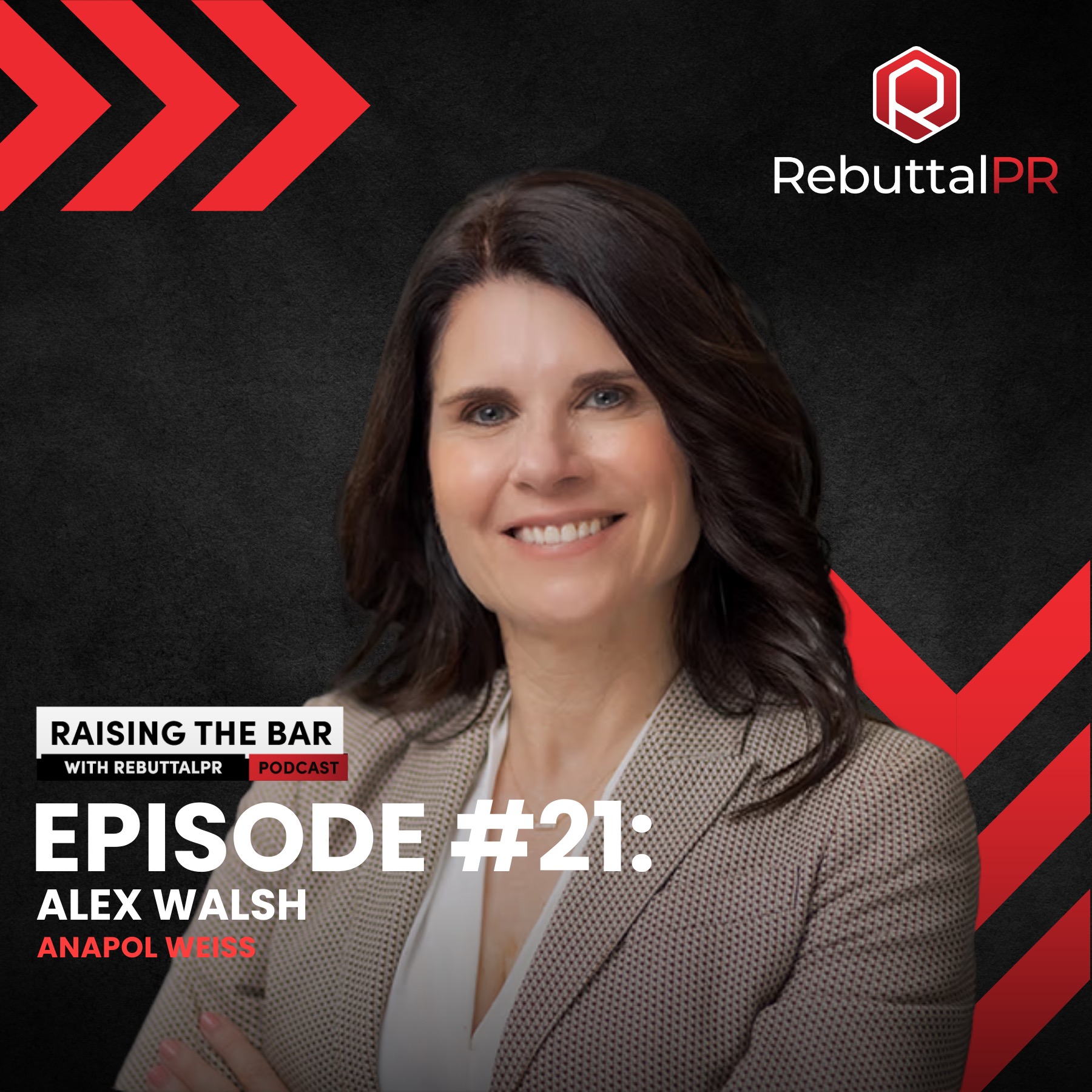
Ray: Hey, everyone, welcome to a new episode of Raising the Bar with RebuttalPR. I'm your host, Ray DeLorenzi. Today, I'm honored to be joined by Alex Walsh of Anapol Weiss. Alex is what I like to call a real-deal trial lawyer. She's seen a few things. She has a very interesting background, which we'll get into later. But she is someone who not only takes in cases, but tries those cases herself. So we're really excited to have her on and to hear about her experiences and her lifetime in the personal injury world. So, Alex, thanks again for joining the podcast today.
Alex: Thanks so much for having me. I'm really excited to be here.
Ray: So, Alex, we like to figure out the person behind the lawyer. So what really drove you into the law in the first place?
Alex: That's a great question. I am not one of those people who grew up knowing I wanted to be a lawyer, who always planned to go to law school. I was a philosophy major in college. I thought maybe I'd try to be a professor, and then I realized that maybe wasn't the most realistic path. So I was like, I'll go to business school. And I really was on the path to applying to business school. And then I had what I really have to call an epiphany. I had this moment where I was like, I shouldn't go to business school, I should go to law school, because it did sort of relate to how I learned to think and write in my philosophy major. And I followed that hunch, and I'm really glad that I did.
Ray: So it's not very common for lawyers, particularly in the plaintiff's bar. And I know your path to getting to the plaintiff's bar was a little windy, but you were a Supreme Court clerk. And I'm curious about that experience, because we don't really have many guests who have that background. Tell me first who you clerked for, but also what was it like being inside something that I think many people would say doesn't have the same transparency necessarily that the executive branch or the legislative branches have.
Alex: Yeah, no, very fair comment. Well, I would be remiss to not talk about the fact that I began having the honor of clerking for Merrick Garland when he was a judge on the DC Circuit. I knew that was a tough clerkship to get. I applied for it. I thought there was a one in a million chance. And he and I really hit it off, and he hired me. And then, like any great mentor, he really encouraged me to continue reaching. He said, you should apply for the Supreme Court. I said, I'm not one of those super brainiac types, I'm not sure that's for me. And he said, give it a shot. And I did.
Back then, at least — I don't know if this is still the case — you apply to every justice. There's sort of this philosophy that you should be honored to clerk for any of the justices. So I applied to all of them, and I had an interview with Justice Breyer. And again, I like to think, and I got this feedback from both of them, that the human aspect — I'm a people person, and my sort of human approach to the law — I think was really appealing to Justice Breyer as well. So he called me half an hour after the interview and said, I'd like to offer you this job. And I was blown away. It really felt like winning the lottery.
I then embarked a couple of months later on one of the most fascinating and difficult and impactful years of my life. I worked every single day except for Thanksgiving and Christmas Day. It did not necessarily come easy to me. Some of the more brainiac types can be out of there at 8:00 at night. I worked really, really hard, and I learned so much and worked on really interesting cases while I was there. It was the very first challenges to the government's exercise of the Patriot Act after 9/11 coming through the court. And I was the clerk in our chambers who had security clearance, so I dealt with a lot of those issues with Justice Breyer. He's a phenomenal, phenomenal man. And to see the inner workings of the court, to see the different justices' approach, to see the collegiality that they shared — it was a huge honor and really a highlight of my career.
Ray: So I think today, but even more so during that era, a Supreme Court clerkship is the pipeline to big law. And I recall reading an interview you did, I think with Law360, where you talked about how you had this itch to do plaintiff's law, and then I think you said like 20 years got away from you or something like that. So you go into big law — did you feel like the path was kind of set, like you were on that path? Or was it something where you thought, I want to do this anyway?
Alex: Yeah, and I think that the path really — and I am happy to report, and I'd love to talk about it more, that I think things are changing. But back then, the path really started in law school. I don't have any lawyers in my family. It wasn't something that I had always known I wanted to do. I knew that I wanted to do something good for the world, and that I liked thinking through tough issues, and that sort of led to my hunch that I should go to law school. But I didn't really know what the different career paths were. And I went to Stanford.
And I would say shortly after I arrived, I began getting a lot of what I think is an accurate term — marketing — from big law firms. They are on the campuses of those law schools all the time. They are hosting happy hours, they are taking you out to dinner, they are doing this on-campus interviewing process. And it just was a very natural path to fall into and follow. And law school is not cheap. Many of us are borrowing money, augmenting it with our savings. There's just a lot of money that's kind of thrown at you.
And I, like many people, thought I'll do this for a couple of years, make a dent in my student loans. And by the way, fantastic lawyers at these firms too, so I'll get great training, and they all have these amazing pro bono programs. The advice that I give to young people now is, if you choose to do that, good for you, but be intentional. Be intentional about — do you right away raise your spending to match your salary, or are you saving money and paying down those loans? Because what happened to me is — first of all, I don't want to denigrate my experience doing that. I worked on great cases, I loved my colleagues. In many, many cases, I believed in the defense that we were putting forth. But I also just kind of got in a rut, and it got harder and harder to step away.
And I think what's changed today is that, thanks to — I think Harvard kind of started this with a Harvard Plaintiffs' Law Association. Stanford now has one. There's a lot more — plenty of plaintiff law firms are being invited to campuses. There's just a lot more visibility, so that young law students who are trying to figure out what they want to do can just understand it as an option. So I think that's a fantastic development.
Ray: So you go to big law, and I think the general public has a misconception — like, oh, then you're in court all the time — which for 99% of big law lawyers isn't true. Maybe they see a courtroom once or twice a year or something. How did you decide your path was, I want to be a trial lawyer and I want to work on complex litigation?
Alex: Yeah. I think part of it is, I love a thorny legal problem. I really like the legal analysis, but what I am most passionate about, and probably therefore best at, is interacting with people. And being in court and getting to talk to juries was the way to maximize that. Now, if that's what you want to do with your career, going to a big law firm is an interesting choice, because the opportunities are few and far between. So I spent my first couple of years kind of paying my dues by being an associate on big trials. Any time anyone asked me to work on a trial, I said yes. No matter what else I had going on — I'd have two trials starting on the same day, and I'd think, well, that's probably the best situation, because one of them's going to move, so they won't end up being on the same day.
I tell people often, it was the things that I thought, how am I going to do this? or I'm scared to do this, but that I said yes to, that really propelled my career. So I did mostly white collar trials early on, which I loved. I got to represent people — white collar alleged criminals, but people — and got to work with people. But I realized, as an eight-year lawyer, that it was going to be an incredibly difficult path for me to be the one standing up in front of the jury and saying, ladies and gentlemen, I represent this party. And so I had a fantastic mentor. Judge Garland introduced me to a woman named Beth Wilkinson, who started the firm that's now Wilkinson Stekloff. She was a great mentor to me. We didn't work together, but she gave me a lot of great advice.
And she told me, if what you really want to do is be the person opening to the jury and closing to the jury, you should try products liability, because those clients — pharmaceutical companies and other consumer product companies — are very sophisticated clients. Their cases are certainly not guaranteed to go to trial, but that much more likely. And they understand the power of having a younger woman who's a mom representing their big bad pharmaceutical company. And so I actually ended up leaving the firm that I originally was at, which was Baker Botts, and went and joined Beth at Paul Weiss and tried cases with her. And she was right. Before I knew it, I was getting asked to first-chair trials, and it was great.
And I worked on — many of us on the plaintiff side lived through these on the plaintiff side — hormone replacement therapy, Zoloft, Xarelto. And eventually, Beth and I left Paul Weiss and started our own firm, which again is now Wilkinson Stekloff, but then was Wilkinson Walsh. And I spent five years doing that. And I can then talk about, if you like, how I decided to become a plaintiff lawyer.
Ray: Before we get to that — and we're definitely going to get into it — I think a lot of the top lawyers in the plaintiff's bar have big law experience and defense side experience, but they don't have 20 years of it. And that's a lot different. I'm curious, what was the first product liability case you did where you thought, okay, essentially what Beth said rang true to you in the moment, like this is the high-stakes stuff where I belong?
Alex: Yeah, I would say it was hormone replacement therapy. We didn't try the case all the way to verdict — it settled — but we opened and began trying the last personal injury hormone replacement therapy case in Las Vegas County Court in July. Stayed at the Bellagio. I will never forget that. But we went up against an incredibly talented trial lawyer on the plaintiff side. We had a two-week voir dire, which was nuts. And I just watched him do his magic. And I guess we actually even settled before opening, so it was sort of a bummer in that way.
On the defense side — which I think is different from most cases on the plaintiff side — the trial lawyers have no idea about resolution discussions. They have no idea what's going on. And so we were headed into court to give the opening, and our client called and said, turn around, the case is over. And that was, frankly, a bummer. But I got that taste and I was like, I just want to keep doing this. I want to be in court. It's such an adventure and such a thrill to do.
Ray: So I'm curious, and you don't have to name the client or the case, but did you ever work on a case during this period where you got that pang where it's like, am I doing the right thing?
Alex: Yes. Yes, I did. I'll just describe it generally, but it was opioids. And it was actually a criminal case that we were retained to work on. I firmly believe in our legal process, and that particularly when you're talking about a criminal case, everyone deserves strong representation. But I also decided that it didn't have to be me who was providing that representation. That was the first time I kind of — I pulled out from that case. I didn't end up working on it. I worked on defending another product. But that was sort of the beginning of, I think, I'm going to need to make a change.
Ray: So you decide to make the change. And I want to start with the reaction from your friends in the defense bar. I was privy to some of the scuttlebutt at the time, but I'm curious, what was the mixture of congrats and I'm jealous versus what the hell are you thinking?
Alex: I think most people who were talking directly to me said, congrats, that's great. I think there were a lot more people probably saying, what the hell are you thinking? But my partners were very disappointed for sure. When I first shared the news that I was leaving the firm, I hadn't completely settled what my arrangement would be going forward. So I really didn't share the specifics — I just basically told them that I was leaving the firm. I love that firm. I think it's such a great firm — Beth Wilkinson and Brian Stekloff. It's just a wonderful, talented group of people.
So I think they were kind of surprised, but it's business, and people move on with their lives, as did I. And a lot of people called me and said, I've always thought about doing that, what's it like? I still have very good friends on the defense side too who sometimes say, tell me exactly how it — I'm not going to name any names, but it's something people think about. And we've seen more and more examples. Lee Floyd is someone who was on the defense side. We didn't really ever work together, but she made the change around the same time I did. At the time, I was like, am I making a huge mistake? It's really one of the best decisions I've ever made.
Ray: So I recall during this period — and maybe it was when you had said you were leaving but weren't sure what the next step was — I heard through the grapevine, some lawyers on the plaintiff's side were like, oh, Alex Walsh has been reaching out. And I'm curious, maybe you were feeling out what to do next. I don't want to say you were like blood enemies, but you were at the trial table in these massive MDLs, these huge cases with billions of dollars on the line. And now you're saying, I want to do what you do. What was the feedback?
Alex: I mean, again, I'd say it was mixed. Everyone was perfectly polite to me directly, mostly to me directly. And one of the first things I did when I made the change was go down to Pensacola, because I was going to try one of the 3M cases. So I just went and started attending trials. And Brad Honholt, who I had tried a case against — a Xarelto case — really reached out a hand and invited me to World of Beer after court and gave me really good advice.
I think I knew this going in, but it definitely hit home for me: I knew that I had a ton to learn. Put aside the business of this side, but there's so much wisdom and skill and learning on our side of the V that I didn't grow up with. One of the things that makes me happiest about making this change is that it was, and still is, a huge learning opportunity. I like to think that when people realized that I wanted to learn and understood their wisdom, people kind of came around, I would say.
Ray: I remember being in Pensacola actually for closings, and I saw you in the courtroom. And I asked someone I trust who was there, and they had this smirk, and they were like, she's joining our side. And I was like, oh. You may not have gotten there yet, but they were like, you're going to get there. So, anyway. When you decided to go on the plaintiff side, what made you say, instead of joining a firm and coming in as their trial lawyer, I'm going to start my own thing? You had obviously built a firm before in Wilkinson Walsh. Did that experience give you comfort, like I can do this on my own?
Alex: You know, I'll be completely candid. I was really actually wanting to join another firm, because I loved the process of building Wilkinson Walsh. I was really proud of what we did there. But I also thought — I knew how much work it entailed and how much that can take away from just focusing on litigating. I very briefly was involved in the Roundup litigation on the defense side, enough so that I had a conflict. And there are many, many firms out there who have Roundup cases. So, as is so often the case in life, something that wasn't your first choice turned out to be the best choice.
I'm really glad that I ended up forming Walsh Law. I know that it allowed me to take some time to learn about the different ways of running the business of a plaintiff law firm — all that goes into it, all of the challenges — to have the ability to see aspects of management, including case management, that I really admired and thought, that's how I want to do it. And to see some other ways of doing it that weren't my cup of tea, or just weren't in line with how I wanted to run a firm. It also helped me a lot with building my team — I spent a lot of time on that, and to have full discretion and authority to do it was helpful. My current partners are very supportive of my recruiting as well, but it was like jumping into the deep end and learning the business in a way that I probably wouldn't have been forced to do if I'd gone into an existing firm. And that has turned out to provide invaluable perspective.
Ray: Sure. So I know you ultimately tried one of the 3M earplug cases. And contrary to some opinion out there, those were not easy cases. I think there were like 15 bellwethers, and plaintiffs won nine, defense won six, though. It wasn't like we were 15 and 0. And not to dwell on it, you were not successful in that case. But as a trial lawyer, you win some and you lose some. How did this one hit, though? Did it hit differently?
Alex: Oh, yeah. It was terrible. I had tried, or been on the trial team, before — criminal cases, one of which resulted in a split verdict, guilty on some counts, not guilty on others, one of which was guilty across the board. So those are very hard verdicts to take. But being the first — I first-chaired that trial. I developed a really close relationship with our client. He's an amazing individual who really served our country in a way that is nothing short of heroic. And I think the jury reached the wrong verdict. I mean, I respect the jury's verdict, but I disagree with it.
One lesson learned is that our client asked if he could attend the summary judgment — or sorry, the Rule 50, where you argue this case shouldn't even go to a jury, plaintiffs haven't proved their case. And I said, yeah, sure, come on. It was so painful for him to hear that. It was really painful for him to hear the defense lawyer stand up and talk about their assertions that he lacked credibility. That's something that I now know to think through and really talk to the client about. That's nothing you'd ever think about in representing a company. So that was tough. I tried that case with Tom Cartmell. I have no doubt that we did everything we possibly could. And I learned a ton, including and especially from Tom — just such a fantastic trial lawyer.
Ray: So a few months ago, it was announced that Walsh Law was joining Anapol Weiss. I don't know Tom, but Sol Weiss and Larry Coben are longtime friends of the firm and me. I'm curious how that took shape and what made you excited about doing that.
Alex: Yeah. So again, really glad I had those three years, whatever it was, of being in charge of leading a firm and all that comes with that, on a strategic level and on a mundane level. But my initial instinct was right, which was that it took up more time than I liked and diverted my attention from litigation more than I was happy with. And around the time I was reached out to, that really became very clear to me. I was introduced to Tom, and I would say by the end of our first Zoom, I just — it's sort of corny, but I was like, this was meant to be. It's like love at first sight. I love this guy. Tom is a fantastic lawyer. He's a really good business person.
And I really loved how he talked about the clients and our business as a profession — that we're not about volume, volume, volume, that it's about taking care of our clients. If that means we leave money on the table, we leave money on the table, but we sleep better at night. If my goal in life was to make a ton of money, I could stay on the defense side. I came to do this recognizing the realities of mass torts — that we need to have volume to our torts in order to get the other side's attention and to get justice for all of our clients — but to be at a firm that blends that reality with our commitment as lawyers to our clients, our communication with our clients, and our respect for our clients. And obviously that exists throughout our bar, no doubt. I'm not suggesting otherwise. But the passion with which Tom and others at the firm spoke about those issues was really inspiring to me. So it happened very quickly — from that first Zoom to us signing the agreement was, I think, five weeks.
Ray: So I'm curious as we wrap up here, what is one major misconception that the defense product liability bar has about the plaintiff's side, and that the plaintiff's bar has about the defense side?
Alex: I would say they're very similar. I think plaintiff lawyers sometimes have a hard time believing that defense lawyers can truly be good people. And they can. You never know what's going on in someone's life, why they ended up where they are, but there are a lot of good people who are doing their jobs. It may not be a job that you would choose to do, but there's just a lot of good on that side. And I actually think that most plaintiff lawyers know that — people end up making friends, you're involved in a multi-year litigation, you see people's humanity.
Likewise, in the other direction, I think in part as a self-justification mechanism, defense lawyers have this vibe that plaintiff lawyers are just in it for the money and they don't actually care about the clients and they cut corners. And nothing could be further from the truth. I was like, I'm sure there are good people on the plaintiff side, I'll find them — and then I was like, oh, they're not hard to find at all. They're overwhelmingly the majority. People are doing this — the people I work with on these cases passionately care about making the world a better place and are using our judicial system and the mass torts vehicle to do that. And I am really, really happy to be a part of it.
Ray: So who knows how many years you'll be doing this — 10, 20, who knows? But when you look back at this chapter in the plaintiff's bar, what will you consider to be a success?
Alex: A case that I'm working on now, which we're still in the beginning stages of, but that involves an online platform that is openly and notoriously being used to identify, groom, extort, and assault children. We are shining a light on that. And I, and my team, and Tom, and our whole firm, we're dedicating tremendous resources to it. And I know that we're going to make a difference there. And I think we're already beginning to make a difference, so I'm really proud of that.
Ray: Alex Walsh of Anapol Weiss, thank you so much for joining the podcast. Really appreciate your time and perspective.
Alex: Thank you, thank you. I really enjoyed our conversation.
Thanks for listening to this episode of Raising the Bar with RebuttalPR. Don't forget to subscribe and follow to join us next time. See you then.