This transcript of Raising the Bar with RebuttalPR was generated using AI transcription and lightly edited for readability. It may contain errors, and speaker labels are approximate. The audio recording is the authoritative version.
Welcome to Raising the Bar with RebuttalPR, the podcast where we elevate the stories of the plaintiff's bar and dive into the key trends shaping the civil justice system today. I'm your host, Ray DeLorenzi, and in each episode, we'll bring you insightful interviews with leading attorneys, expert perspectives on current legal events, and in-depth discussions on the issues that matter most. Now, let's jump in.
To face the institution that failed him every day in court is not an easy thing to do. And the other survivors there understood that and could not be more appreciative and grateful that they stood behind Tom throughout the whole trial and to spend and dedicate the amount of time that they had to be there. It was a long trial.
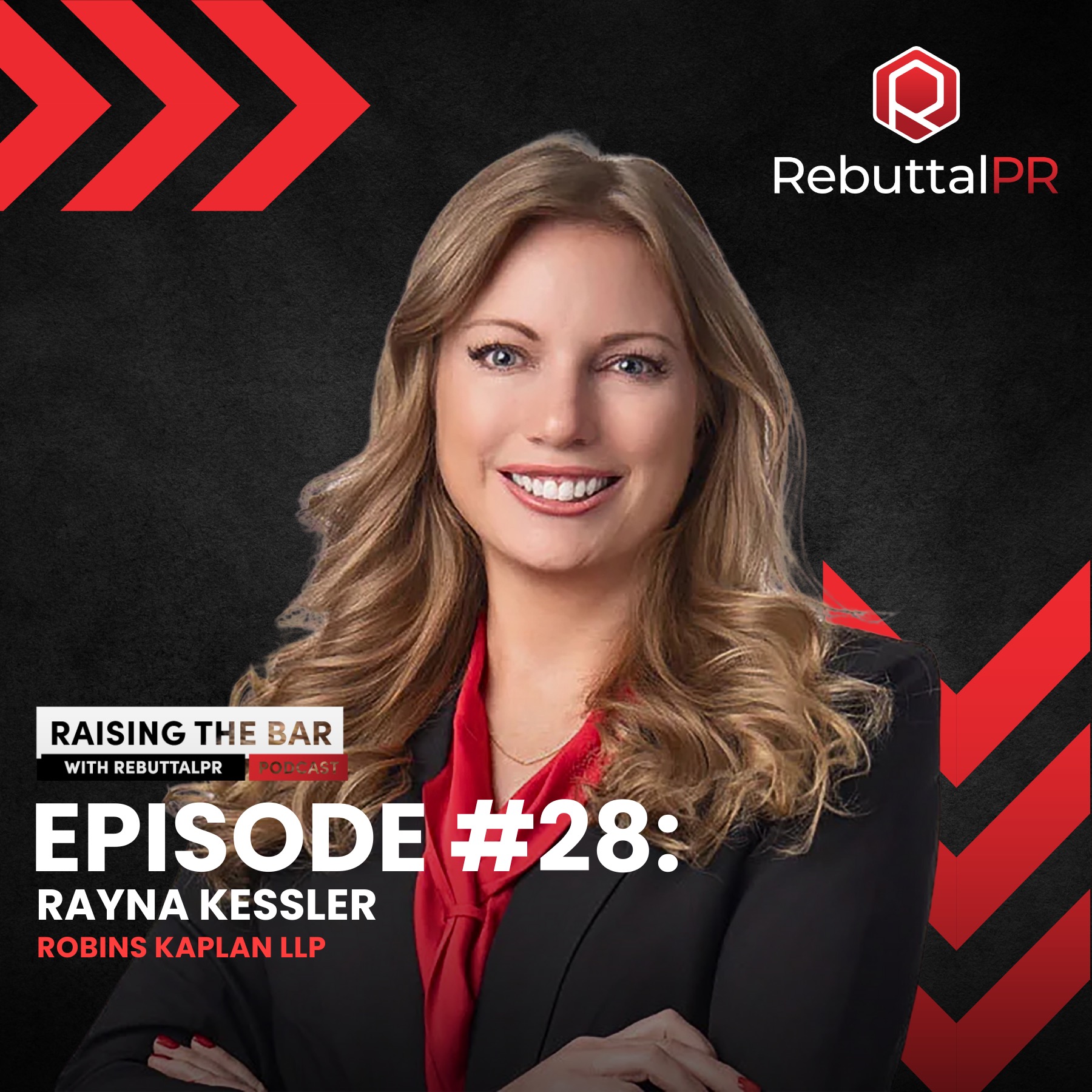
Ray: Hey, everyone. Welcome to a new episode of Raising the Bar with RebuttalPR. I'm your host, Ray DeLorenzi, and today I'm honored to be joined by Rayna Kessler with Robins Kaplan. Rayna is a very well-known, very accomplished mass tort trial lawyer. She recently tried a very significant case against the Catholic Church and a private school in New Jersey. While Robins Kaplan is based in the Minneapolis area, Rayna is also in New Jersey, where I am. Rayna, we are so glad to have you on the podcast today. Thanks for joining.
Rayna: Thank you so much, Ray, for having me.
Ray: So, I do want to talk about that trial for a little bit because I know that was something you've invested a lot of time in and it was historic in nature. But before we go down that road, I'm really curious, as with all our guests here, to learn how they became lawyers and what drives them. So, why don't you take me back to, you know, baby Rayna growing up, what that was like for you, and then what inspired you to be a lawyer?
Rayna: Sure. So, baby Rayna grew up in a small mountain town in Colorado, very middle of nowhere, off the map west of the Fort Collins area. And I think I wanted to be a lawyer before I understood what being a lawyer was. Since I was a teenager, it was something I wanted to do. And I did take time off between college and law school. I actually worked at a defense firm in DC, Williams & Connolly, and saw what big firm life was like and was quickly like, I don't think that's for me. And being on the defense side was something I just didn't see in the cards for me since the beginning of what I knew to understand about the different sides of the "v."
So I was very fortunate that after law school, I clerked for Judge Higbee, who was a really well-respected mass tort judge in New Jersey that became elevated to the appellate division after my clerkship. And that's what really exposed me to the area of law that I practice now, which is mass tort, where I was very fortunate to see three different mass tort trials during my clerkship and really got to understand how significant these cases are and the effect that they can have on our society as a whole.
Ray: So when you were a teenager and saying, you know, I want to be a lawyer, where did that come from? Was it, you know, oftentimes it can be from like TVs and movies? Was it some class you took in high school? What was the inspiration for that? Family members?
Rayna: Yeah, my dad is an engineer, or physicist-turned-engineer, I should say. And he always instilled for me at a young age to pick a career that was challenging, that every day would be different and would really keep my interest. And then combine that with something that was meaningful. He was always a big believer in giving back to the community. He actually served as a volunteer wildland firefighter for our community. He built a volunteer fire station and ran the wildland fire crew on a volunteer basis. And I just really respected and admired that he, even though he didn't necessarily have that through his career, he found it through an avocation. And from a young age, I wanted to combine those two and be able to pursue a career that was challenging that also had that community impact that I think is really important to leave a legacy for.
Ray: So, Judge Higbee, for those who don't know, was sort of a legendary judge in that she did several strings of mass torts and trials. Did you know that going into that clerkship, and that you had this interest in mass torts, or were you just like, it's an opportunity to be a clerk, and I'm going to take it and see where it brings me?
Rayna: It was more the latter, Ray, because when I was in law school, it was through the recession, and I was a bit lost, I would say, in my second and third year in law school, in the sense that I didn't know what type of law I wanted to go into, which is what I think is great about a JD is that you can use it as a springboard for all types of areas of law. And I went to law school thinking that I belonged in criminal law and that I would go the prosecutor route. But I quickly learned as I had more experience in law school that I didn't think that would be the right fit for me, right off the bat, at least. And so I didn't really know what to do, because it wasn't high on my list to become a civil trial attorney, to be honest, and certainly not on the plaintiff's side.
I went to Temple Law, which is well known among the plaintiff's bar, and certainly a lot of very good plaintiff trial lawyers come out of Temple, but my experience was, you know, go to the biggest firm that hires you is what's considered the most prestigious, and that doesn't necessarily mean the plaintiff's bar. So, when I got the offer for the clerkship with Judge Higbee, I didn't even know mass tort was an area to practice in. I really didn't know that it was something I wanted to do. So I was beyond fortunate to land into this niche area of law that really combines the medicine with the science and the law, and how they don't always mix very well together, and has just created a really challenging career where, you know, every day is different.
Ray: So, Judge Higbee oversaw pelvic mesh, Accutane, Vioxx. When you started clerking, where was she in terms of the cases she was overseeing? And what were you tasked with?
Rayna: Yeah, so she was in her trial mode era when I clerked for her. So she loved having trials and she would schedule them back to back, and during my year-long clerkship she had three mass tort trials and was gearing up for her fourth as my clerkship ended. In New Jersey, all clerkships are limited to only a year term. So I had a lot of experience. The first trial that she had was Accutane, and it was a three-plaintiff trial. Very interesting trial that ended up going to the appellate division as well. And then the second trial was a Fosamax trial, and then a Levaquin trial as well.
Ray: What stands out to you now in terms of those trials and that advocacy you saw, and also how Judge Higbee treated the parties and her expectations for that?
Rayna: Yeah, I also should say that when my clerkship was happening, there was a book published by a reporter that had observed a Vioxx trial that Judge Higbee had, and that was a very important trial, not only in that litigation, but in mass tort history as well. Vioxx was one of the biggest blockbuster drugs that Big Pharma has ever produced, and lots of claims were filed. And that book, I read it during my clerkship, and it really gave an overview of what a mass tort trial is about and the impact that it has, and the impact that extended beyond anything that was happening in the courtroom. And I think that's how I really became sure that this is the type of law that I want to practice, because reading that book and then observing these trials and realizing that it's not only about the parties that are there, but all the other parties behind that plaintiff who are waiting for their day in court as well.
Ray: So, tell me about the courtroom advocacy you saw. And as someone who is a trial lawyer, what did you see there that stood out amongst the lawyers that were there? Was it sort of what you expected? Was it impressive? Were there things you learned where like, yeah, I would never do that?
Rayna: All of it was so impressive. You know, coming right out of law school and seeing that caliber of arguing on both sides of the "v.," being there with these large defense firms that have so many resources behind them. Also understanding the impact that just one of these cases can have. And then having that against a really well-organized plaintiff's side of the bar, too, where multiple firms were involved in each one of those trials and seeing how they work together and orchestrate different parts of the case to bring it for the jury is really an incredible experience to see early on in a career.
Ray: So, after the clerkship, you decide to become a lawyer, or you had been a lawyer but then start practicing. And you mentioned before you knew the defense side wasn't for you. Tell me about what led you ultimately to go to Robins Kaplan, which is a unique firm in the sense that they have a very significant plaintiff's practice, but they do a lot of other stuff too that a typical plaintiff's firm wouldn't be involved in.
Rayna: Yeah. So right after my clerkship, I went to a plaintiff's firm in New Jersey and I focused on asbestos practice while I was there, all plaintiff-side, mesothelioma cases, which I really enjoyed, but I also wanted to expand beyond doing one type of mass tort and really make sure that my career was dedicated to learning mass tort generally, being able to do more types of cases. So I moved to a firm to be able to work on larger mass tort cases. And at that firm, I began developing a new litigation that hadn't been filed yet, and that was the Benicar litigation. I developed a group of cases early on before there was even a warning change issued by the FDA. And it just so happened that Robins Kaplan was also looking at those cases around the same time. I was one of the first ones to file into the Benicar litigation. I was contacted by Robins Kaplan as they were interested in making a commitment to the case, and then I joined Robins Kaplan and continued my leadership roles in Benicar.
Ray: Tell me about the process of creating a mass tort from inception and investigating that. And I don't know if you even recall, how did it get on your radar? And what's the process to start working that up? Also, probably thinking or knowing other firms are looking at this too, and wanting to be on the front lines and take a leadership role. How does that work?
Rayna: That's one of my most favorite parts about our practice. I think it takes a lot of creativity from the beginning to be able to recognize something that is an emerging mass tort, as well as being a firm that is able and willing to make that investment, which at that point can become a really risky investment, especially where there was no FDA warning yet. A lot of firms wouldn't jump in until the FDA has taken action. So it just happened to be kind of this collection of events that made it as early as it was. But I have since then always worked on case development, and I tend to like to be at the forefront of new litigations. It's something that really interests me, and I'm a bit of a news junkie, and I'm always reading about and thinking about new potential litigations that have this kind of societal impact that I'm looking for in the kind of work that I do.
And what drew me into Benicar, which ended up being a smaller MDL — there were about 2,200 cases that were filed into that MDL, which is a lot of cases, but compared to 3M or talc, you know, a smaller MDL. And the reason why I really wanted to do that case and really believed in it was because my first client did such an incredible job explaining the impact that those injuries had on her. And from a first glance of what those side effects were, which were mostly gastrointestinal based, you know, it would be maybe easier to dismiss them as not so serious — how serious can GI events be? But really getting to know my client and talking with her about how it impacted her personally, it just really drew me in to make sure that those clients received the justice that they deserved. They were on this drug for a really long time. It was a blood pressure drug, you know, which is a lifelong drug for many patients, and she was on it continuously through all of these side effects that she was experiencing. I think it really comes down to understanding what the injuries are and how they impact our clients.
Ray: So, pivoting to injuries that impact clients in a very visceral way. You have been on the front lines of representing many abuse survivors. I'm curious, as in recent years, states have passed legislation allowing many of these claims to come forward. What was your reaction or posture when you see states doing this and you making that determination: this is an area where I can make an impact?
Rayna: Yeah, I mean, it was incredibly eye-opening. I didn't know how harsh the laws were until I started realizing and looking into the legislation that had been pending for a very long time in New York and New Jersey to modernize their laws, which in New Jersey had been pending for, I believe, 17 years before it was passed. And the statutes of limitations that still exist in a lot of states around the country are really so harsh that they serve no purpose other than to protect the perpetrators and those that enable the abuse to happen. And in New Jersey, before the 2019 legislation was passed, the law was that a survivor only had until age 20 to bring a claim for child sexual abuse.
And we know now, through so much research, and it's so well documented, that for a survivor who chooses to disclose — which is still believed to be a minority of survivors, most survivors do not disclose in their lifetimes what's happened to them, but those that do — the average age of disclosure is 52 years old, which makes sense understanding the trauma that, as a child, our clients were taught that what is now understood to be abuse, while it was happening, they were groomed to believe it was normal. And it takes a long time to be able to process that layered trauma and understand and recognize how it was abuse and it was wrong and it should have never happened, and then to be able to do something about it, to hold those responsible accountable.
Ray: So, I want to talk about the trial that you just wrapped up in New Jersey against Delbarton School. For those who are unfamiliar with Delbarton, it's a very elite school in New Jersey. And I know the case is on appeal, so I'm not going to get much into details of the case, but I'm really just interested in your philosophy and approach. This case was historic for many reasons, one of which was, you know, essentially to go the distance, go to trial in New Jersey under the Child Victims Act. When you sort of appreciated the fact that, okay, this is going to trial, I guess in this case or in any case, how do you start getting your arms around the facts of the case and developing the concept of, hey, this is how we need to try the case and best represent our client?
Rayna: Yeah, I think one of the main themes that we spent a lot of time discussing, and I think is really important, is that our client's abuse happened in the 1970s, and the defense's main theme around that is: what happened 50 years ago? It was a long time ago. Things were different. And really understanding the facts around how the psychological harm that was caused still exists through present day, and how that has really affected a survivor's life from the minute that the abuse occurs, and that that trauma becomes very layered, especially when it's perpetrated by such an important father figure, religious figure, and person in an authority position — how that magnifies the effect that it can have on someone, and that that's really a lifelong trauma. And one of the points that really was focused on with the jury, and that the jury clearly resonated with, is that we don't have to guess what the harm was with our client, Tom, because we have 50 years to show how this has affected his life. And it was that vulnerability and willingness to be transparent with the jury of how it's affected someone's life, and let them see that and experience that through his direct testimony, and be able to then put that into the expert perspective, followed by a damages expert who can talk about the layered trauma and the way that it has affected someone throughout their whole life — that is a really powerful message when those two are put together.
RebuttalPR is a strategic communications firm that works exclusively with the plaintiff's bar to market their firms and win high-stakes litigation. For more than 15 years, the nation's leading plaintiff law firms have turned to RebuttalPR to create winning communications campaigns, ranging from billion-dollar mass torts and class actions to positioning attorneys in their markets to grow their businesses and make a bigger impact. What sets RebuttalPR apart is the unique skill set of our team, which combines legal knowledge with public relations expertise. Our team's ability to understand the facts and law of a case, as well as the media landscape, means we can develop compelling, narrative-driven campaigns that resonate with key stakeholders and support your firm and legal strategy. Visit our website, rebuttalpr.com, to learn more. Now, back to our episode.
Ray: So, your jury's picked. You're going into openings. I've talked to many lawyers, and I would say half of them, when I ask if they're nervous, they say absolutely. And the other half say never — I'm too prepared to be nervous. I'm curious, and it's not even nervousness, but what is your thought going into openings? You know, whether you're delivering those or supporting others who are doing that? Are there nerves, or does the preparation just sink in and it's like, you know, it's time to deliver?
Rayna: Yeah, I think the main concern is to get across the story. And, you know, with a story as complex as an institutional abuse story where Tom, our client's abuse, is not in a vacuum, but part of an institutional timeline of what the institution was aware of and when it was aware of it — that there are survivors that were abused before Tom, there are survivors that were abused after Tom — and, you know, just making sure to tell it in a compelling way that isn't lost in the details of those facts, but in the message that this school was aware that this was happening and having accountability for that. And then also, we spent a lot of time in our opening, as well as the closing, in really talking about Tom in particular, and making sure to introduce our client to the jury so that they know him from day one and that they understand that his story hasn't changed for 50 years. He's been telling the same story, and having the jury know what that story is in a way that is relatable and also detailed, in the sense that the jury has a right to know what happened the night of his abuse and how that affected Tom from day one that it happened.
Ray: So, as you mentioned, Tom, your client — that abuse did not happen in a vacuum. And during the trial, I think probably perhaps every day of the trial, there were other abuse survivors in the courtroom. And I'm curious if that weighed on you at all, although your job in that moment is to represent Tom. Does the weight of the fact that there's an unfortunate abuse survivor community looking at this case as, you know, part of their way to speak as well?
Rayna: It certainly weighed on us, knowing that we were the first ones to try such a historic case in New Jersey and to do justice not only for Tom, but for all survivors that hopefully will have their day in court soon as well, and that have been waiting a long time for the same opportunity that Tom now has had. But it also had a really amazing effect having them in the courtroom every day. It brought an energy and a support network that was built into our trial team really from day one in that courtroom. And I think it was important for the jury to see that other survivors were behind Tom.
I think it was important for Tom to have that support in the courtroom and to be able to relate to other survivors that know how difficult it is to come to court for seven weeks and sit directly across from your perpetrator, because the perpetrator priest was also a defendant in our case and was in court every day as well. And to face the institution that failed him every day in court — it's not an easy thing to do. And the other survivors there understood that and could not be more appreciative and grateful that they stood behind Tom throughout the whole trial and to spend and dedicate the amount of time that they had to be there. It was a long trial. The seven weeks is really just so incredible and heartwarming.
Ray: And Tom is there for seven weeks. And, you know, I could not imagine being in his shoes, but I assume many feelings at the start of the trial, probably nervousness and a vulnerability. And then you move throughout the trial. And then, you know, at the end, a jury delivers a $4 million verdict. I'm curious — another word for lawyer is counselor, and you're a counselor in that situation. What was it like to be with your client day in and day out as you're presenting your evidence and the defendant has their version of the story, and just managing and working through all that?
Rayna: Yeah, it was $5 million, right?
Ray: I'm sorry — $5 million. Yes, I apologize.
Rayna: But, yeah, a lot happens in seven weeks at trial, I'll tell you that. So our case in chief was about 10 trial days, and then the defense's case in chief was about 13, I believe, and then we had a punitive damages phase after that. And so there's certainly days where there's highs, and there's certainly days where there's lows. But it was really important that every day we felt like we're telling the story and that we're using our time efficiently to honor the fact that the jury is there as long as they are there for it, which is a huge amount of their lives that they have taken to dedicate to understanding the facts and understanding what has happened, and making sure that every witness that we put on the stand is part of that story and honoring them, especially other survivors that testified about their experience at Delbarton and the abuse that they had suffered — that all of it is connected, and all of it builds that for the jury to understand the true impact of what has happened in this institution.
Ray: Just to move more broadly, when you're trying a case, philosophically or strategically, what do you feel like are the most important things that you can do as a trial lawyer to get that successful outcome you're looking for for your client?
Rayna: I think in a sexual abuse case, it's so important to really spend time with your client and understand the psychological harm that's happened. And, you know, I said it a few times, but it really can't be understated how important that layered trauma is. And we would talk to the jury about it as separate injuries. And they really are — even though they're related, from the same event, they've impacted Tom differently and in different ways that show up every day in his life. And so a bit during the closing statement was spent on a day in the life of Tom. And, you know, for Tom to have the vulnerability that he had during his direct examination and to be as transparent with the jury as possible on one of the hardest topics you could ever imagine having to sit on the witness stand and talk about — that is built around the trust and respect and time that we've spent together developing the relationship. And really honoring that trust and telling their story is such a big part of it.
And with Tom's case, you know, there wasn't economic damage in the sense that there wasn't a lost wages claim. It really is about the non-economic damages of trauma and diminished childhood and diminished enjoyment of life. And there's no way to relay that to the jury without getting into the details of what that really means. You can't say it's lifelong trauma without then explaining how it affects someone on a daily basis. And it really takes a long time understanding your client and having them be willing to open up about how that affects their daily life.
Ray: For younger lawyers who are looking to represent survivors — and unfortunately, there's too many that need representation — now that you've gone through this landmark trial and you're years of experience representing them, what sort of advice do you offer them if they want to go down that path in their career?
Rayna: I think it's really important from the beginning to understand what the client's goals are. And many survivors, just like all of our other clients, have different goals in bringing a case and bringing a claim. And I think it's very important to develop that trust and rapport from the beginning to understand what that specific client's goal is, and make sure to honor that throughout the whole process. I think it's also very important that, to the extent possible, I feel I'm there to be part of the healing process and very sensitive to not do anything that would make it harder. And my main goal in getting through the litigation process and ending up on the other side is that at the end of the day, a survivor feels like it was healing and that they do feel that finding the courage and the bravery to do what they've done has an impact that goes beyond just the monetary impact as well.
Ray: With that, Rayna Kessler of Robins Kaplan, thank you so much for joining the podcast. Really appreciate your time and your perspective.
Rayna: Thank you so much, Ray. It's great to be here.
Thanks for listening to this episode of Raising the Bar with RebuttalPR. Don't forget to subscribe and follow to join us next time. See you then.