
- September 21st, 2026
- 8 minutes
- Ryan Litner
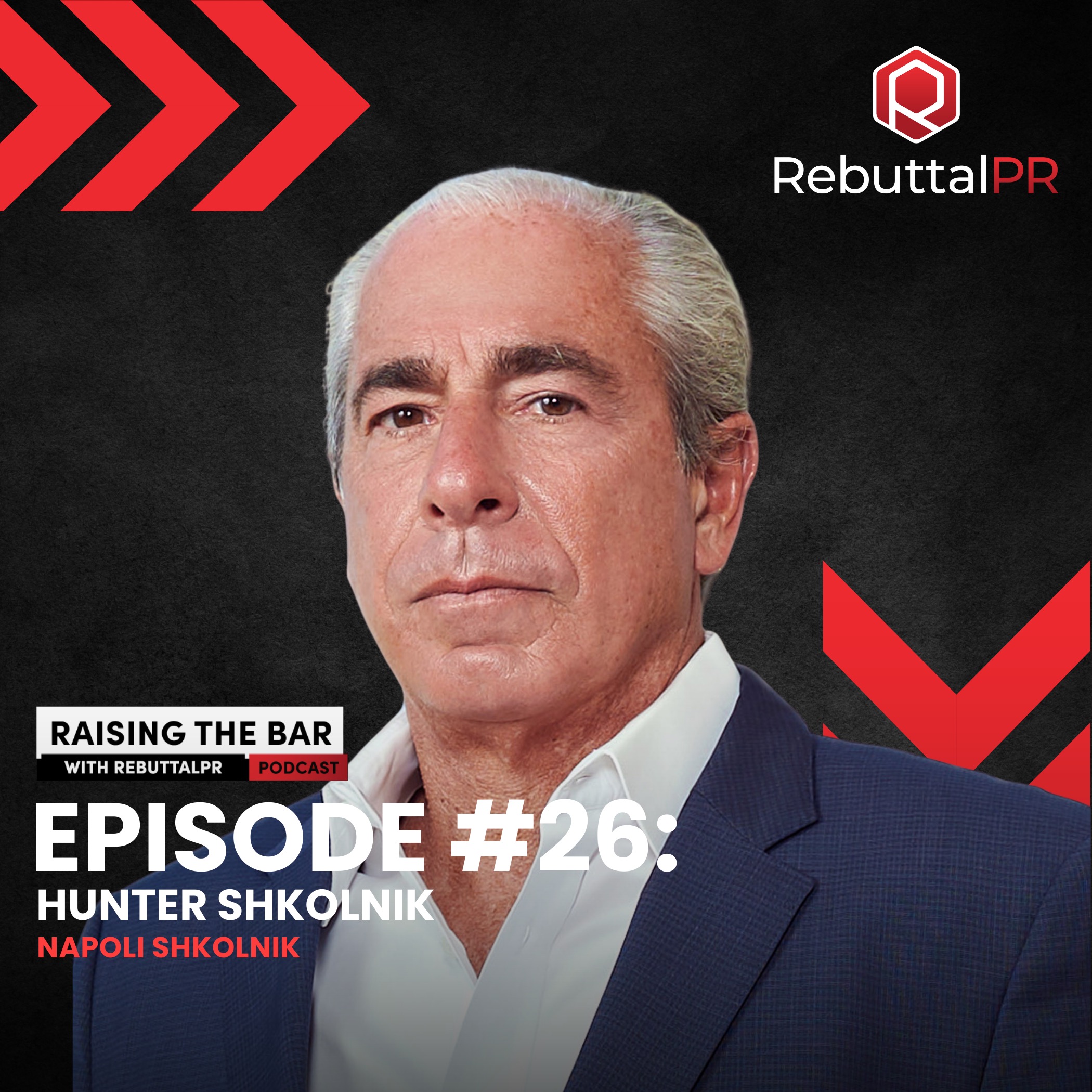
In this episode of Raising the Bar with RebuttalPR, host Ray DeLorenzi sits down with Hunter J. Shkolnik, partner at Napoli Shkolnik and a nationally recognized trial and mass tort lawyer. Hunter leads discovery and trial teams across environmental, pharmaceutical, and medical device litigation and has played central roles in some of the largest mass tort matters in U.S. history.
Hunter traces his path from an early plan to become a physician to a career defined by courtroom advocacy, mentorship, and trust. He reflects on his formative years under legendary trial lawyer Dick Friedman, his early trial experience, and the lessons he carried through transitions between plaintiff and defense work before ultimately joining Paul Napoli as a partner.
He walks Ray through his leadership roles on major settlement committees, including the national and New York opioid litigation, Johnson and Johnson Talc, Red River Bankruptcy Torts, Kidde AFFF bankruptcy, and the Flint water crisis. Hunter explains how honesty, preparation, and credibility guide his approach when negotiating frameworks that affect entire communities.
The conversation also explores Hunter’s work as a legal and political news analyst, his long-standing involvement with AAJ and national litigation groups, and his commitment to mentoring young lawyers in an era where trial opportunities are increasingly rare. He closes by reflecting on working alongside his daughter at the firm, sharing the profession with family, and why trust remains the foundation of every case he takes on.
Learn more about Hunter Shkolnik and Napoli Shkolnik:
https://nsprlaw.com/en/attorneys/hunter-j-shkolnik/
Read the transcript
This transcript of Raising the Bar with RebuttalPR was generated using AI transcription and lightly edited for readability. It may contain errors, and speaker labels are approximate. The audio recording is the authoritative version.
Welcome to Raising the Bar with RebuttalPR, the podcast where we elevate the stories of the plaintiff's bar and dive into the key trends shaping the civil justice system today. I'm your host, Ray DeLorenzi, and in each episode, we'll bring you insightful interviews with leading attorneys, expert perspectives on current legal events, and in-depth discussions on the issues that matter most. Now, let's jump in.
Number one, be honest. Number two, you better prepare more than your adversary. I'd almost see the words in the document in my head, and it's not because of photographic memory, it's because I read it over and over and over again.
Ray: Hey, everyone, welcome to the latest episode of Raising the Bar with RebuttalPR. I'm your host, Ray DeLorenzi, and today I'm honored to be joined by Hunter Shkolnik with Napoli Shkolnik. Hunter and I go back, and he may never remember this, but I've known him since I was at AAJ. It's probably 2008, 2009. And my one recollection of Hunter is he had the most interesting cases of the lawyers I would stumble across. And, you know, when you're in the media world, interesting cases and interesting stories are what drive things. And I just recall Hunter as, whenever you were looking for something interesting, he was one of our first calls. So he's done a lot of different things since then. In any event, Hunter, thank you again for joining the podcast today.
Hunter: Thank you for having me. I really do appreciate it and look forward to chatting a little bit.
Ray: So, Hunter, I always like to start these off by understanding what makes people tick. Tell me about young Hunter growing up. And I know you also wanted to be a doctor, which feels like a common thread amongst lawyers who, you know, I don't know, couldn't make the cut or wised up and didn't want to be doctors. But anyway, tell me about your upbringing.
Hunter: I grew up in New York City. Lived there most of my childhood, and then my mom decided to pack up and move to, as we would call it, the country, even though it was only 20 miles away on Long Island. And it was quite a bit different. Trees, backyards, and all that, and we didn't have that in the city. But overall, a pretty good life as a young kid growing up in New York City.
Ray: Did you have lawyers in your family?
Hunter: No, not at all. Mine was a medical family. So if you ended up going to law school, you didn't make it into medical school, is pretty much the takeaway. Dad, a doctor; uncle, a doctor; cousins all made it to medical school, and I didn't quite cut the grade.
Ray: So, did you even think about medical school, or you knew, like, that's not for me?
Hunter: No, no, I was on track just like the rest of the family. I was going to medical school. I was a little slow when it came to college, five years of college, chemistry major, and I had, I thought, one more semester to get out. And then I was told one of the classes that I didn't finish, I'd have to stay into the second semester of my sixth year. And I said, you know what, I can't do this anymore. And chances of getting into medical school at that time with my grades, even though I was an extremely good student from my second year to my fifth year — my first year was a great year of skiing, not such a great year of academics. And when they merged all the grades together, I wasn't getting into a medical school in the United States.
So, right before the MCAT, I said, you know what, there's got to be something else I can do. And I didn't have money at that point. So I was like, maybe just go to the military, which really probably would have been the best thing for me at that time, since I wasn't really finding myself. But I chose not to and said, you know what, let me go take the LSAT, and I did okay. And I applied to law school instead, and it all ended up working out. I think, in retrospect, I'm quite happy. I'm the one lone lawyer in a field of doctors in my family.
Ray: So, when you decided to take the LSAT, did you have any interest in being a lawyer, or was it just out of desperation that you did it?
Hunter: It was either go in the military, go in the military and become a lawyer there and owe them — I think at the time it was like six or seven years — or just do something not to start life yet, you know. So it was go to law school. And it turned out I liked it, I enjoyed it. And for me, it was really the best opportunity.
Ray: Did you have a sense then, going into law school? You have sort of an image of what a lawyer is. Did you have an image of what kind of a lawyer you wanted to be? What you wanted to practice? Or was it just like, you know, it delays real life for a bit, let it ride?
Hunter: No, I wouldn't say I had an idea of what a lawyer can and should be. Let's face it, I was a kid watching Perry Mason. Aren't all lawyers trial lawyers with an aha moment? But no, I really didn't have an idea. When I got into law school, I realized I wanted to go into shipping, admiralty, and anything to do with the sea. So that was really my goal. I was going straight admiralty law, until my law professor said, there's not a chance in hell you're ever getting one of those jobs. So I became a personal injury lawyer. You know, they say someone gives you a lemon, you make lemonade. I did that.
Ray: So you got into personal injury law. Was that when you started doing medical malpractice at the same time, or did that come a bit later on? Or were you doing, you know, sort of your run-of-the-mill type cases? Tell me about essentially your first job out of law school.
Hunter: So, actually, it goes back before I graduated. As I was saying, I didn't have money for law school. I was borrowing like crazy. I just needed to live. I wasn't one of the kids who got, you know — I went to school in Manhattan at Cardozo Law School. I didn't have the apartment provided to me by my family. I didn't have the ability to go out and hang out and party in the city. I commuted from Long Island on the train every day. And I had to work. So even though I was in law school, right from my first year, I had to find jobs to hustle. Into my second year, after I clerked for a state court judge, I got a job writing headnotes — the old days, the law books had the little headnotes. I wrote headnotes for a year, or I could say half a year. And it allowed me to have money to take the train back and forth.
And then I realized I just couldn't keep writing in this book. So I found a job as a file clerk at a plaintiff's firm. I was willing to take anything. I just wanted to be in a law firm. And they would only hire from Cardozo, at the time, for non-law-clerk positions. So file clerks, calendar clerks. They only drew from NYU. And I took the job anyway. It paid me, I think it was six dollars an hour or something. It was something real low. And I worked as a clerk, putting mail into the files and delivering them to the lawyers.
And one day I heard the senior partner of the firm screaming in his office, with a number of expletives, where is so-and-so, you know, need something done right away. And I went in, said, you know, I can do it. And he's like, come on, you're the mail clerk, but go get this done. And I did, and I became his right hand, the lawyer son he never had. His son that he did have didn't go into law. And he came from a family of lawyers. And he just took me under his wing and basically said, kid, you want to be a trial lawyer? Stay with me. Don't worry about law school. Just pass. And I followed his guidance, and I guess it worked.
Ray: Tell me about after that — and was that where you went after law school? Did you continue?
Hunter: Yeah, I stayed with him. I mean, he died tragically four or five months after I graduated law school. He was a pilot and had his own plane. And I used to fly with him all the time, and this one weekend I didn't. And he crashed. And, you know, I would have been with that firm for the rest of my career. It truly was — he was like a dad and really a mentor. And then I had a run with his partner shortly after that, where he would never be aggressive with me because I was the other partner's protege. And I realized, you know, now that my boss was gone, is he going to start kicking me around? And I just said, you know, I quit, and I walked out. And I was a young lawyer, recently married. My wife was pregnant. I had a student loan bigger than most mortgages. I had a mortgage bigger than most student loans, and I was in a bad position. And I just realized I had to leave. My wife supported me on it. And, you know, I walked out and just said, I've got to find something else to do.
Ray: So what was that next thing?
Hunter: I had been working on an unusual case against a firm. It was Rivkin Radler, which at the time was a couple hundred lawyers. And the case was pretty cantankerous. It was pretty ugly. But one of the partners there said, if you're ever looking to become a defense lawyer, give me a call. And I'd been working on that case before I graduated law school. So I was the face they always saw, they all knew me. And he said, if you're ever looking, just reach out to me. And right around that same time, my mother-in-law, who was a legal secretary, happened to be working for a lawyer whose husband was a partner in that firm as well. And it just clicked. The two connections — I called them up and they said, come on in. They offered me a job.
So I went there for five years. And my sole requirement at the time was, you're going to make me a trial lawyer. I'm not going to sit in an office and be a paper pusher. And I was given an assurance that one year from the day I start the job, I'll try my first case. And at that time, the attorney's name was Anthony Maturo. He was the managing partner for the medical malpractice department. He made me that promise and he kept to it. And he let me try my first case a year later, and I won it. And once you win a case, you get another one, and another one, and another one. So I had four years of non-stop trial work, which was great.
Ray: What are the trial skills that you developed then that really stand out to you, or that you mentor younger attorneys with? What are the main tools in the toolbox, or the things you always go back to to be the best trial lawyer?
Hunter: Well, I mean, what I did then — and it's very important to put it in perspective of what we're doing today with remote. I was in an office. By the time a couple of years in, the firm went from 200 to almost 400 lawyers. It was a big operation, a lot of great trial lawyers. And what I learned just being there and helping — anytime someone needed something, I just happened to be there. And I'm like, look, I'll do it. I'll do whatever you want. I don't care. You could call me whatever you want, but I'm going to do that job and help whoever it is.
And it allowed me to watch some great trial lawyers. I mean, guys like — I think he's retired now, Bill Lewis, it became Lewis Johs — just good trial lawyers who let me watch them, and had me go to court and didn't say go back to the office. I could sit in that courtroom and watch them. And progressively they would give me bigger and bigger projects, because they knew I was willing to do it and work as hard. And if it meant all night long — I mean, for years I was the number one biller in that firm. And we're talking hard-work billing, not make-believe. I'd stay there until all hours of the night, and that's what you've got to do. That's what I learned. If you work and you just keep pounding away, you're going to do good.
Ray: So, you're doing this defense work, and at some point you decided you wanted to go back to the plaintiff side. Was that a gradual progression, or did you have sort of an epiphany? What led to that?
Hunter: You know, it was kind of like my medical-school-to-law-school thing, to be blunt. I was clearly on track to partner. I was five years in at that point when I just started getting antsy, when I saw that you have someone like myself who could have been billing 2,700 hours a year, and you had someone billing 1,800 hours a year, but as long as our class year was the same, we basically got paid the same amount, a $1,500 difference. And I'm thinking — and every month you get your printout on how many hours you worked, how much they're billing per hour, how much the client is being billed per month on your work. And I'm thinking, I'm doing 2,700, 2,800 hours a year at X dollars, but the person in the next office is billing 1,800 hours at X dollars. I'm making you one-third more for what I do, and I'm only getting paid $1,500 more. So it kind of irked me.
So I went and sat with the managing partners and I said, look, I'm one of these people who will stay forever if it's right, but this isn't right. I said, I'm out, I'm going. And they came back to me and said, rethink this, please. Give us a little bit of time. And they came back, had me sit down, and offered me what I think at the time was the youngest partner offer in the firm's history up to that point. At least that's what I'd been told. And they said, look, we're going to make you a partner. And you're part of the future. They had sent me to courses on how to sign up clients and marketing. I was being groomed to go into the real management of the firm as I grew with it. And I was like, well, okay, they're going to make me a partner.
So we sat down and I said, well, what does that mean? And they said, well, you're going to get a bigger office with an extra window. I'm like, okay. Then they said, you get to pick whatever furniture you want from this furniture catalog for your new office. I'm like, okay. You get a parking space. I'm like, okay. With your name on it. Let me see what else they offer. Oh, I get to eat in the partner's dining room every day for lunch. And partner cocktails like Wednesday or Thursday night. Like, okay, keep going, what am I getting here? Let's hear about it. And they said, well, then you're going to get a percentage pool of money that gets divvied up among the equity partners, and it'll be a discretionary bonus. I'm like, okay, we didn't have bonuses before, but it really wasn't exciting me. And I said, what about my salary? And they said, it's going to be frozen. You don't get more salary. You're going to get the bonus.
And I said, wait a second, let me get this straight. By this point, I was trying back-to-back trials. I was never in the office. So I'm going to get an office with an extra window and nice new furniture, but I'll never sit in it. I'm going to get a parking space for my car, which — you have to put it in perspective. The building was out on Long Island, and it was like the frozen tundra in the winter. So the newest partner got the farthest parking spot with their name on it, which was upwards of a football field away, whereas no one parked in those spots anyway. Everyone was in the inside parking lot where you could at least get into the building and not be a frosty snowman. So I'm like, I'm not going to use the parking spot. I'm not going to get the rooms. I'm not going to sit at the desk. Breakfast and lunch, I was in the courthouse every day, so I wasn't eating the partner's lunch, and I was not going for cocktails because I was generally prepping witnesses every night.
And I finally said to them, guys, you give me nothing. You're giving me ice in the winter, and I'm living in Alaska. And they said, think about it, you're the future, we want you to be with us. And I said, okay, let me think about it. And I went home, discussed it with my wife — she and I have been together since we were in high school, we've been married, you know, 40 years now. And she's like, look, I'll support whatever you want to do. I said, I'm going to become middle management in a bank. I mean — you're a lot younger, but there was the Beverly Hillbillies, Mr. Mooney in the bank, you know, the bank guy. And I'm like, you were fungible if you were middle management. You never went anywhere. And I said, I just can't do it. And I just quit. Again, no job. Now I had two kids, now I had a bigger mortgage, still had that student loan going on, and didn't have a job. So that's what I did.
Ray: So take us from there. How did you get back into the plaintiff's world?
Hunter: I picked up the New York Law Journal and looked for ads of people hiring, and there was a plaintiff's firm looking for a trial lawyer. Back in the good old days of faxing, I faxed my resume there. You know, I was still with the firm. I wasn't just going to leave. I wasn't leaving them high and dry. I gave them over a month because I had a pretty big caseload and trial schedule. And I just started sending resumes, and I got an interview right away for a small plaintiff's firm on Long Island. I went and met with them, and they offered me the job. And they said, you know, in five years you'll be an equity partner here. Try cases, you get a big percentage of what you win. To me, it was a win-win. So I just packed up and left and became a plaintiff's lawyer. I've got to be honest — I was a trial lawyer. I didn't care if it was a plaintiff or a defendant. I was trying cases, and I'd win them as a defendant, I'd win them as a plaintiff.
Ray: Did the new firm — I guess they had no concerns or hesitations about changing allegiances, if they just wanted someone who knew how to try cases? Or did they actually see an advantage to someone who had been trying these cases on the defense side?
Hunter: Both. I think they truly believed having someone with the defense perspective was very, very good and helpful for the firm. They also, just from our meetings and discussions, saw the kind of hours I was billing, which was not what plaintiffs typically look at. You know, the PI firms don't always think of the defense PI — I'm not talking about the big corporate firms, but the insurance defense — you don't think of them as being 2,700, 2,800-hour-a-year billers. You see the guys in court, nine-to-fivers, and they saw that I was one of those hard workers who put the hours in. So that was a big plus. And they needed a trial lawyer, they needed a trial lawyer quick.
But I ran into a bit of a wrinkle when I started, because as soon as I got in, they gave me my first trial, and the senior partner who was getting close to retiring — kind of a gruff old-time plaintiff's lawyer — sat me down and said, you're not a defense lawyer anymore, this is how you're going to try the case. And says, get a pad and start taking notes. And I got my pad, started taking notes, and he started telling me how I'm going to try the case, and I'm like, look, I'll just pack up and go home. I don't need the job that badly. You can try a case the way you try a case. I've got a pretty good name for myself, a good reputation. I try a case a certain way, and I'm not going to change myself. And it became a heated debate, pretty close to me quitting and him saying, basically, get the hell out. But the other partners stepped in and said, go try this case. And I ended up taking a case that was worth maybe 20 or 30,000 and came back with almost a half-a-million settlement. And they woke up and realized, yeah, the guy could try a case, don't tell him how to do it. Not to say I'm so naive that I can't take advice, but don't tell me how to try it. Discuss it with me. Let's work through the difficult things. And they realized I could try a case, and from there, once again, I went back to back, whether it was med mal, PI, product liability, you name it, I tried it.
Ray: Do you have a philosophy when you try a case, or a certain approach? Or is it not one size fits all — knowing the details, you could do things differently? But if someone were to ask you — and I guess I'm asking you — describe your strategy for trying a case.
Hunter: Tell the truth. Tell the truth. Anyone who gets up there and tries to be someone else — which is exactly what that lawyer was trying to get me to do. He wanted me to be him. I can't do that. I can only be me. You've got to be truthful with yourself. You've got to be honest with that jury. You damn well better be honest with the judge. And you better be prepared. I mean, I wouldn't sleep. My weekends were work. You learn that case, you learn it inside out.
I don't have a photographic memory. I wish I did. But I had this ability that once I start reading the documents over and over, and I read the deposition transcripts, and I have a witness up there, it all comes through preparation. That's the answer to your question. Number one, be honest. Number two, you better prepare more than your adversary. Once the cross-examination started, I'd almost see the words in the document in my head. I would see the words on the deposition transcript as I'm crossing the witness, and they try to say something different. And it's not because of photographic memory, it's because I read it over and over and over again, to the point where people would look at me like, how many times are you going to read the transcript? It's not going to change. But it's so you have it at your fingertips, so that when that witness deviates, bam, you hit him.
Ray: When you think back on all the cases you've tried, is there one trial in particular that stands out? And it doesn't even need to be the most amount of money, just a case that will always sing to you as, that was the one.
Hunter: There were two cases that will always be in my head. One I lost, one I won. The first, the one I lost, was when I was with that first plaintiff's firm after I left defense. It was a wrongful death case. A woman giving birth in Brooklyn dies from bleeding out during the postpartum period. Baby lives. It was just a tragic case. And there was money on the table. Everybody was saying, you killed this case, you've got this, you can't lose this case. And I was on fire. You just get the feeling. Every witness is collapsing on the other side. Their experts — I mean, if it was there. And I never told the client, don't take the money. But the people had nothing. The family had nothing. And for me, whether it was a million dollars or 500 or 10 million, it wasn't changing my life. I was a lawyer in the firm, I wasn't getting the share of those profits on that case.
And in the middle of summation, one of the jurors collapsed and stopped breathing. It was near tragic. And it was amazing — the defendant, a doctor, didn't move. He just watched, and people were screaming to call 911, get first aid. And finally, someone said to the doctor, basically, get off your ass, go and help. He resuscitated the juror. The juror gets excused. I move for a mistrial. The court says no. The jurors all said they could be fair and impartial. And the money was taken off the table. We ended up with a defense verdict. And to this day, I think of how that family was devastated, not only by losing mom, but the money — it would have been life-changing for them. So you only have that once in your life. You don't let another one happen that way. You sit down with the clients and you really make them understand. I'm not saying take every offer, but I learned that your obligation is to sit with them and make them understand that this money can change your life. Yeah, I can get you more, possibly, but I can't guarantee it. And that stuck in my head — knowing that I could have made such a difference, that the child who never knew her mother would never have had to worry about any expenses in life. But it didn't work out. And it's because, deep down, I didn't do anything wrong, but I could have guided them to a better answer, a better decision.
The other one was a wrongful death case, a helicopter crash, which everyone said I couldn't win. And it was such a wonderful family, a man who owned a helicopter company, had the whole family in it, out in Arizona. And he crashed, survived, and was paraplegic. And it's, again, one of those cases where everything clicked in the courtroom. You felt it, and you felt how good it was for the plaintiff seeing that. And while the jury was out — the jury gets the case, I guess, at like one o'clock or close to one o'clock. We go out for lunch, and 15 minutes into lunch, we get called up to come right back to the courtroom. The jury has a verdict, and I was devastated, because I went to the defense lawyer — everyone knows a fast verdict is a defendant's verdict. I went to the defense lawyer and I was like, wow, I don't know how this happened, but congratulations. We go in, and it was a $24 or $26 million verdict. And, you know, it's like two extremes, two absolute extremes, but I'll never forget it. And then the opioid trial for seven months — I'll throw that one in. Just the fact that we tried one of the biggest and most impactful cases in the United States for seven months during COVID and won it. That was another one that kind of sticks in my head.
Ray: So that leads me to my next question — moving from doing single-event work to becoming Napoli Shkolnik and doing mass tort work. What inspired you to want to go toward the mass tort route?
Hunter: My story seems to be repetitive. So, five years at that other firm, and I was supposed to be made the equity partner, and I had been making them a lot of money. And I went to them and said, guys, it's anniversary time. You haven't said anything. A couple of months have gone by. And the response was, you know, you've had a couple of really good years, and we've had some lean years, so let's push it one year, because we're going to have a good year, and this way we'll be even. And I'm like, well, that's not the deal we cut. The fact that my years were good is because I did good. The fact that you didn't do well, it's your own fault. You didn't try the right cases, or didn't try them right, whatever. So I just, again, in an expletive-laden fashion, said, I'm out. I walked out the door. And I'll always remember it. I got in my car, and I was late for my older daughter's — it was a school talent night. I walk in, sit down next to my wife in the auditorium. She looks at me, she goes, what happened? I said, I quit.
Ray: Was she surprised at this point? I mean, you've done it a few times.
Hunter: This one, I think she was surprised about, because we were all contemporaries, and I was doing good. Things were well. So it wasn't something that was a blindside. And then again, I'm out of a job, back to the mortgage, and I still had my student loan at that point, getting close to the end. But now I had a book of business at this firm. I had trials back to back scheduled. And now I didn't have a law firm.
So what I did was I went to court the next day. I went to Nassau County Supreme Court in New York, and there was a lawyer's room. I went in, got my cup of coffee, went to the lawyer's room, dressed in my suit, had my briefcase and everything, and I grabbed the Law Journal again and just started reading it. And everyone's coming over, hello, how are you doing, what's going on? And I'm sitting there, most people thinking I'm reading it for the law, and I was reading it for the jobs — I didn't have a job. So there was a block ad like this big that said, med mal firm, trial lawyer needed. And I just ripped it out of the paper, which you were not allowed to do in the law library there, the lawyer's room. And I left and found a fax machine and faxed my resume.
And the firm was Rheingold — Paul Rheingold in New York City. I don't know if you know his name. Paul was one of the old-timers. In law school, the section on mass tort and class action cited Paul Rheingold's writings when he was in law review. So he was like one of the fathers of mass tort pharmaceuticals and mass tort in general. And it just so happened — I sent my resume to him, went and met him, and he was about to hire someone until he saw my resume. And he said, we need to make this decision right away, will you take the job? Well, first of all, he said, I want to see you today. And I'm like, well, I can't drop what I'm doing, I'm in court — I wasn't without a job. And I said I can meet you tomorrow for lunch. I go meet him, he offered me the job, and I said I need a couple of weeks. I went and tried a case in Florida — I think it was two or three weeks that I had, this way it wasn't tied to my old firm, wasn't tied to the new firm. I could make the money myself. So I went and squeezed that trial in, came back up, joined them, and I was just there to try med mal and product liability cases, single-event cases. He had a big mass tort practice, pharmaceutical, but that wasn't me.
And about, I guess, four, five, maybe six months later — he had been studying at the RAND Institute as a resident scholar. They were writing a paper on mass torts. And we got two of the 12, I think it was 12, women from the Fen-Phen Mayo Clinic study as clients. The women who had taken the diet drug. They both had developed valvulopathy, the valve disease. And I realized, I know a good case when I see a case. I didn't know what a mass tort was, I didn't care what a mass tort was, but I saw two really good cases. And next thing I know, we're getting call after call after call, because they then recalled Fen-Phen, and he was away, and we weren't supposed to do anything with mass tort, we were supposed to just let it sit until he came back. I'm like, screw this, sign up 3,000 cases. I got appointed. The judge who was overseeing it in New York State court, I used to try a lot of cases for, and she appointed me as a co-lead in the case. And then he came back from the RAND Institute, blew up, like, how dare you do this? And I'm like, someone had to do it while you're away. And it got me into mass tort by accident, to be really honest with you. And I'm close with Paul Napoli, my current partner — so it was a good turn.
Ray: What has kept you in the mass tort world, versus just doing Fen-Phen and then going back? What has led you to essentially make this the latest chapter in your career?
Hunter: You know, I've stayed in it. I love it. To me, there is nothing like working with the lawyers — and we talked before: Paul Geller, Chris Seeger, Jayne Conroy, Peter Mougey at Levin Papantonio, Elizabeth Cabraser, you name them, Joe Rice. I mean, I'm working with the biggest of the big lawyers. And sometimes you're in a room — and I'll give you a handful of them, there's a lot more, I'm not here to give a list of everybody out there — but you sit in a room and you almost have to pinch yourself when you're saying you're with the best of the best lawyers. And the thrill, the excitement of these types of cases, where you're not just making a difference as to your plaintiff — these cases are making a difference for society. And never in my wildest dreams did I ever think I'd be involved in something like that.
But on the other hand, I still can't give up the fact that I'm a plaintiff's lawyer, a trial lawyer. So I always have a handful of fairly significant, quality personal injury cases — airplane crash, heavy truck — just something that keeps me grounded in what got me here, where I sit with families and deal with their needs and get in the courtroom and fight for them. So, unfortunately, I have less and less time for that, because these cases have just become — it just takes over everything. But I still make a point. I have a major rollover vehicle case, death, other injuries — I'm going to try that case. I have a helicopter crash case — I'm going to try that case. I have an airplane case out of Wisconsin — I'm going to go try that. And it's something that keeps me grounded and makes me realize why I do this stuff. But the big cases are the mass torts. There's nothing like it when we announce a multi-billion-dollar settlement. Opioids, over 60 billion, 65 billion. Working now with my partner Paul Napoli in the AFFF, you know, the first 4 billion, and God knows how many more billions are going to be coming down the road. When I got into this, I never expected this type of stuff. It's excitement every day.
Ray: So, I want to end on a more personal note. I know that your daughter is at your firm. What is that like? I assume she didn't want to go to med school and just wanted to be a lawyer — but you can correct me if I'm wrong there, or you can just leave that alone. What was it, deciding to go to law school? And I assume you'd like to mentor her. Is she interested in you mentoring her? What is that dynamic like?
Hunter: She didn't want to go to medical school. Yeah, it's hard having me mentor her, because I don't have the warm and fuzzy. I'm much more warm and fuzzy as a father and a grandfather. But when it comes to training, I'm short. I'm like, look, come on, why don't you get this? So she's in a position where she could fight back, whereas the average associate would be like, okay, I'll go fix it, I'll go do that. So that makes it a little bit harder. But I have to tell you, it was one of the most exciting times when she joined me in cases.
And we're seeing a lot of it now, whether it's Mike Papantonio with his daughter, or Jayne Conroy and her daughter. I mean, because we do so many CLE programs, we joke of it as, we have a Nepo panel. We've got all our kids on it, who are smarter in many ways than any of us. They're learning this at a time with AI, and they get it. They understand the electronics. For me, it takes a bit of a learning curve. So we learn from them when we go to these. We joke of it as the Nepo panel, but the truth of the matter is, these young lawyers have lived it, are living it, in our households. Not saying they learned to become lawyers, but they knew what it took and saw the way their parents — whether it was mom or dad or both — worked like dogs to become successful in this field, and they understand that that's what it takes. And it's really a pleasure that you can't even put into words, having your daughter or your child work with you like this.
Ray: Hunter Shkolnik of Napoli Shkolnik. Thanks so much for joining the podcast today. Really appreciate you taking the time with us.
Hunter: Thank you for having me. It really was a pleasure. Take care.
Thanks for listening to this episode of Raising the Bar with RebuttalPR. Don't forget to subscribe and follow to join us next time. See you then.
Related episodes
- Chris Seeger on Building a Premier Mass Torts Practice
- Jayne Conroy on The Power of Curiosity in Complex Cases
- Elizabeth Cabraser on the Power of Collaboration
Learn how RebuttalPR delivers mass torts litigation PR for cases that shape public justice.
Discover Insights & Trends
Featured Stories

- September 4th, 2026
- 6 minutes
- Melissa LoPiccolo
How to Vet a PR Firm: 8 Questions to Ask Before the Contract is Signed

- August 21st, 2026
- 4 minutes
- Stephanie Wolf
Aligning Your Benefits with Your Values: Parental Leave Edition