
- September 21st, 2026
- 5 minutes
- Ryan Litner
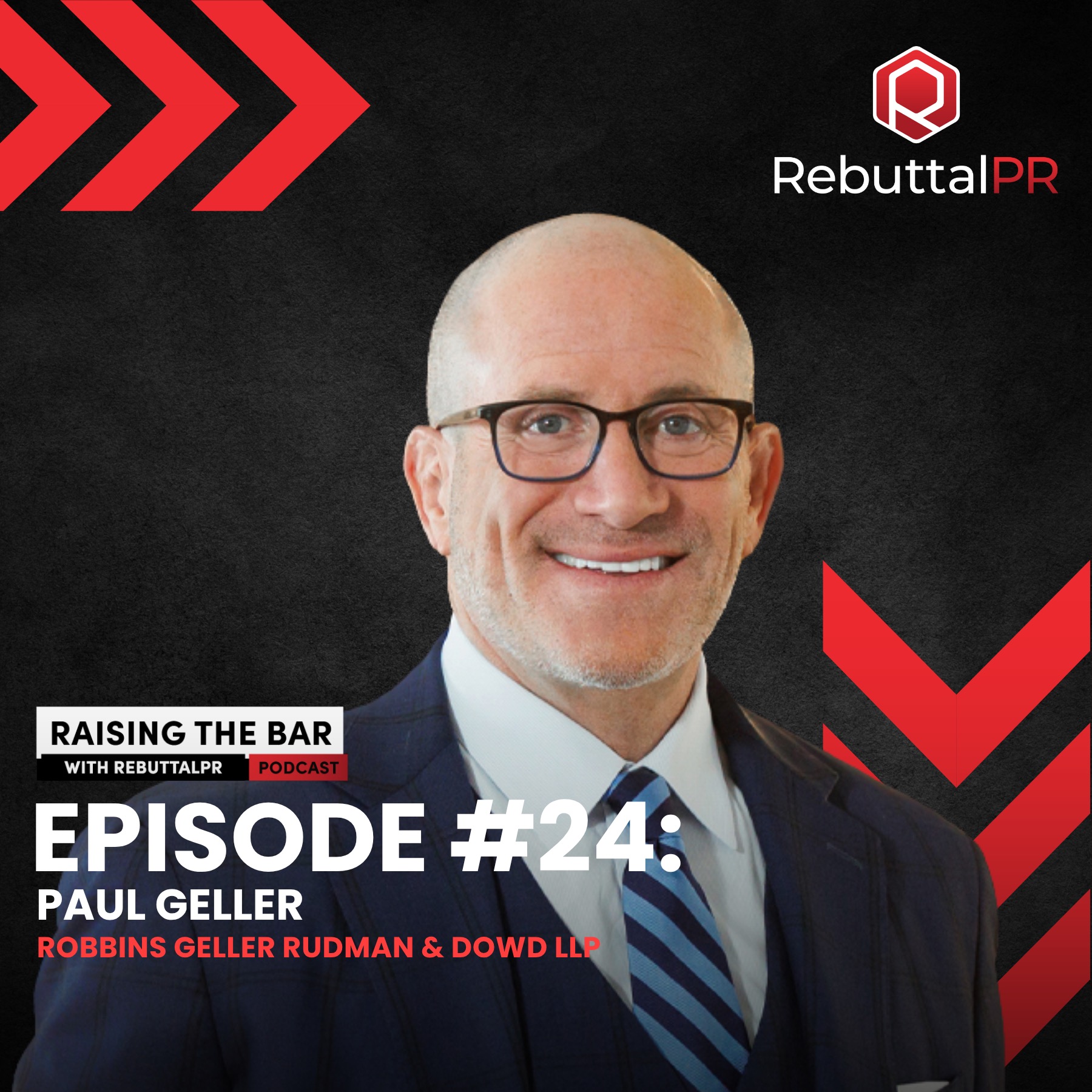
In this episode of Raising the Bar with RebuttalPR, host Ray DeLorenzi sits down with Paul Geller, founding partner of Robbins Geller Rudman & Dowd LLP and one of the country’s most accomplished class action and mass tort litigators.
Paul reflects on his early days defending corporations and the moment he realized he was “on the wrong side.” He shares how that realization reshaped his career and how Robbins Geller became a powerhouse firm leading landmark recoveries for investors, consumers, and communities across the nation.
They discuss what defines effective advocacy, why many of the best plaintiffs’ lawyers began on the defense side, and how empathy and listening can drive negotiations forward even in billion-dollar cases. Paul also highlights the importance of balance, sharing how jiu-jitsu helps him stay grounded and focused while managing some of the country’s most complex litigation.
Learn more about Paul Geller and Robbins Geller Rudman & Dowd LLP:
https://www.rgrdlaw.com/attorneys-Paul-J-Geller.html
Read the transcript
This transcript of Raising the Bar with RebuttalPR was generated using AI transcription and lightly edited for readability. It may contain errors, and speaker labels are approximate. The audio recording is the authoritative version.
Welcome to Raising the Bar with RebuttalPR, the podcast where we elevate the stories of the plaintiff's bar and dive into the key trends shaping the civil justice system today. I'm your host, Ray DeLorenzi, and in each episode, we'll bring you insightful interviews with leading attorneys, expert perspectives on current legal events, and in-depth discussions on the issues that matter most. Now, let's jump in.
The striving for perfection and the, you know, just going over your drafts over and over and over again, and editing things and changing words and moving commas. I think that's what helps get excellence. Every word matters so much, and you can't just kind of mail it in.
Ray: Hey, everyone, welcome to a new episode of Raising the Bar with RebuttalPR. I'm your host, Ray DeLorenzi, and today I have the honor to be joined by Paul Geller of Robbins Geller Rudman & Dowd. Paul, for those who don't know, is one of the nation's most esteemed class action litigators, has worked on massive deals spanning all different sorts of industries and practice areas. We're so glad to have Paul here. Thanks again, Paul, for joining the podcast today.
Paul: Happy to be here. I figure the guests that you wanted probably canceled. So I'm honored to be your second choice.
Ray: No, this is a get for us. So thank you for being here. Like myself, I know you were born and raised in New Jersey. I always like to get sort of, you know, the background of how folks like you become the prominent litigators you are today. So tell me about your upbringing in, it was in Old Bridge.
Paul: Yeah. So it's funny that you know that because most people have not heard of Old Bridge. There's one other class action lawyer or mass torts lawyer, a guy named Dan Lipinski from Motley Rice, who was my best friend growing up and all through high school in Old Bridge. So it's funny, two of us. And a guy named Scott Musoff from Old Bridge is a very prominent class action defense lawyer at Skadden. So Old Bridge is the hotbed of developing class action lawyers on both sides of the V.
Ray: No kidding.
Paul: I grew up in a sort of blue-collar town in Old Bridge. My mom was a school teacher. My dad was a salesman. I have an older brother. Very, very loving family, good, wholesome upbringing. And then ended up going, you know, I applied to all these great, you know, Harvard and Princeton and got rejected everywhere and ended up going to the University of Florida. I got a scholarship. It seemed like a cool place, Gainesville, for a 17-year-old boy, you know, and kind of the rest is history.
Ray: So, I had read that you actually had wanted to be a doctor before you became a lawyer. Tell me about that and what made you, you know, eventually zig, and where was that in your youth?
Paul: Yeah. So, you know, I had a Jewish mom who, you know, I think was very happy when I once said maybe I should become a doctor. I don't know, Ray, that I really ever truly was passionate about that. I was sort of a typical student. I was a pretty good student. And, you know, it's not like I took organic chem and decided this is not for me. I just kind of outgrew that desire to be a doctor. I'm very glad that I did.
And then, you know, I'm not sure why I ended up going to law school. It's not like I have some great story or some, you know, I saw To Kill a Mockingbird and it inspired me. Nothing like that happened. The reality is, I guess I viewed law school maybe as like a socially acceptable way to defer adulthood for another three years. And some of my friends backpacked through Europe to kind of find their path. I filled out law school applications and ended up going to Emory Law School in Atlanta. And I really did find my path. Like, you know, somehow through luck or hard work or whatever, I did well and I really enjoyed it. Whereas college was, you know, I did well and I studied, but it was a lot of fun and socializing. By law school, I had a very serious girlfriend who has been my wife forever. And I really focused and I loved it. I read the cases, I got into it. Enjoyed the fact that your words and logic can really have an impact. And so, yeah, I sort of found my path accidentally, but it really was my path.
Ray: So, I think, you know, like a lot of lawyers, when you're in law school, or before you're a lawyer in law school, you sort of get fed into the defense bar industrial complex. And you were not, you know, immune to that either. Tell me about that path.
Paul: So I tell people this now when I've, you know, my kids did not go to law school, but I have friends whose kids are in law school now. And there should be like a warning label at law school that says, warning, if you do well and you make law review, you will get unsolicited attention from large corporate defense firms. It's like a conveyor belt. You do well in law school. You're almost fed either a federal clerkship, which I think is a great option for people, or go to one of these big white shoe firms and defend corporations who were doing horrible things to people. So I got caught up in that, and they wine and dine you. They have very structured summer programs. They pay starting salaries that most plaintiffs' firms don't necessarily pay.
So, yeah, I ended up going, you know, back up for a second. I'm from the Northeast. My wife, Leslie, who at the time was either my girlfriend or fiancée, depending on when in law school, is from Texas. And, you know, part of the decision, I think, at that age is not only what do you want to do? Do you want to be a litigator or a corporate lawyer? Do you want to do criminal stuff or civil stuff? But also, where do you want to live? Where do you want to kind of put down your roots? And we chose Florida together. We met in college in Florida. We both had friends and family in South Florida. So I applied to Greenberg and Holland & Knight and all of the big Florida firms that you've heard of. And there was a firm called Steel Hector & Davis. It no longer exists. But at the time, in my opinion, it was the go-to firm if you wanted to be a litigator. A lot of judges, federal judges, you know, Don Middlebrooks was a partner there who I worked for. Pat Seitz, who's a federal judge, was a partner there. Burt Jordan, who's on the 11th Circuit Court of Appeals, was a partner there. It was really kind of top-notch. And so I felt very lucky to get a job there. And I spent the first portion of my practice as a young associate defending. And I can get into it if you want, but that was my first exposure to MDL and class actions on the wrong side.
Ray: So I'm curious, you go there, and you know, an esteemed firm, at what point did you realize this isn't for me and it is, in fact, the wrong side? Because I assume, and tell me if I'm wrong, when you went there, you didn't view it as the wrong side on day one.
Paul: No, so I don't think I was mature enough or had the foresight enough to sort of really think about where is my passion and what do I believe in? So, it's exactly like you said: I went to this firm, I was so proud. And the first case I worked on was an MDL. It's interesting because I know you know a whole lot about MDLs, and that's a big part of my practice. It was MDL number 989, I believe. Now we're at the 3000s. Each MDL is numbered sequentially, so this is 2000 MDLs ago, and it was an MDL in Chicago, and we were representing pharmaceutical companies that made a blood product, and the plaintiffs were hemophiliacs or the estates of hemophiliacs that had died taking this blood product called factor concentrate that was made from plasma donors.
And a lot of the ones who died were kids. They got HIV. Back then, Ray, this is before AIDS was even sort of the name of this horrible disease, they called it GRID, which was something like gay-related immunodeficiency, because all they knew was that it was transferred a lot, you know, often through homosexual sex. They would go to jails where, you know, thank God I've never been to jail, but those kinds of activities happen. And they would take blood from donors, from inmates, and they knew about this HIV, this GRID that was out there, but they didn't test it. It was too expensive. So they ended up making these factor concentrates and giving them to this class of hemophiliacs, including children, and so many of them got HIV. And back then, it wasn't as treatable as it is today. So it was a death sentence. And I learned from some great lawyers, but I would go home at night and say, I'm on the wrong side. I'd so much rather represent these kids and their families than represent the companies. So it was pretty early on that I felt like, shoot, I think I could be a pretty good lawyer, but I would be so much happier, and my heart would be in it if I were on the side that I felt was right.
Ray: So, walk me through the segue to leave the defense bar and what that looked like and how you then became a plaintiff's lawyer.
Paul: So, I ended up leaving Steel Hector to go to Proskauer, then called Proskauer Rose Goetz & Mendelsohn, since they switched their name to just Proskauer, I think. But I was also still defending cases, defending class actions. And I got to know some plaintiffs' lawyers on the other side, like Darren Robbins, who's been my partner now for over 20 years. They had a securities case called Brothers Gourmet Coffee. And we were defending Brothers Gourmet Coffee against allegations that they cooked the books. And everything that they were alleged to have done, they did. And when we settled the case for, I don't remember, but maybe $20 million, which back in the mid-90s was a lot of money, we were celebrating in the conference room at Proskauer because we only had to pay $20 million. Like, it just seemed off to me.
And so, through getting to know Darren and getting to know some other lawyers on the plaintiff side, I just said, you know what? I got to switch sides. And I was married at the time, but we didn't have kids yet. And, you know, I was very, very close to my parents. My dad, who has since passed, was so proud of me. And I talked to him about it, and he said, You are out of your mind. You've got this great job at Proskauer, and you're making a lot of money, which as a young kid, I was making a lot of money. Don't do it. You're nuts. And it was the first time where I've disagreed with my father. And my wife was so supportive and said, You're going to crush it no matter what you do. And if for some reason you don't, who cares? You'll wipe yourself off and do something else. And so we made the decision. It was such a big deal to go to the plaintiff side. It was like going to the dark side. My boss at the time was a guy named Howard Coates, who's now a state court judge in Florida. And he said to me, You're on this great track here, like you're nuts. This is career suicide. Long story short, but years later, he ended up joining me on the plaintiff side. So, yeah, it just worked out.
Ray: So, when you started the firm, you know, Robbins Geller is now a massive firm, particularly for a plaintiff's firm. You know, you think of a defense firm, they can have thousands of lawyers. I mean, you're in the hundreds at this point. Did you have the idea that that's what it was going to be, or did it just happen? Like, was it an iterative process to grow the firm?
Paul: Yeah, no, I think we just grew as we had the cases and we had the need. And, you know, in our line of work, as you know, we're always up against the best of the best. And I have such respect for defense lawyers. I don't hate them. I think I'm lucky to have found the side that I believe in. But I have so many lawyers I respect at Skadden, at Kirkland, at Cravath. And you can't compete really at the top level with those firms when you have a 10-lawyer shop or 20-lawyer shop, unless you're working on one case. And we have a high volume of cases, but we don't have sort of the typical volume practice where we're just churning and trying to settle quickly. We really handle the cases, I think, the same way defense lawyers do, like very thorough, and we research everything and we prepare the cases for trial. And I think my firm tries more of these large cases than most, maybe than any other firm on our side that does MDLs and class actions. And so I think we sort of grew out of it, it was necessary, certainly not just for growth's sake.
Ray: I have found, and it's not always the case, but I think some of the best plaintiff class action lawyers came from the defense side. And I'm curious, and again, it's not always the case, there are many amazing plaintiff lawyers who never practiced on the defense side, but is there a skill set that you learned on the defense side that you felt was sort of immediately transferable and helps in terms of the trial prep or deal making that needs to happen in these cases?
Paul: It's a really, really great question. Because I'll tell you, even when I'm giving advice to young law students, I think going to the defense side, even though I'm such a plaintiff's lawyer through and through, I think even my firm, we don't train young lawyers, you know, first years, the same way I think defense firms do. They just have a structured program, at least where I went. And, you know, the striving for perfection and the, you know, just going over your drafts over and over and over again, and editing things and changing words and moving commas. I think that's what helps get excellence in your work product. So much of our cases are in federal court where the written product is critically important. Of course, it's important to be an oral advocate, too. But there's so much brief writing and research. And I think I came out of the defense firms thinking like, shoot, you know, every word matters so much. And you can't just kind of mail it in. You can't just, you know, shoot from the hip.
So, yeah, I do think that's a good training. And, like I said earlier, and this is just the reality, it sounds terrible, but the top law students who do really well in law school, who make law review, for the most part, end up with the defense firms. Every once in a while, like you said, you can hire a plaintiff's lawyer straight out of law school who maybe wasn't top of the class, but they can be phenomenal plaintiff's lawyers. They could be phenomenal lawyers. But that's probably more the exception than the rule.
Ray: I want to read a quote from you in an interview you gave. So you said there are a number of firms that practice in the space, referring to securities and class action and MDL work, but plaintiff class action law firms are not fungible. One of the frustrations I have is that some clients, even sophisticated institutional investors, and some judges, even well-respected, brilliant judges, seem to think that class action law firms are interchangeable, but they're not. So let me pause there. Why do you believe that there is that sort of stereotype that they are interchangeable to some degree?
Paul: Well, there's a number of reasons. In the securities realm, there's a statute called the Private Securities Litigation Reform Act, the PSLRA. And in simplest terms, whoever represents the largest client in a particular case gets appointed to be lead. So, unlike the MDLs, which are a whole beauty contest in the slate of firms who are appointed, in PSLRA cases, which can be huge cases, multi-billion dollar cases sometimes, it could be one firm. And let's say your client is, and I'll just pick on some who we've represented and others have represented, large institutional investors, CalPERS or TIAA. Those are good clients of my firm, so I think they get it. But a lot of the smaller institutional investors will say, okay, well, Robbins Geller, you guys got to us first here, so we'll hire you for this one. But Labaton also monitors us. One goes to Labaton, and the one after that goes to Bernstein Litowitz, you know, and those are just firms that are in our space. And it's frustrating to me because, and I'm not picking on Labaton or Bernstein Litowitz, I'm just saying sometimes firms think it doesn't matter who they use. And they want to rotate or whatever.
And, you know, rightly or wrongly, I believe that our firm drives the best results. And then when you look at judges, they award fees oftentimes based on lodestar. And I don't think that they necessarily consider the subjective expertise that a particular firm may have brought and why maybe this firm deserves more than you otherwise would have awarded because they did something special. And maybe they have a particularly great trial team. And so it's a little bit frustrating because I do think we're all lumped together. And, you know, maybe it's narcissistic, maybe it's sort of, you know, we're drinking our own Kool-Aid, but we think that we're better.
Ray: So let's say you're talking to an institutional investor that's looking to hire counsel, or you're talking to a judge overseeing an MDL and they're doing their beauty contest. What's the pitch about what makes Robbins Geller, you know, the cream of the crop, that you can lead these?
Paul: Yeah, I think the important thing that we try and do, and that I try and tell or help younger lawyers who make these presentations do too, is despite the fact I just told you I think we're better than everybody else, we don't say that in the pitch, right? I think it's really bad form to go into a presentation, whether to a judge or to a potential client, and speak poorly of other law firms and say we're better than this one, we're better than that one. We have enough data to show that we have literally the largest recovery, whether it's in absolute dollars or in percentage of recoverable losses, than any other firm in every genre of class action, from securities cases to consumer cases to antitrust cases. We've done really, really, really well. And so I think that's our pitch: we have charts and graphs, and we try and convey that we take these cases very, very seriously.
We have, you know, bigger is not always better, but in this area, we have the resources, the human resources, the number of lawyers. And despite the fact that I'm not technically advanced, we have all the technological capabilities. We host our own documents on the Relativity platform. We don't have to hire a vendor. So there's a lot of things that we do in-house. Even in the securities context, all these firms monitor the portfolio of these large institutions. We do it ourselves. We have dozens and dozens of non-lawyers, forensic accountants, and others who monitor, whereas a lot of other firms farm that out to outside vendors, where I think you don't have as much control over security and that sort of thing. So I think we have a lot to point to. And luckily, a lot of clients hire us and a lot of judges like us, but we don't always get the client or the case.
Ray: Let's move away from securities and more towards, let's say, the MDL space. Your firm has had leadership appointments in cases like opioids and Volkswagen Clean Diesel. You led the Facebook Biometric case. How do you decide, when you're dealing with and have helped resolve cases of that size, you see something on the horizon, what makes you pull the trigger and say that's a case we want to be involved in? When you're involved in cases of that scale, are you always looking for something of that scale again? What's your sort of thought process?
Paul: Yeah, I mean, once you start getting cases of that scale, it's a little bit addictive, and probably not a great word when we're talking about opioids, but you want to continue doing impactful cases. So I think that's the key: we really try and get involved in cases where we feel like our firm can have an impact on the case, but the resolution of the case in the right way can have an impact on society. So all of the cases that you mentioned, I think, are of that ilk. You know, opioids, that's the largest public health crisis in history. And we wanted to be a part of it. We got hired by some cities and counties early on. And that, you know, not surprisingly, probably, that's the most meaningful case I've ever had the privilege of working on and being part of a negotiating team there. You know, we've recovered — all the headlines say 50 billion now with Purdue and the Sacklers, and with some of the other cases or settlements with smaller defendants, it's probably closer to 60 billion in recoveries. Facebook was a really important case that we can talk about because of, I think, the danger of biometrics. And of course, Volkswagen, you know, polluting the environment, people are paying extra for a car they think is green when it's really causing more harm than normal cars.
Ray: So you have tried cases and gone to verdict, but also at this point in your career, you know how to resolve a case. When something comes in the door, you decide the firm's going to invest in the case. Are you still wearing your trial hat? Are you thinking, you know, from the beginning, what does landing the plane look like? How does your team approach a case like that? Let's use, and you know, maybe we use Facebook as an example because I think that's a really interesting one.
Paul: Sure. So you're exactly right. You know, sort of at this stage of my career, I really enjoy trying to be creative in coming up with ways of resolving cases short of trial. But part of the reason I'm able to do that, and I'm able to do it successfully, I think, is because we have so many lawyers at our firm that are just chomping at the bit to try cases. And you don't have to be a prosecutor to become a trial lawyer, but we have a lot of really, really, really excellent former prosecutors. A guy named Dan Drosman was a prosecutor, a guy named Jim Barr was a prosecutor. Jason Forge was a prosecutor. These are really high-level prosecutors, and they just want to try cases. And so I think it makes it easier to have a settlement dialogue that's sort of on a separate path than the trial path. And that's kind of what we do, whether it's intentional or not. And, you know, of course, I've tried cases. Every lawyer who is a litigator needs to know how to try a case. You know, we tried an opioids case for the city and county of San Francisco, along with Elizabeth's firm. But what I really enjoy is getting in a room because I think I offer something in the settlement context, in the negotiating context, that's a little bit different than a lot of plaintiffs' lawyers.
Ray: What is that?
Paul: So I'll give you opioids as an example, right? So Judge Polster appointed a committee to negotiate. It's a large structure representing various groups of plaintiffs in that case. And it's against, as everybody probably knows, the manufacturers, the distributors, and the retail pharmacies related to opioids. And so Judge Polster appointed seven lawyers to this negotiating committee. And I was lucky to be one of the seven. And, you know, it's almost like less a negotiating committee and more, you know, Survivor: MDL edition. I mean, you've got seven alpha lawyers who each individually have settled, you know, cases for billions of dollars or hundreds of millions of dollars. And we all think we know the path to the finish line. And we're in a room, and you know, of course, you're negotiating against the smartest and most capable defense lawyers, but you're also sort of having to form alliances and have backroom conversations with fellow plaintiffs' lawyers. And it was kind of a weird situation, but I loved it. And you've got, I mean, it's the who's who, it's the people you've put on your podcast, right? You've got Elizabeth, you've got Joe Rice, you've got Chris Seeger, you've got Russell Budd. It was a group of egos, myself included. And maybe except for Elizabeth, she doesn't have an ego. She probably deserves to have the largest ego of any of us, but I think I do a good job of sort of dealing with personalities and making people feel like they're being heard, even if I'm trying to sort of navigate things a certain way.
And even in the negotiations, right, you're negotiating with lawyers from these top firms, and they're really good. And I think sometimes plaintiffs' lawyers, even the best plaintiffs' lawyers, if a defense lawyer says it's got to be black, they knee-jerk say, no, it's got to be white. Like, there's still sort of this positional bargaining that goes on. And I take a different approach, Ray. I like to listen more than I talk, at least initially. And, you know, for example, some of the defendants, we were demanding what they thought were crazy amounts of money. And they said, we can't pay that unless we pay it over 18 years. And a lot of people in that room said, no effing way, you need to pay it on day one. You know, I have a securities background and I can read financial statements, and I spent a long time understanding the financials of these public companies. They couldn't pay what we wanted them to pay in year one or year two or year three. It was going to be a long time.
And I think one of the things I said, and agreed with the defense lawyers, if that's important to them, let's think about this. We're trying to abate a public health epidemic. We need to build more treatment beds. We need to come up with educational plans. This is going to take many, many years. And our clients are governmental entities who historically suck at spending money. Aren't we better off budgeting, not getting billions and billions in year one and then they blow it, but getting billions or hundreds of millions year after year after year after year? So you build the treatment facility, but now you have money to staff it over time. And so just an example of saying, you know what, maybe let's agree with them here. And when you agree with them on something, they're more likely to then agree with you on something that's important to you. So I think if you spend some time listening and understanding what's driving the defense lawyers, not just they want to pay a little and we want them to pay a lot, but sort of beyond that, what's driving them strategically, emotionally. They have clients, you know, there are certain things that are important to them, and so that's what I try and do.
Ray: So, as you mentioned, there's seven egos in that room on the plaintiff side, and all seven of you have, you know, the right answer. What's something that you learned from your colleagues, maybe that you weren't expecting to, about the way they thought about it? Did you come away from that project and say, you know, my skills got sharper because I saw these also great lawyers in action?
Paul: Absolutely. Look, I think in anything that we do, you know, observe others. And there were many things I didn't like that I saw that I was like, I would never do that. I would never say that. But of course, I mean, these are top lawyers and they don't get to be where they are without having some real skill. And so I'm not beyond learning. I try and learn all the time. And so there are certain things, you know, just the word no. Sometimes you're so deep into it that the notion of just saying no, we're not doing it, period, don't bring it up again, and you're willing to pack up your bags and leave. You know, I was like, you know what? That was a pretty cool move. That actually was effective. Wouldn't have done it. But yeah.
Ray: I want to end with asking you about jiu-jitsu, which I feel like the best plaintiffs lawyers all have some interesting outlet, like Elizabeth Cabraser was a drummer, she's on the podcast. Chris Seeger also does jiu-jitsu. What is it about that for you that makes it such an important outlet and something that you really enjoy doing? And also, you're really good at it, I understand.
Paul: Well, thank you. I cannot express to you enough how critical it is to my career, my life, my health, my happiness. I've tried to play golf. I've taken a few lessons. It's not really for me. I know Elizabeth's a great drummer. I'm going to see her drum tonight, actually. But for me, jiu-jitsu, I've always been involved in martial arts. I've always enjoyed it. And, you know, you have the whole sort of standing up to the bully, which kind of goes along with being a plaintiff's lawyer, I think, because a lot of corporations are bullies.
But I think jiu-jitsu really is just a physically and mentally challenging outlet that, you know, people talk nowadays about being present, and when you're on the mats and you're, we call it rolling, you're grappling with big, strong guys who are trying to choke you or break your arm, you're in the moment. Because if you're not, if you're thinking about the deposition I have to take tomorrow or the shopping list that my wife gave me to stop at Whole Foods on the way home from jiu-jitsu, which happens every time I freaking go to jiu-jitsu, if you're thinking about that, you're not going to do very well. And so you're in the moment. And, you know, Joe Rogan does jiu-jitsu. He's a black belt, legitimately. He's not a celebrity who was given a belt. He's a really tough guy. And he says jiu-jitsu is high-level strategic problem solving with dire physical consequences. And that's exactly right. Like you're in these horribly compromised positions, and you have to sort of think, what's my next step? How am I going to escape this? And how am I going to turn on the offense? And if you mess up, you're going to get hurt or you're going to tap out.
And I think it translates to the cases that we do. Like we have to make strategic decisions. And if we make the wrong decision, we could lose the case, or we could be set, you know, way behind. And I don't think I could sleep. I don't think I could be healthy if I didn't have some outlet. Because these cases that we do, they could be all-encompassing. I mean, I can literally work on my caseload seven days a week all day long. And you need to have something. And so I think it's really important whether you run, whether you play golf, play drums, or do jiu-jitsu. I happen to think jiu-jitsu is the way. And you mentioned Seeger, Chris Seeger, one of the best lawyers I know, also on the negotiating committee, phenomenal, also a great jiu-jitsu athlete, and has become a great friend because we have so much in common. But I think both of us are better lawyers, better husbands, better fathers, better friends because of jiu-jitsu.
Ray: With that, Paul Geller with Robbins Geller Rudman & Dowd. Thanks so much for joining the podcast. Really appreciate the conversation and thanks for coming.
Paul: This was a lot of fun, Ray. Thank you.
Thanks for listening to this episode of Raising the Bar with RebuttalPR. Don't forget to subscribe and follow to join us next time. See you then.
Related episodes
- Tobi Millrood on Storytelling, Authenticity, and Embracing Being Underestimated
- Elizabeth Cabraser on the Power of Collaboration
- Chris Seeger on Building a Premier Mass Torts Practice
Learn how RebuttalPR supports growing a plaintiff practice with integrity and impact.
Discover Insights & Trends
Featured Stories

- September 4th, 2026
- 4 minutes
- Melissa LoPiccolo
How to Vet a PR Firm: 8 Questions to Ask Before the Contract is Signed

- August 21st, 2026
- 4 minutes
- Stephanie Wolf
Aligning Your Benefits with Your Values: Parental Leave Edition