- September 21st, 2026
- 5 minutes
- Ryan Litner
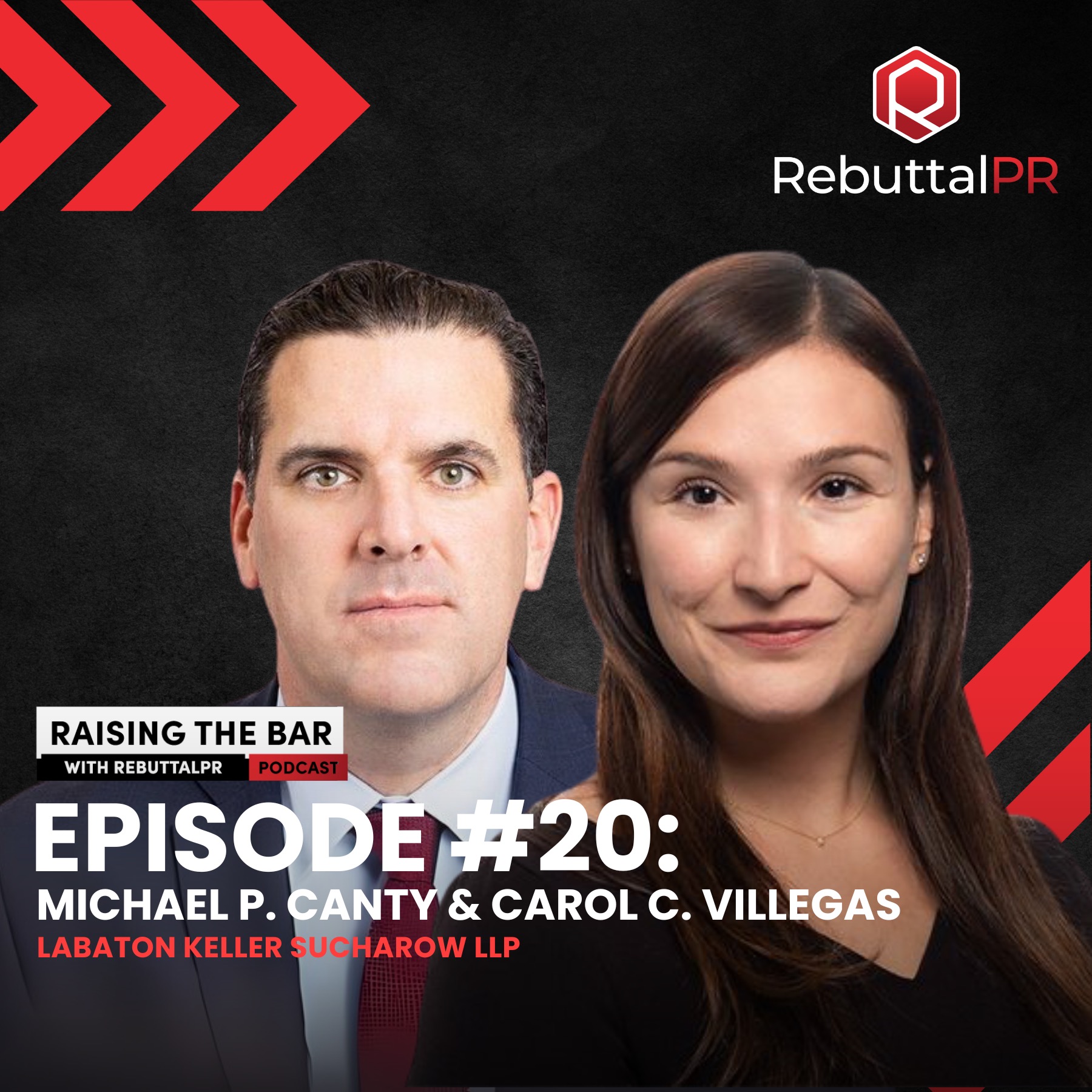
In this episode of Raising the Bar with RebuttalPR, host Ray DeLorenzi sits down with Carol C. Villegas and Michael P. Canty, Partners at Labaton Keller Sucharow LLP.
Carol shares her path from big law to the DA’s office in Staten Island before finding her way to plaintiff-side securities work. Michael recounts his early days as a Nassau County prosecutor, his years at the U.S. Attorney’s Office in Brooklyn, and why his trial-first mindset still drives his approach to securities and privacy cases today.
Together, they explain why courtroom experience matters in civil litigation, how Labaton carefully vets fraud cases rather than chasing every stock drop, and why trial readiness changes the defense calculus. The conversation turns to their recent California jury verdict against Meta, where they exposed how sensitive reproductive health data from the Flow Health app was quietly transmitted through Meta’s software development kit.
Carol and Michael break down how the case was built, why it was the first of its kind under California’s wiretapping statute, and what the verdict means for consumers in the age of AI and black-box algorithms.
Learn more about Labaton Keller Sucharow LLP: https://www.labaton.com/
Read the transcript
This transcript of Raising the Bar with RebuttalPR was generated using AI transcription and lightly edited for readability. It may contain errors, and speaker labels are approximate. The audio recording is the authoritative version.
Welcome to Raising the Bar with RebuttalPR, the podcast where we elevate the stories of the plaintiff's bar and dive into the key trends shaping the civil justice system today. I'm your host, Ray DeLorenzi, and in each episode, we'll bring you insightful interviews with leading attorneys, expert perspectives on current legal events, and in-depth discussions on the issues that matter most. Now, let's jump in.
We're very selective in the types of cases that we bring. And, you know, for us, we want to win. One thing that I'll say about me and Mike is, you know, we're very competitive, and in a good way, right? We want to bring our clients the best result possible. And you're going to do that when you have really good cases.
Ray: Hey, everyone, welcome to a new episode of Raising the Bar with RebuttalPR. I'm your host, Ray DeLorenzi, and today this is our first episode with two guests. So this is extra exciting, double exciting. I'm with Carol Villegas and Michael Canty of Labaton Keller Sucharow. We haven't really gotten into the securities world, and this is our first time doing it, and I'm really excited to have Carol and Michael with us today. Thanks, guys, for joining the podcast.
Michael: Thanks for having us.
Ray: So, you know what, Carol, I want to start with you. I know you're just off a very big case against Meta, which we're going to talk about later in this episode. But I'm always curious about the people behind the cases and how they get into the law in the first place. For those not familiar with Labaton, it's, you know, the heavy hitter, if not the heaviest hitter, in the securities world. How did you become a lawyer and get into this space?
Carol: Well, I didn't even know securities fraud litigation existed when I was in law school. I did what a lot of people in law school do. I got a high-paying job out of law school at a big New York City firm. And I discovered pretty quickly, maybe in the first couple of years, that it wasn't for me. I was defending corporations who were accused of doing some pretty bad things, and it was kind of hard for me to live with that. So I did a complete 180, and I went to work for victim services in the Bronx, which couldn't be more opposite what I was doing at King & Spalding. And I loved that work. I was helping victims of domestic violence get orders of protection, helping them with divorce proceedings.
And that kind of led to a relationship with the DA's office in Staten Island, who were helping me with some domestic violence issues, and I ended up getting a job there. And it was one of the coolest jobs I think anyone could ever have as a lawyer. I loved the work that I did there, doing trials, representing the people, representing victims. It was really, really rewarding. But I kind of missed some of the high-stakes litigation that I did at King & Spalding. And I came upon Labaton, who does plaintiffs' work, and they do plaintiffs' work against some of the largest law firms in the world. And they represent some amazing clients. And I was like, wow, this is incredible. This is a way for me to really help clients, help victims of fraud, you know, get redress from these big companies, and do it in a way that a lot of people don't realize, which is a class action. And for a lot of our clients, if it weren't for the class action mechanism, they never would have a way to get back money or to vindicate their privacy rights like we did in the Meta case. So it's kind of like the best of both worlds for me, where I could be doing this high-stakes federal litigation, but also do it with a mission-driven purpose.
Ray: Less common these days, I don't know if you see it this way, to do public service. And then, you know, a lot of folks, they're just on that hamster wheel from law school to big law, and that's it. What did folks say when you left big law and you're like, you know what, I'm going to go work for a prosecutor? I mean, I think they were like, one, are you crazy? But two, they probably assumed you're just going to go back to big law, because that isn't as uncommon a path.
Carol: So it's funny that you asked that question, because my parents, who come from very humble beginnings in South America, when I got the big job at King & Spalding, my dad was like, wow, I can't believe how much money you're making, I'm so proud of you. And when I left King & Spalding and told my dad I'm working for victim services and I'm going to the DA's office, he actually cried, and he was sad about it. And I said, no, dad, you don't understand, this is what I really want to do with my life, and it's not about the money, it's about helping people. And also, I was the only Spanish-speaking DA in Staten Island, and they have a pretty large immigrant population there, and I was actually able to help the community. And the DA of Staten Island actually invited my father for a cup of coffee and told him about my work. And then my dad cried again, but it was because he was really proud of me.
Ray: Michael, I'm curious as to what brought you to Labaton. But also, I know you come from a background in public service as well.
Michael: Yes. I graduated law school and my first job was at the Nassau County District Attorney's Office. When I was in law school, I didn't have any lawyers in my family, kind of similar to Carol's background, it was kind of a new endeavor. And classmates would ask me, what kind of law are you going into? You can do corporate, or you can do litigation, transactions. And I kind of naively said, no, I'm going to try cases, I'm going to be in a courtroom. I thought that's what all lawyers did. And I had some professors that said, you should look into the DA's office. I actually said, well, what about that U.S. Attorney's Office? I heard that's a really good job. And they said you can't really go there right out of law school, you should go to a local DA's office. And I grew up in Nassau County on Long Island.
And I was thrilled to have the opportunity to work there. I got to work with a lot of great people. And everybody asks about my experience trying cases as a federal prosecutor, but I really learned the trade of how to try cases at the DA's office. You are quite literally thrown into the deep end. You're given 200, 250 misdemeanor cases to handle just a few months out of law school. And then a year later, you move into handling serious violent felonies, where you have maybe 40 or 50 cases. And from there, my career progressed. I was an arson prosecutor and then ultimately the homicide prosecutor. And from there, an opportunity presented itself to work at the U.S. Attorney's Office in Brooklyn, the Eastern District of New York. And I immediately jumped at the opportunity. I applied and was accepted, and then spent the better part of six and a half years working on federal cases.
And then Labaton, it was not intended that I was looking to leave public service. A colleague of mine had interviewed at Labaton. His father was a plaintiff's lawyer, and he said, I think he'd be really good at this, you should really reach out, they're looking to hire somebody. And I kind of took the interview more out of curiosity. And I was really, really impressed with the people at Labaton and the work they were doing. It was very similar to the work I did as a federal prosecutor. And I always tell people, a little bit more difficult in certain respects. I didn't have the full arm of the law backing me up. I didn't have subpoena authority, I didn't have FBI agents or DEA agents. It was a little more difficult in getting witnesses to speak to you as a civil litigant, but the work was equally rewarding. And I thought I'd give it a few years, and now we're on to eight years since I left, and it's just been a great experience.
So kind of a non-traditional route, but I always tell people I love being a lawyer. I get so disappointed when I hear people tell young people, oh, don't go to law school, you'll hate it, or don't be a lawyer, it's a terrible profession. I love it. I think it's so rewarding. It has provided me an opportunity to work on great things, work with great people, and really make a difference.
Ray: So I'd be remiss not to ask, based upon your experience in the Eastern District of New York. There's been a bit of turmoil, I don't know if you've seen the news in the last eight months or so about what's going on in some of those federal districts in New York. I know the Southern District may be a bit more exciting, for lack of a better term, but I'm just curious, from having been there, what is your take on it? And I know those offices have also prided themselves on their independence. I'm just curious, in these times, what's your take on what's going on in those offices, and amongst the federal district enforcement offices generally?
Michael: Yeah, it's interesting. I look at the career prosecutors that are in supervisory positions now, and these were young assistants that I was supervising when I was a deputy chief in general crime. So it feels like it was yesterday that I left, but they have kind of worked their way through the office. I always get a little saddened when people comment from the outside. I'm not in the office, so I can only tell you what I know from the colleagues that I speak to. And the ones that I know that are still in the office are the consummate professionals, and they know the job. They know what the task is. They know that their obligation is to try to keep our community and our nation safe. I worked in our national security section primarily when I was in Brooklyn.
And they're still doing great work. I know that politics always kind of plays a part, but I will tell you that those I've spoken to recently, they know the task. I think they try not to get distracted by that. They know the work that they have to do and the importance of the work they do. And I always like to see, when the press releases come out, some of the cases that they're working on, because I know how hard it is to develop some of those cases. So maybe I'm an optimist, but I'm always impressed with the work they're doing. And I'm always loath to comment on some of the work from the outside. I don't think it's fair to those that are on the inside. They may know stuff that we don't know. So I'm just kind of an outsider, supporting them and cheering them on, because it really is important work.
Ray: Yeah, I have friends in those offices, and it's just like a nose-to-the-grindstone kind of mentality. And I think a lot of them have a great ability to block out the politics, which, there's politics regardless of the administration. Maybe it's a bit more potent in certain ones. But no, I agree. It's just like, you know, onward, we have cases to prosecute.
Michael: That's right. Yeah.
Ray: I want to ask you both about having that trial experience and being in the courtroom. You know, in a prosecutor's office, working for domestic violence victims, you may be in the courtroom four times a week, you're just constantly doing that. And that is not very common these days for many lawyers. They may see the courtroom twice a year, if they even see it. So how did those skills translate going to the securities bar?
Carol: Yeah, so I think one of the best things that we have at Labaton is the fact that we do have a lot of former prosecutors, people with trial experience. The thing about bet-the-company cases, high-stakes litigation, is that only 1% of all civil cases go to trial. There's a reason for that, right? It's because there's a lot on the line. But in order for us to be able to drive cases, drive large settlements, or just take a stand in a case and say, look, we're not going to settle for less than X, you have to have the chops behind that. If a defense firm knows that you're the firm that knows how to prepare a trial case and go to trial, they're going to take that threat a lot more seriously than, say, a firm that maybe doesn't have the same type of experience.
So the way Mike operates, and not to speak for Mike, but I've seen him in action, it's like from the minute you get the complaint, Mike's prepping for trial. And some of the questions he asks in discovery, the things that we do at summary judgment, it's all sort of working backwards from knowing that we're going to get this case trial-ready. And that is a real threat to the big defense firms, because they kind of know that the case is going to be worth a lot more for our clients.
Michael: Yeah, and I think that also works in reverse, right? We go up against defense counsel where we know if they have trial experience or they don't. And that also figures into the calculus as to how you litigate a case. But to Carol's point, I'm always trying to train young associates at the firm to be prepared to go to trial. We run a summer program, I've done it a few times that I've been at the firm. It's a trial advocacy program for associates. And what it does is it hones skills, whether it's through deposition-taking or through brief-writing, that ultimately your objective is to create the ability to have a winning case at trial. And we've done that. And like Carol said, we have buy-in from the firm, we get support from the firm to make sure that we have people prepared.
Anecdotally, we had a case where we were not looking to settle early. It was a securities case. And ultimately the defense attorney said, oh, well, we'll try the case, we'll try the case. And ultimately they were relieved, they had to bring in trial counsel, because when we said we're going to try the case, we meant it. And we pushed that case right to essentially the courthouse steps. And ultimately it settled, but not before the original counsel for the company was replaced with trial counsel. Because it wasn't a threat, it was a promise: that if we are not able to settle this for what we think is reasonable for the class, we will try it. And that threat we saw through all the way to the point where new counsel came in, and ultimately we were able to get real value for the class.
Ray: So I'm curious about the structure of Labaton. When you look at the defense side, it's not uncommon for them to have a law firm that works up the case from the time they're served the complaint, and then they bring in trial counsel. It sounds like you guys are taking the case from drafting the complaint, and you're ready to go try it yourself, and aren't necessarily looking at bringing a ringer in at the last minute, which, again, you're seeing that's more common on the plaintiff's side, but you're also seeing plaintiff's firms bring in trial counsel as well. So what's your structure and your approach to cases? Are you bringing them and going to try them if needed?
Carol: Absolutely. I mean, I think there's a real benefit to us in doing that, because you have the institutional knowledge from the very beginning of the case. I mean, you live this case, right? Some of these cases go on four, five, six years. You've been there for every strategic decision. You know the documents. You kind of believe in the case. Like, we joke about it a little bit at our firm about drinking the Kool-Aid and really loving the case and believing in it. That's how we feel about our cases. And I actually think that gives us an edge. You bring trial counsel in at the end, and it's like, oh, it's a job, I have a trial, I'm going to do the trial. And I'm sure they're professionals and they're going to do a good job. But we have been living this case for four to five years. It is everything to us. And I think that really makes a difference.
Michael: Yeah, and I think you raise a broader issue, which is the plaintiff's bar, and Labaton really specifically. We're nimble, so we're able to deploy people that are experts in certain areas. So, for example, if we see somebody is good at brief-writing, we will have them focus on brief-writing. If we have those that are good at taking depositions, we'll have them work on that. We really try to develop the whole lawyer. And to Carol's point, we identify cases early, and if we see this is a case that wants to go to trial, we have the ability to turn on a dime and prepare with people. We don't have people that are stuck in a specific role on a case. If they need to move and pivot to something else, where we think their expertise and their skill set can be deployed, we do that. And I think that's what makes Labaton in particular very successful at what we do.
Ray: So I want to talk about the securities side. And I know you both lead the part of the practice that does consumer protection and data privacy. And we'll put in the notes of the show, I didn't go through, in your introduction, all the awards and recognitions you've got, and you guys are top of the field here. Let's talk about the securities side first. And I feel like there's this misconception out there, it's really been driven by, you know, the U.S. Chamber of Commerce, that a company discloses, the stock drops, and then the securities bar is just doing its thing. And that's not how things work. I'm curious, and I'm not looking for you to refute that, because we don't need to get into their nonsense, but what I am curious about is, from the securities side, and we'll talk about the data privacy in a minute, how do you evaluate a case? And what makes it a case that is for Labaton to say, we can make a difference here?
Michael: Yeah, I think that when you talk about experience, my experience as a federal prosecutor allowed me to identify fraud. And I think that's what distinguishes Labaton. One thing that I was particularly concerned about when going to a securities plaintiff's firm was: what kind of firm is it? Is this a firm that is volume, that just files cases, like you said, where there's a disclosure, a stock drop, and then we're going to file the case? Labaton is not like that at all. We have in-house investigators that really dig up information on the case. And what I like, and I always like mentioning this, when we reach out to clients on a new case, so somebody else files a case, our initial reaction is not, hey, you should do this case because you have the largest loss. Our first reaction is usually, this case has been filed, we now have 60 days to investigate it. We're going to investigate it, and we're going to get back to you.
And I love that part of the case, because that allows us to dig in to see if the case has some teeth, if the case is a real fraud. And more often than not, there is fraud, but there are times where we've gone back to clients and said, look, this is management, or the disclosures were fairly clear, these risk disclosures said that this was going to happen and it did happen, investors were aware. But that's what I really liked about Labaton, is that we have those in-house investigators that give us the ability to really dig in. And I always tell clients, we're not looking for those cases where it's simply a stock drop. Ultimately, like Carol and I talked about, we want cases that are going to have jury appeal, that we're going to be able to convey to a jury: hey, look, this is fraud, there were lies here, there were specific statements that were made to investors that they relied on, that insiders knew. Oh, and by the way, they were selling their stock before they disclosed the truth. There's a panoply of information that we look at that creates that mosaic of a case where you're like, oh, a jury would really like this. So that's what we do. We're not hesitant to say there's not a case here.
Carol: Yeah. I mean, we represent some of the largest state pension funds in the United States. We represent some of the largest asset managers in Europe and around the world. These are serious clients. They don't want to be embarrassed, and neither do we. We have a reputation to uphold. And, you know, both of us having been prosecutors, you feel this integrity about what you're doing. And there have been a lot of occasions where we've done an investigation and said, yeah, no, I wouldn't bring this case, this isn't a real fraud. And I'm really proud of that, because we're very selective in the types of cases that we bring. And for us, we want to win. One thing that I'll say about me and Mike is, you know, we're very competitive, and in a good way, right? We want to bring our clients the best result possible. And you're going to do that when you have really good cases. So we bring, I don't know, I think every year something like 250 cases get filed, and I think we might look at 40 and we might bring 20. It's a very small sliver of the market, and that's by design.
Ray: And, you know, I brought up the chamber before. I mean, there have been efforts over the years to, in their view, essentially, actually, I'll give my view, essentially deny investors any legal recourse, whether through forced arbitration or class action bans. There was recently legislation passed in Delaware that would change some of the corporate rules, which we won't go down that rabbit hole. But what do you view as the risks to investors from a regulatory and legislative component, even though we're in an era when people's faith in institutions is pretty much the lowest it's ever been?
Michael: Yeah, I mean, we didn't get here by accident. We have to look back, now almost 100 years ago, right? We had the stock market crash. We had a total lack of integrity in the markets. We had the creation of the SEC in reaction to that. We had the passage of the Exchange Act and the Securities Act, right? So Congress saw fit to make those changes. Then we had a period where maybe there was a lack of value for investors, and corporations saw an uptick in what they call strike suits. And what did Congress do? Congress reacted. They passed the PSLRA in 1995. And what that did, I think, for a firm like Labaton, it really was a huge benefit, because it created a framework where you have a heightened pleading standard, you have courts requiring those really detailed investigations before you bring a case.
So I think we provide tremendous value for investors. And the alternative is hiring 10,000 more SEC prosecutors that really won't have the bandwidth or the time to do these cases. Some of these cases go four, five, six years. And we're incentivized to bring cases where we think we're going to be successful. To Carol's point, we're not looking to drag a case out for four or five years if we think it's going to lose. So I think we provide real value to the market. And you see that. Without private securities litigation, I think you would see a real change in how corporations disclose information, how they handle insider trading. And from our perspective, now, when you're talking about changes in regulation, and we don't have to get into the politics of it, the private securities litigation provides a real function to investors.
And I think that the institutional investors, like state pension funds and large institutions, are stepping up, and I think that sends the message. That's your answer. If these states weren't getting involved, if these large public pension funds weren't getting involved, I think the Chamber of Commerce argument would carry more weight. But the fact that you have these states getting involved and leading the charge on these cases really speaks volumes as to how they see the framework. They see it providing real value to their pensioners, to their retirees.
Carol: Yeah, the way I like to think about it is all investors want the capital markets to be safe, right? They want companies to be truthfully disclosing things. And throughout various presidents and political regimes, the SEC expands and contracts all the time, right? Some administrations have a lot of regulation around disclosures, some don't have a lot. But one thing that's consistent is we have the courts, and the law that Mike mentioned, the Private Securities Litigation Reform Act. No matter what's happening with regulation, investors will always be protected, because there's always a way for us to go and seek redress for fraud. And companies know that, investors know that. And I think it's just a really, really important thing that we do.
Michael: Yeah. And just to put a finer point on that, we see a lot of executive action, right? Administrations change, executive orders come and go, you have a new administration, and all of a sudden the rules change. Not with the PSLRA, right? Because they did it the old-fashioned way, they passed it through Congress. Interestingly enough, it was vetoed by President Clinton, and then a bipartisan House and Senate overrode the veto to make it a law. So they did it the right way, the way people say they should be doing it, like, pass a law. And when you do that, what you have is consistency, and you have stability. And I think Carol's right, markets see the PSLRA as being kind of a backstop to make sure that the markets remain consistent and have their integrity.
Ray: I want to pivot to the data privacy side of your work, which, I don't know if it includes data breach work, but I think when people think data privacy, they think of breach. And that's not necessarily what it means in a lot of instances. And I feel like it requires a different level of sophistication and investigation to figure out the privacy aspect. And also, you know, I'm packing in a bunch of questions here, people don't realize their personal data is out there. But I also wonder if people like to shrug their shoulders at this point, because they're like, it is everywhere. So I'm curious, as we talked about your approach to securities work, what's your approach to data privacy, and how do you investigate these cases and figure out what is there, when we are just surrounded by so much data, and in an environment where it's just bought and sold on an open market?
Carol: It's a great question. And to answer the first part of your question, I think you're right, it's sort of a different level of sophistication and investigation that we need to be able to do. And essentially, to talk a little bit about the Flo Health case with Meta, it's being able to understand how the technology works, and that this code that Meta developed and gave away to app developers for free is able to essentially record all the data that any user would put into the app and then pull it into its systems and use it in its machine learning algorithms for advertising, right? So there's a lot there to unpack, but there's a lot of investigation that we needed to do to get to that point and sort of figure it out.
But it's different than a data breach. And I also think it's different than, and Mike and I talk about this all the time, we're not suing a clothing company because they found out Carol wanted to buy a black jacket and then they served her a bunch of ads on Google. That's not the type of case we bring, and that's not what this data privacy case is about, or the ones we're interested in. The cases that we bring, and the ones we're interested in, are ones that involve very intimate, private data, the type of data that you don't want anyone to have, like health data, like reproductive health data, financial data. And I think that there's a difference, right? A lot of people are like, oh yeah, whatever, they all have my information. But do you really think that Meta has information about when you're ovulating? Probably not. And I think that this case kind of shed a spotlight on some of the data that companies like Meta are getting from when you use an app or a website. And so I think that's what makes this case a little bit different.
Ray: So to build this up a bit, and give a bit more background for those listening at home, one of the reasons I reached out to Michael and Carol was that they are fresh off a case against Meta. They got a verdict on August 1, so we're taping on August 12th, so, you know, 11 days ago. And this case involved a few defendants, and we'll go deeper into it in a moment. Flo was an app that would help essentially with family planning, and it relied on a software development kit, or SDK, that Meta, which owns Facebook, Instagram, WhatsApp, and a bunch of other stuff, provided to app developers. And let me stop there. Why don't you tell our viewers, at a very high level, why would a company like Flo use that SDK, and how that created essentially a pipeline of data between the app developer, in this case Flo, and Meta?
Carol: Yeah, so essentially a software development kit is pretty ubiquitous, right? It's in a lot of apps, it's pretty normal for it to be out there. And essentially what it does is what it says, it's a software development kit. It helps developers who want to build apps build their apps better, build them faster. It provides a service to app developers to help them do that. And it lets them track analytics, like how many people didn't make it through the first four questions because they were too long or boring when signing up for the app, or how many people purchased something. But what a lot of people don't know about software development kits is that there's essentially a give-and-take, right? Meta provides a software development kit, and it's free, so they're not charging anyone anything. And the app developer, in exchange, is essentially allowing Meta to record information that its users put in.
And our case was based on a number of app events, like actions that people take within the app, that were sent over to Meta, and were sent over with personally identifying information, like advertising IDs and information of that sort. So that, and this all came out in the trial, Meta was able to match the information that it received from the Flo app to actual Facebook users. And then they were also able to use that information in their machine learning algorithms to train their ad systems to deliver ads better. And we all know Meta is very, very good at delivering ads. And that's because they're able to access all this information.
Ray: You know, I don't know if you've ever read this book, but it reminded me, several years ago there was a book by Charles Duhigg called The Power of Habit. I don't know if you're familiar with it, but it gives this anecdote about how it essentially involved data and how it was allowing retailers to track consumers. And it talked about how this father stormed into a Target, asked to speak to the manager because his teenage daughter was getting coupons for pregnancy-related items. And essentially, Target was able to realize, through this person's purchases, that they were pregnant. And Target knew before the father. And I'm curious, where is the line between advertising and sort of targeting individuals based upon their purchasing habits, and a violation of a person's, not just privacy, but protected health data? Where did you see that line? And did you ever sort of question, is it really fuzzy, or is it pretty black and white?
Michael: It wasn't fuzzy here. I mean, this is what came out at the trial, the absurdity that individuals from Meta could not simply answer that where a woman was in her menstrual cycle is private information, or whether or not a woman was trying to get pregnant is private information. These are things that, and Carol and I joke about this, these are things that you don't ask. I wouldn't ask a female colleague at work. I may ask Carol where she went to dinner last night, I may ask her how her family vacation was with her kids and her husband. I would never ask those questions. And I think when you look at this type of data and you look at the world we're living in, why that may have value, whether a woman's trying to get pregnant certainly has value. Would an employer want to know whether a woman was pregnant or not? Maybe, maybe not, right? Where a woman was in her ovulation cycle, obviously, that's highly sensitive and private information.
And I always, we talked to the jury about this, the one tool that they had was common sense in making these determinations. To Carol's point, it wasn't a part of our case, but whether a woman is looking to buy a black jacket, I don't know if people would consider that a confidential communication. Maybe some would. And that gets into the gray area you're talking about. But the issues that we were dealing with were fairly egregious. Like I told the jury, it was not a close call. This is private information.
Ray: So now you say it's not a close call, but you just said you couldn't get Meta to answer some basic questions. And I wonder if it's just, and look, there's been a ton of reporting about this, that they just have this culture there that nothing's private, and it's just the world we're living in. Did you get that sense? Is it hubris, or do they really just not have an appreciation of what should be private? I wonder how much, if there's anything you could share, about that culture and philosophy and way of doing business that they operate in?
Michael: You know, I wouldn't want to comment on that. I will say, though, that the jury's verdict clearly sent the message that they disagree with Meta's assessment of whether or not it was private. And one of the arguments that we saw at the end, Facebook, or Meta, made the argument: well, we had the consent of these women, because they were all Facebook users, and our terms of service and our data policy allow us to collect from third parties any information we want, anytime, anywhere, and under any circumstances. And the verdict form, which is public, the last question is: did Meta have consent? And it was a resounding X through that box, that the answer was no, they did not.
Look, I think when you're dealing with billions of pieces of data, maybe you become numb to the fact that this is private data to that individual. I'm not a psychologist, so I don't want to get into it, but the idea that when you have it in the aggregate, in the billions, you say, well, where's the harm? But it is a harm to that one woman who went on the app with the expectation that this stuff would be kept private, and it was recorded. And we still have laws on the books, right? California passed the law. Come back to the old-fashioned way, you pass a law that says you can't record this information. Recording devices come in all shapes and sizes in 2025. And when you break the law, you're going to be held responsible.
Ray: I know we're bouncing around a bit, but how did you even come across this case?
Carol: So I believe the FTC did an investigation into these practices. And at some point, Flo settled with the FTC, and it was very newsworthy at the time. And we looked into it and said, oh, this is interesting, I wonder if there's a there there. I wonder, putting Flo to the side, what about the companies that they were sending the data to, Meta, Google? And so we started looking into it. We hired an expert to help us reverse-engineer the app and see what app and code traffic was going from Flo Health to Meta and other companies. And we looked at the law and we said, wow, this seems like a pretty bad breach of women's privacy. And we did some research, and I think ours might have been the first case of its kind using CIPA, a wiretapping statute, to do this. But, like Mike said, we live in 2025, wiretapping comes in all shapes and forms. And we decided this fits squarely into the definition of a recording. And so that's how the idea for the case came about.
Ray: So I know you also all worked on the biometric data case against, I guess that was just Facebook at the time. And no one puts Meta and privacy in the same sentence unless it's to say they don't care about it. When you approach a case like this, especially if you're going to go to trial against Meta, I mean, they have all the resources in the world, did you, again, from the start, expect to go the distance? Did you, especially since it's kind of the first case of its kind, think that they were going to do that from the beginning? Or, if you could think back to when you first filed the case?
Michael: Yeah, I mean, you brought up BIPA. We went fairly deep with BIPA as well, and we had thought that that was going to go to trial. They had taken that case up to the Ninth Circuit. They were unsuccessful at the Ninth Circuit, came back, the judge set it down, I believe he had set a trial date, I can't confirm that, but we were very close to trial there, and ultimately we were able to reach a settlement. So I knew that there was a possibility that they would go to trial. And to the point we made very early on in this discussion, Carol and I were always preparing with the expectation that it would go to trial. You have to, and if you don't, you will get caught flat-footed. And that was one of the reasons why I think we were successful here. This class was certified in the spring, late spring, and then the judge had a pretrial conference in June and said, you're going to trial in July. And we were ready. We said, okay, the expectation was that this was going to go to trial. So we had the July trial date, we were prepared, we had anticipated that that was a distinct possibility.
At the same time, and we talked about this earlier too, only 1% of civil cases go to trial. So, is this going to be the 1%? And only, I think, 0.7% go to verdict. Is this going to be the 0.7%? Yes, it is. At the time, we're always looking for an off-ramp, right? We want to be able to bring value to the class. We want to be able to get them something sooner rather than later. And we understand that taking a case to trial takes a lot of time. Post-trial appeals take a lot of time. And at some point, you definitely want to be able to tell your class, look, here is the value that we're bringing you, we got a jury verdict, it's, you know, $5,000 per user, and we want to be able to get that to them.
But yeah, I think we were always looking for some kind of off-ramp, and you saw that we settled with some of the other parties. But I think for Meta, they have a lot of other cases that are sort of happening right now in this area. They've got litigation around Pixel, which is the same type of software, but for websites. And I think for them, it was sort of a broader question whether to settle or not.
Michael: Yeah, and just anecdotally, I mean, without too much detail, there was a moment where Carol and I turned to one another and we were like, okay, this is really happening. We were kind of like, could it settle? And then at one point we were like, all right, this is it, this is really happening. And it was kind of like, okay, we're prepared, we're ready, but there was no doubt at that point that this was going to trial.
Ray: Yeah, it's like a switch in your brain, when you think about going to trial, where you're like, okay, today is the day that you start working 24/7, and that happened, right? Like gearing up.
Carol: So that was the moment Mike was like, yeah, we're going.
Ray: I want to talk about off-ramps for a second. And I know you were up against Google, and I saw some reporting where, and again, I wasn't in the courtroom, but it seemed like the judge said on Friday, look, you should take the off-ramp. And you did, and you resolved that confidentially. I'm curious, when the judge said that, maybe it didn't come as a surprise to you, but did you ever, when you knew the trigger was "we're going to trial," did it ever make you question, like, oh, what is the judge thinking about this case? Or did you just see it as totally separate, they're obviously separate defendants, separate facts? But I'm just curious, at least from the reporting, it seemed the judge was fairly direct in saying where their mind was at.
Carol: The California Confidentiality of Medical Information Act, the CMIA, that was the statutory claim that we were suing Flo under. And it's actually a pretty new statute, unlike the wiretapping claim, which has been around for a very long time and has a lot of robust case law behind it, right, the Meta one. This one's pretty new. And we also thought that our facts fit squarely into the claim, and we had been operating all along that way. We got to the end of the presentment of our case, and the judge told us he was a little bit skeptical that it did. And so we heard him, we heard him loud and clear. And again, if you ask Mike and me, we'll sit there and tell you, till forever and the cows come home, that of course it fits within the statutory definition of the CMIA. But I'm not wearing the black robe, the judge is. And essentially, he looked at it a little bit differently than we did. That happens. And so you kind of have to take that into consideration in making your next strategic move.
Michael: Yeah, and on that, there were a number of other claims that we had against Flo that were still active. And the mediation is confidential, but this is like what we talked about with those that are still in the U.S. Attorney's Office, I don't know what's going on behind the scenes, so you kind of have to have a healthy respect for that. I would also take caution that the mediation necessarily wasn't a reaction to what a judge said. There are a lot of factors that go into whether or not you decide to settle a case. We had the opportunity to brief it, we would have had the opportunity to appeal if the judge made a certain ruling. So, that being said, there are a number of factors that go into the decision-making process.
Ray: Yeah. I want to end with asking, and again, congrats on an enormous outcome in what's going to be looked back at as a landmark, first-of-its-kind case. We are now moving, though, into a world where, so you have apps like Flo and the SDK, we're now moving into the world of AI. And I'm curious if you can sort of predict out over the next, let's say, three to five years, which, I know, is very difficult when all this AI stuff is changing weekly. How does the data privacy landscape change in the world of AI? Do we see these companies being even more flippant with people's privacy? Is it going to be harder to uncover whether that flippancy leads into illegal conduct? I'd be interested to hear from both of you. And Carol, why don't you go first, what do you think the landscape's going to look like?
Carol: Yeah, I don't think anybody knows, but I have a few guesses in mind. We actually dealt a little bit with the AI issue in this case, because the data that got recorded by Meta from Flo got pulled into its AI algorithms. And one of the arguments that Meta made was, well, no person actually saw the data, it just went into the AI, the machine learning system, and it analyzed it and spun out ads for people, or kept people engaged. I think it's an interesting thought, that AI is not a person, although we do know that corporations are people, based on a Supreme Court decision. And so I think we're going to be seeing a lot of arguments around "no one saw it, it wasn't a violation of privacy, it just got put into the machine, and then the machine did something with it." I'm not convinced by that. I think, you listen to the testimony of the women that we put up on the stand, and they felt very raw that their information and their privacy was violated by their information being used.
I also think one of the things that we have that's very troubling is that, and our expert, Jen Golbeck, talked a little bit about this, no one knows what happens inside the AI system. They call it a black box for a reason. Not any expert in the world can tell you what happens inside that neural network, how the data is used, where the data goes. It's just stuck in the training system, right, forever. And so that's also kind of troubling, that once your data is out there, you can't get it back. And I think that's going to be something that we're going to be thinking a lot about moving forward: how, is there a remedy for that?
Ray: Michael, anything you want to add to that?
Michael: No, I mean, I think Carol hit a lot of the points. The one thing I would say is, I'm not optimistic. I try to be an optimist, but...
Ray: Yeah, well, you totally torpedoed that.
Michael: All right, so I will retract that and say I'm optimistic in that there are, thankfully, people like myself and Carol who are going to be watching. Because, look, I think this technology is awesome, and we've always talked about that. Like, we use it. It is a huge benefit. I think it has the potential for doing a lot of great things in medicine, in science, in education. The problem that we have goes back to where it's always been with a lot of these large tech companies: they don't get proper consent. They feel like they are kind of this benevolent actor that does this stuff, and that excuses the conduct they engage in, which requires, under the law, that they get consent. We've always said that, whether it's BIPA, whether it's here under the CMIA, whether it's CIPA, under these statutes, you have to get certain consent. You have to let people know what you're doing. And eight or nine pages of a terms of service or a data policy that refers you to another hyperlink on another page, that refers you to another page with a hyperlink with footnotes, it becomes absurd to think that consumers understand what's going on.
So until these companies understand that they have to get proper consent, and not roll out these new technologies and then ask for forgiveness years later, we're going to have firms like ours. People like Carol and myself are going to be watching, and we're going to be looking to bring these cases. Because consumers care about this stuff, they do, especially when they find out what's really going on. That was the unique thing about this case: they finally got to look behind the curtain and see exactly what Meta is doing with the information, and how they're using it and profiting off of it. So, I am optimistic, if that will stand.
Carol: So, just to echo what Mike just said, the thing that I thought was so very cool about this is that normal, ordinary people actually got to listen to what happens to the data, see where it goes, what's done with it. They were told what happens, and they gave a verdict, right? And it was, resoundingly, we don't want this. And, you know, you said before, the first of its kind, this is the first opportunity that consumers have had a chance to sit there and stand up to Meta and tell them, we don't want this.
Ray: With that, Carol Villegas and Michael Canty of Labaton Keller Sucharow, thank you so much for joining the podcast. Really appreciate you coming on. Thanks for watching.
Carol: Thank you so much.
Thanks for listening to this episode of Raising the Bar with RebuttalPR. Don't forget to subscribe and follow to join us next time. See you then.
Related episodes
- Jean Martin on Class Actions, Data Privacy, and Building a Movement for Women Litigators
- Eric Cramer on Antitrust, Fighter Pay, and Using the Law to Drive Social Change
- Deepak Gupta on Leveling the Playing Field at the U.S. Supreme Court
Learn how RebuttalPR approaches PR for securities litigation and data privacy trials.
Discover Insights & Trends
Featured Stories

- September 4th, 2026
- 4 minutes
- Melissa LoPiccolo
How to Vet a PR Firm: 8 Questions to Ask Before the Contract is Signed

- August 21st, 2026
- 4 minutes
- Stephanie Wolf
Aligning Your Benefits with Your Values: Parental Leave Edition