
- September 4th, 2026
- 4 minutes
- Melissa LoPiccolo
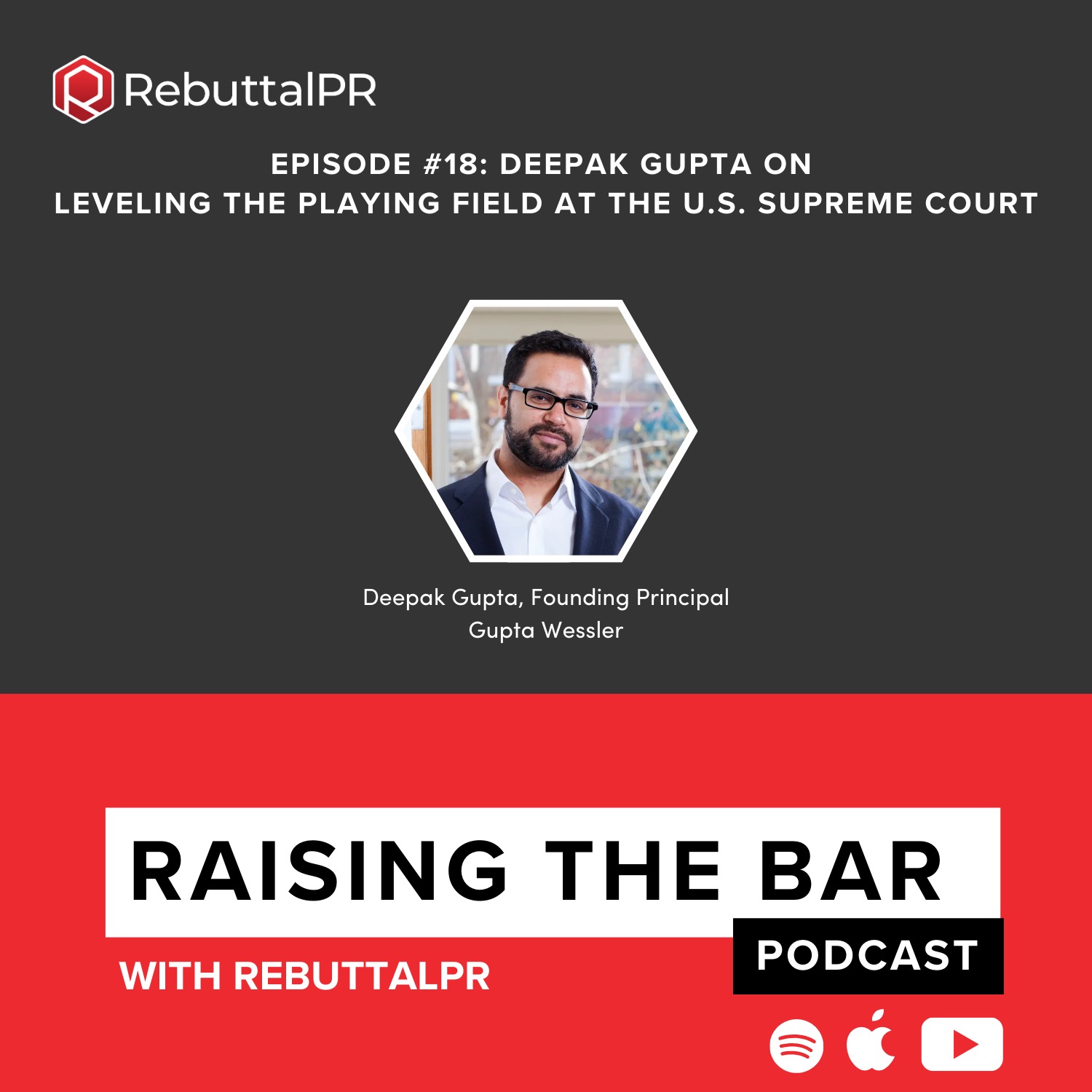
In this episode of Raising the Bar with RebuttalPR, host Ray DeLorenzi sits down with Deepak Gupta, one of the most respected plaintiff-side Supreme Court and appellate advocates in the country. Called “a mainstay of the Supreme Court lectern” and “the go-to advocate” for plaintiffs, Deepak has argued eight cases before the U.S. Supreme Court himself, and aided his colleagues at Gupta Wessler in many more. As a result, the firm has achieved the highest win rate among the Court’s most active practices.
Deepak shares how he forged an unconventional path to appellate advocacy, why careful case selection is critical in a conservative-leaning court, and how he’s secured improbable victories just this term in cases like LabCorp v. Davis and NVIDIA v. Ohman. He explains the little-known strategies that can keep a case out of the Supreme Court entirely, how collegiality shapes appellate practice, and why his firm invests heavily in mentoring the next generation of advocates.
Deepak offers a candid and inspiring look at what it takes to prevail at the highest level. Learn more about Deepak Gupta and Gupta Wessler LLP: https://www.guptawessler.com
Read the transcript
This transcript of Raising the Bar with RebuttalPR was generated using AI transcription and lightly edited for readability. It may contain errors, and speaker labels are approximate. The audio recording is the authoritative version.
Welcome to Raising the Bar with RebuttalPR, the podcast where we elevate the stories of the plaintiff's bar and dive into the key trends shaping the civil justice system today. I'm your host, Ray DeLorenzi, and in each episode, we'll bring you insightful interviews with leading attorneys, expert perspectives on current legal events, and in-depth discussions on the issues that matter most. Now, let's jump in.
You know, it is the Supreme Court. It's a very majestic place, but once you're there, you're right up close with them. You're talking to them. It's a very intimate conversation. You have to be able to press your case, and you can't be sort of cowed by the importance of their position.
Ray: Hey, everyone, welcome to a new episode of Raising the Bar with RebuttalPR. I'm your host, Ray DeLorenzi, and today I'm honored to be joined by Deepak Gupta, founding partner of Gupta Wessler. Instead of me doing an intro of Deepak's bio, I'm just going to read off a few quotes here. The New York Times has called him a skilled appellate lawyer. The Washington Post has called him an all-star progressive Supreme Court litigator. The New York Law Journal, quote, a progressive legal rock star. We can go on and on here. But Deepak, thanks so much for joining the podcast today.
Deepak: Thanks for having me, Ray.
Ray: So here's what makes Deepak special. Compared to many of the other amazing litigators that we've had on the podcast, Deepak specializes in appellate and U.S. Supreme Court work. Gupta Wessler is the only boutique law firm that works with plaintiffs when their cases get to the U.S. Supreme Court level. So we're really excited to hear his perspective today. Deepak, how do you get into this line of work? You know, especially since, what, maybe 150 lawyers, let's say, argue at any Supreme Court term, and there's probably over a million lawyers in the United States. So we're talking like 0.01% who are at the U.S. Supreme Court. Did you ever, when you became a lawyer, like, you know, the Supreme Court, here I come? What was that journey like for you?
Deepak: No, not at all. I mean, I went to law school, like a lot of people, wanting to be a public interest lawyer. And I still think of myself first and foremost as a public interest lawyer. I think it's just that the venue I happen to do it in increasingly is appellate courts and the Supreme Court. And, you know, some people argue to juries, and I argue to these, for better or worse, these other kinds of juries, sometimes of nine people. But the way I got into it is a different path from most of the people who do this, and that's part of the problem.
There's increasing specialization in Supreme Court practice over the last few decades, and it's focused heavily on a small number of corporate law firms, firms in buildings around me here in DC. And that's where people learn how to do this stuff, either there or in the Solicitor General's office. I came through a different path. After clerking for a federal judge, I worked at Public Citizen, and Public Citizen is one of the few places, a nonprofit organization, that has invested in trying to level the playing field in this area. And so that's how I learned how to do it. That's when I had my first Supreme Court argument.
And then I worked at the Consumer Financial Protection Bureau for Elizabeth Warren, another institution that's trying to level the playing field. And when I left the Bureau, I decided to hang out a shingle and build a firm to do this kind of work, because I realized there was this just enormous advocacy imbalance in Supreme Court and appellate stuff, and there really wasn't a firm doing this kind of thing for the plaintiff's bar.
Ray: So let's talk about that imbalance. And I want to go through some stats here with you. Gupta Wessler in 2023 through 2025 had seven arguments at the U.S. Supreme Court. And if I have my stats right here, that gives it a win rate of 71%. And only four other firms, all corporate firms, had a number of arguments really, you know, eight to ten, with win rates 50% or below. So you're arguing a massive number, you and your firm, and you're winning at a high rate. Why do you think that is? Particularly when there is this thinking out there that the Supreme Court isn't exactly a level playing field, and the deck is stacked against individuals versus more corporate interests.
Deepak: Yeah, I mean, it is. Because, look, there's no denying it's a conservative court. A lot of people think of it as hostile territory for our issues on things like arbitration and access to the civil justice system. I think, first of all, I encourage people not to just have a knee-jerk reaction that the Supreme Court is always going to be bad for us. I think it varies from issue to issue, and it's also changed over the years. And so, as a firm, we try to be really, really careful about what battles we take on. So we're really careful when we take things to the court. And then, when the court has decided to take something and we're brought in after that, we try to take a very careful, kind of defensive posture.
An example of that is two of those wins you mentioned from this past term, in a securities case called NVIDIA and in the LabCorp case, which I think anyone who practices class actions probably knows about, which is about injury in class actions. The way we won those cases is not because we convinced the court to write some magnificent opinion that says how great plaintiffs in class actions are. It's because we convinced the court that they couldn't decide the case and they had to throw out the cert petitions that were granted. So that's an example of the kind of case-specific, defensive posture that we're sometimes taking in a court that people regard, I think often rightly so, as kind of hostile to plaintiffs.
Ray: So there's this mysticism around the U.S. Supreme Court that the two other branches of government I don't think have. And, you know, our team was just kind of spitballing: there have been so many TV shows about the White House and about Congress, and there's never been a U.S. Supreme Court television show. We were saying that Shonda Rhimes would be perfect to put something together. But why do you think that is? And what do you think are the misconceptions about the court that exist because of that mysticism? Or, you know, it's not even secrecy, but there is a bit of secrecy around it, too, in some way.
Deepak: Yeah, there is secrecy, right? I mean, the deliberations of the court are under a cloak of secrecy. We had a couple of leaks in recent years, but that's very, very unusual. And the whole setup of the court, you walk into that room, for those who haven't been there, and it's these big red curtains, it's very majestic, they're wearing black robes. I mean, it's like a temple. And I think that's part of the majesty and grandeur of the law that the court has tried to cultivate.
And so it's an institution that historically people have a lot of respect for, but they don't understand its inner workings. Now, some of that's changed. If you look at the public opinion polling on the court, particularly in recent years, there's been an erosion of public trust in the court. But that discourse is generally about the really big, hot-button political cases that dominate the headlines.
What we think of in our firm is that there's also a docket that we like to call the law docket, where the court is not as much a political institution. It's behaving more like a court of law, and it's deciding questions. And we think we can win those cases if we bring the right legal arguments to bear. And sometimes that means using conservative methodology. It means, like in this recent class action case, we traced the history of things that look like class actions all the way back to English law. And those are the kinds of arguments that can resonate with these justices. So I think if you look past the headlines about the really big hot-button cases, it is actually a court.
Ray: Take me back to your first argument at the U.S. Supreme Court. I want to know a little bit about the case, but also what your preparation was like. And walk me through how you were feeling in that moment. Don't be like, oh, it was just another argument, but like, we know it wasn't, you know?
Deepak: No, it's never just another argument. And no matter how many times I go there, I'm always going to feel some nerves that morning. And honestly, if that ever stops, I should just pack it in, because I think that that's helpful. So I'm an obsessive preparer, and we do lots and lots of moot courts in our firm. We do that not just for the Supreme Court, for everything, but particularly for Supreme Court arguments. By the time you get up there, those questions shouldn't be questions you didn't anticipate. They should be questions you've thought about a lot. So, for my first argument, and for every argument since, I do tons of moots. I want to have the hardest questions and really think them through way in advance.
The first case I argued, and I don't recommend this, arguing a really big case as your first one, but it was AT&T versus Concepcion, which the court decided five to four on class action bans. And despite all my preparation, I remember being in the Supreme Court cafeteria that morning, and I looked down at my hand and it was shaking, which was like objective proof, if I needed it, that I was in fact nervous.
But I'm sure lots of advocates have this experience. Once you get up there, once you start talking, you forget all of that. You're in the moment, and you've spent a lot of time thinking about how you're going to react, and it's almost like you've developed a muscle memory. When you hear that question, you already know what that question is, and you've already started to think about how you're going to formulate your answer. And then you can actually listen carefully, you can be there in real time. And the more I do it, the more comfortable it gets, the more I'm able to be there in the moment, listen to what's really happening, pay attention, because I'm confident that I've done whatever I can to prepare. At a certain point, you get to a place where it's like, okay, I've done everything. Now, I just have to do this.
Ray: So, how many have you argued at the U.S. Supreme Court now?
Deepak: So, I think the one I just did was my eighth argument. And for us as a firm, I think we've had like over 20.
Ray: So the firm's at over 20, and the question I'm getting to is: the environment in the court, and the justices. There are, you know, repeat players like you and folks at your firm. There are folks at more corporate firms that have done more than one argument, talking five, ten, dozens potentially. And I find it interesting compared to what you see at a trial level and a run-of-the-mill argument. There is not a combativeness that you see in the lower courts. In fact, there was a big story in this last Supreme Court term. I'm not going to say who the Supreme Court litigator was, but they got smacked down by one of the justices, and this person had appeared many, many times and said something pretty dismissive of opposing counsel. And I'm curious about that environment. It's like you're adversaries, but you can't be adversarial in some ways, or combative.
Deepak: Yeah, I mean, I think that this is just true of appellate and Supreme Court litigation in general. One of the things I like about it is that you can be collegial. It's easy to be collegial because you're not fighting over stuff like discovery. The only thing maybe you're going to disagree about is whether to take an extension. And so it makes it easy, in a collegial environment like that where you're not fighting with each other, to be friendly with the people on the other side. And because there are so few people doing it, you might find yourself opposing each other one day and being on the same side another day. And so it's important, I think, to cultivate those friendships. And yeah, the stakes are high, people are competitive, but the justices don't want to see people personalizing their combat in the Supreme Court.
I'll mention the advocate that you mentioned. It's Lisa Blatt. She's a friend of mine. She has a unique style in which she is a lot more combative. And I do think that advocacy at that level brings out people's unique styles and approaches, and you kind of have to be who you really are. I am just by nature never going to be that combative. I think it serves me well in situations where somebody like Justice Alito, who might not agree with everything I'm saying, if he was going to raise the temperature, I actually, by not being combative, kind of lower the temperature. And there's a recent argument where he and I were actually agreeing quite a bit. And so I like that about it. I think some people are better suited to the rough and tumble of trial litigation and discovery fights and things like that, and other people are more well-suited to that kind of discussion. It's a little bit more like a philosophical debate than it is like a street fight.
Ray: Because there are so few of you that handle these arguments on a regular basis, I understand that you get to know the justices. You don't know them personally, but you get to know them to a certain extent. When you go, or your colleagues go, in to argue, do you fear or wonder, like, are some of the justices being like, oh, here comes the plaintiff folks again, versus they may not have that view of someone who could be on any side of a commercial dispute? How do you sort of deflate that balloon, or do you think they don't even think of it that way?
Deepak: I mean, I do think, just like in any court where you have people that are repeat players, if there's a local traffic court and there's somebody who's there often, judges are going to form opinions of those advocates based on their advocacy. So, if there's somebody who's credible and trustworthy, the judge is going to trust that person, right? And if there's somebody who shades the truth a lot, they're going to be concerned about the representations that they make. So I think that's true in the Supreme Court, just as it would be true in any court. But I don't think that the justices are like, okay, well, you represent these kinds of clients, and so I have a natural inclination against you. I think, to the contrary, what the justices care about is the legal argument and the jurisprudence that they're going to set for the whole country.
I do think there was a moment in my career where I really started to feel comfortable, and that was, I had this case where the Supreme Court invited me to argue a case. This sometimes happens when there's not one side that continues to press its position. So the Solicitor General had abandoned the position, and the court asked me to argue. And so I was actually arguing a position I normally wouldn't agree with. I had to argue an anti-plaintiff position in that case. It's the only time I've done that. But it made me feel very comfortable. And the justices, I think, value the service they do, providing to the court. And ever since then, I've kind of felt like, you know, this is it. It is the Supreme Court, it's a very majestic place, but once you're there, you're right up close with them, you're talking to them, it's a very intimate conversation. And you have to be able to press your case, and you can't be sort of cowed by the importance of their position.
Ray: So when you're approached about taking a case on, it's like a vote-counting exercise in some ways. You need to get to five. But also, when you've talked about some other cases, like, what if we get to a place where it's just five saying this shouldn't have been granted in the first place? How do you even get your arms around it initially? You know, it's something that's been going through the lower courts, you may have had no familiarity with it until a lawyer comes to you and says, hey, the other side is seeking cert. What do we do?
Deepak: Yeah, I mean, I think that one of my favorite things about this kind of practice is that moment when you come into something and what you're contributing is your fresh perspective. So somebody has been battling something maybe for the better part of a decade, and you can lose any kind of perspective by doing that, right? You know all the facts, you were there. What you don't have a sense of is how this is going to look on a cold, hard record when it goes up to an appellate court or to the Supreme Court. And so that's a big part of what we provide, just perspective. And then also, we're narrowing the way we're looking at your case to the particular issue in question. So any plaintiff's-side advocate is naturally going to think about the case as a whole, whereas appellate courts and the U.S. Supreme Court are going to think about whatever this particular jurisdictional point or particular legal question is. And so I think the more, every year that I do this, the more I get better at being able to see the big picture and focus in on the thing that's really going to resonate with the judges or the justices.
But it's a collaborative exercise. Every single case that we do, we do with co-counsel. And I think there might be some people who do this who just think, oh, it's my way or the highway, and they just kind of take over, and whoever was working on it before, they don't really talk to them. I think that's really stupid, and that's never our approach. Our approach is always to work really closely with the trial lawyers. They're always going to know more than we do about the record. They're going to have deep familiarity. And so what we're looking to do is create a team for each case, sort of on the fly, that brings out the best in everyone, where you're harnessing that experience, but you're also harnessing our ability to know and to predict what the appellate judges or the justices are going to see in the case.
And you mentioned, what do you do when the other side's petitioning the Supreme Court? That's actually my favorite moment, because there's so much bang for the buck. We can come in and try to keep the case out of the Supreme Court. And that's never about who's actually right or wrong on the legal issue, right? It's about the dark arts of what motivates the justices. And so that's actually my favorite kind of brief to write, just, you know, there's nothing to see here, move on, and you preserve plaintiff-side victories, and you kick the can down the road. It's not as glamorous, it's kind of under the radar, but I think we add a lot of value when we do that.
Ray: So that's a good pivot. While we've been talking about the U.S. Supreme Court, you do a ton of writing and arguing at lower appeals courts at the state and federal level. Let's talk about some of the state appellate work you've done. You had a huge win in Nevada recently regarding a case involving Uber. You've done work regarding PCBs. How does the approach differ, particularly when you're getting dropped into a state where, you know, you know the nine Supreme Court justices, but let's say you're at the Nevada court. I always say Nevada, Nevada, I never know which one's correct, but in any event, it's very important that you don't get that wrong there. But you don't know those justices as well, I assume. So how does that affect and impact how you approach those cases?
Deepak: Well, I think it's a really great question, and you have to approach it with some humility. Actually, I do know the Nevada court kind of well now, because I've just been there twice in the past year, and I just came back from Nevada where I spent some time with most of the justices at the Nevada Justice Association convention. But I think it is tough, because there are 50 states, and they each have a unique legal culture and politics, and those people are separate, totally distinct individuals. And so if I'm coming into a state for the first time, like I said, I have to approach that with a lot of humility. First of all, I might just talk somebody out of hiring us. I might say, you know what, for this issue, it's really very state-focused, we might not add some value, you probably don't need us. But if it's a high-stakes matter and we think we can really add value, then what I do is I try to talk to a lot of people in the state.
I find maybe a recent solicitor general. I talk to people who have clerked on that court, I bring those people into our moots and strategy sessions, and really try to understand how that court thinks. And in state Supreme Courts, you can actually ask people who are recent justices on the court, which you can't do in federal court because they have lifetime tenure. So we include those people in focus grouping an appeal. And we really spend a lot of time so that by the time we're up there, I like to feel I know that court as well as anyone who's living and breathing it in the state. But it takes work. And that's a big part of our process. We do that for anything we're arguing in any court. We really have to put work into making sure that we know better than the other side does how the court is going to approach that case.
Ray: You know, some trial lawyers, unsurprisingly, may have a bit of an ego, and, look, there are a lot of incredible trial lawyers out there who can go in front of a jury and make that argument. But then they carry it forward, meaning, like, if I can win over a jury, I can go handle the appeal too. And I'm curious, and I know this is sort of a self-serving question in some ways, how do you convince a lawyer who may be on the fence that, you know what, you should bring in an expert on this, and you may not be best served by making the argument yourself? And I know these things are often on big issues, and there are a lot of people in that lawyer's ear, but I'm curious as to how you navigate that.
Deepak: Yeah, I would say I don't really try to make a hard sell about this. Look, there are a lot of really fantastic trial lawyers in this country, and some of them also do appeals. If it's an appeal that's really fact-bound and they know the record really well, and there's not that much at stake, it might be a totally rational thing for them to keep it for themselves and do that appeal. I don't want to suggest that this is some domain where only people like me can do it. But I think there's an increasing recognition, because of the corporate side of appellate specialization, because people see how much value it adds for the defense side, they recognize increasingly that we need the same kind of specialization on our side. And so, like I said, I don't try to browbeat people into bringing us on board. I think if people recognize it's a situation where the stakes are high and the legal issues are novel, they're going to come to us, and we're happy to have conversations with them about how we work with people collaboratively. I don't think it really pays for people who do our kind of work to have an arrogant, elitist attitude. And it's just not our style anyway.
Ray: So how do you approach a client? Let's take LabCorp, where it was granted, and there was concern about what could happen here, and you're like, you know, the strategy is essentially to cut our losses, or, in a very good scenario, I mean, of course you want to win, but you also know the circumstances around the case. It was a massive win to have essentially the court say that we shouldn't have taken cert on this in the first place. What's that conversation like with your client, to be like, this is how we're going to do it, when it seems like we're not going for a straight win on the issue and they've been invested in the case for so long?
Deepak: Yeah, no, it's a really good question, Ray. And I think the answer is going to differ from case to case. But in that case, LabCorp, for those who don't know, the issue was, is it okay for a court to certify a class action if some of the people in the class could be uninjured? And there was a constitutional dimension to that argument and a Rule 23 dimension. So I would say it's safe to say that the entire class action bar was freaked out when the court granted that case, and not without good reason. And I wasn't involved in the case until, actually, I think the first conversation I had with the plaintiff's counsel was the day that the Supreme Court granted the case.
And so that's something where you know that that grant, this is an issue that's been floating around for a long time, when the court grants that, there's a very, very serious risk of a negative decision. And I think you have to go into that in a somewhat defensive crouch. And you have to level with the people you're working with and say, look, if you think we're going to get some victory where all the justices are going to say how great class actions are, that's just not realistic. And so we have to temper our expectations. At the time that the court had granted the case, I don't think it was apparent to me that we had this path where we were going to be able to tell the Supreme Court, as we did at argument, hey, this cert petition is fatally defective, and you have to dismiss it for lack of jurisdiction. Often it's just not apparent that those arguments exist until you really, really dig in.
And so what I hope we do is we build trust with the people we're working with. We have experience in doing this, and we're going to be able to dig in and find the best arguments to try to land that plane the best way we can. And sometimes it's a damage-control exercise, right? Sometimes it's like, look, there's no way to really win this, but what's the way to lose this in the least bad way?
Ray: I'll talk about mentorship. While we've been talking about you and all the Supreme Court and appellate arguments you do, you have amazing colleagues. Matt Wessler founded the firm with you. He's argued several times. You have other folks you work with who have had their share of U.S. Supreme Court and appellate arguments. How do you get folks sort of ready for that? What's your approach? And also, I'm curious: do your clients say they're going to be the one whose case is the first, like, my case is going to be their first argument, and how do you get over that with them?
Deepak: Yeah, it's a great set of questions. And I have to say, this kind of stuff is one of my favorite parts about having a firm. A lot of these Supreme Court appellate practices are based around one star who kind of takes all the arguments and does everything themselves. And I've never believed in that kind of system. I've always wanted to have a really team-oriented approach. So every single one of our partners has argued before the Supreme Court. All of our associates get to argue. We try to get them in court all the time. And we have a summer program where we get amazing summer students. We have a fellowship program to try to bring people into our kind of work right after they've clerked. And all of that mentorship and training is a huge part of what we do. Because think about it: there are all these corporate-side appellate groups, but there aren't people doing what we're doing. So we need to build a site of training so that we have talented lawyers who can do this kind of work.
And it's my totally firm belief that this kind of work does not work if someone's doing it alone. It has to be a product of collective brainstorming and teamwork. And if I'm doing a moot, it can't be a situation where someone's afraid to say, hey, you know what you said? That makes no sense. That's not going to work. We have to build a culture where people feel comfortable. And it can be a really vulnerable moment when you're getting ready for an argument. It's very emotional, actually, that process. And so it's very important to have team members that feel comfortable with each other, getting people to that moment where they can stand up at the podium and be the best version of themselves and do the best job for our clients.
So the moment where one of our associates is arguing an appeal for the first time, that's one of my favorite moments for us as a firm. And really, when they're there, the whole firm is there in some ways at the podium with them. We are all watching it, if it's video broadcast, and commenting on it together and sharing in everybody's success. It's a wonderful part of our firm. And we have people who are alums of ours who have gone on to, we have one alum of our firm who's now a federal appellate judge. We have an alum of our firm who was the chair of the Federal Trade Commission. We have somebody who's running appeals for all of California at the ACLU. I'm really proud of all of our alums. And I think part of what we're trying to do is brainwash the next generation of people to realize: hey, if you want to do this kind of work, you don't have to do it for corporations. There is a path where you can do it in the public interest.
Ray: I've gotten the sense at the U.S. Supreme Court that when someone's arguing for the first time and really has no business arguing, they don't have the patience for it in some ways. But it's the opposite when someone, let's say from your firm, is there for the first time. They almost are excited for them in a way, and they offer, I don't know, more patience. They're not there to beat them down. And I'm just curious if you've gotten any sense that the Supreme Court in particular really values your approach and having more people argue from the firm, knowing what your perspective is, versus seeing the same people up there time and again.
Deepak: Yeah, I mean, I think justices are going to be careful about what they tell you directly about this, but I do think they certainly know us. We're there often. I got that appointment, which was really nice. We send clerks there. They hire our alums as clerks. And there are just moments like my colleague Jennifer Bennett, who has mastered the history of the Federal Arbitration Act. And I can think of a moment where Justice Gorsuch was talking to her and said, you know, I'm sure you know the answer to this, how does this work? And you can just tell that there's a kind of trust that's being built. So yeah, I think that's a strength of our approach. And it also means we're better at helping each other out. If you have only one person that knows how to do it, you're not as good at helping each other out as a team.
Ray: To end this, while I think people in this country are down on all institutions, the Supreme Court, though, has taken its fair share of lumps over the last couple of years. Give people some hope out there, especially for those on the plaintiff side, when they have an issue of importance and they're at the U.S. Supreme Court.
Deepak: Yeah, well, let's bracket out the future of American democracy and our constitutional order. If you're just thinking about, like, how do plaintiffs fare in the Supreme Court, I actually think I'm really optimistic about this, because I think there was a moment, you know, 10 years ago where the court was more dominated by kind of chamber of commerce thinking. And I think that's really changed. I think some of the newer justices, they care about access to justice. They care about some of the modes of argumentation, like historical arguments. They care about that stuff, and you can reach them, and you can win. I think our record over the past couple of terms is proof of that.
And I just think ultimately you have no choice but to be optimistic. This is the only court we have. We've got to work with what we have. And at least our example is proof that we can prevail. And so I'm not cynical about our prospects. I know that a lot of people are, but I think if you really look past the headlines and look past the political battles and the culture wars, there's really work to be done, and the law actually matters.
Ray: With that, Deepak Gupta of Gupta Wessler, thanks so much for joining the podcast.
Deepak: Thanks so much for having me.
Thanks for listening to this episode of Raising the Bar with RebuttalPR. Don't forget to subscribe and follow to join us next time. See you then.
Related episodes
- Pamela Gilbert on Four Decades of Consumer Advocacy
- Tony Romanucci on Civil Rights Litigation, the George Floyd Case, and Holding Power Accountable
- Eric Cramer on Antitrust, Fighter Pay, and Using the Law to Drive Social Change
Discover how RebuttalPR shapes PR for impact litigation that levels the playing field.
Discover Insights & Trends
Featured Stories
- August 21st, 2026
- 4 minutes
- Stephanie Wolf
Aligning Your Benefits with Your Values: Parental Leave Edition


- August 17th, 2026
- 5 minutes
- Blake Tousignant
In the Legal Space, Design Is Not Decoration. It’s Strategy.