- October 19th, 2026
- 4 minutes
- Jillian DeSimone
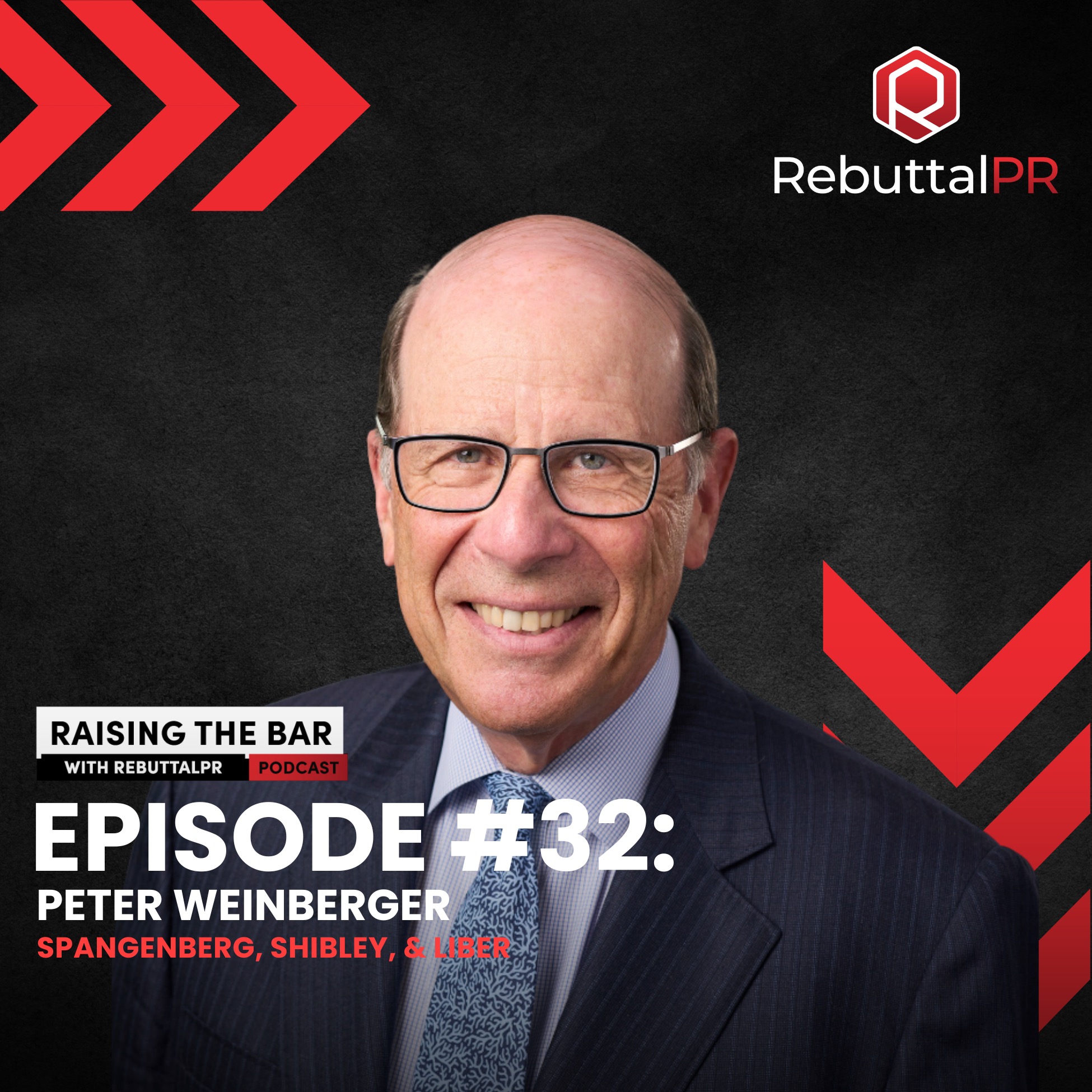
In this episode of Raising the Bar with RebuttalPR, Ray DeLorenzi sits down with Pete Weinberger, partner at Spangenberg Shibley & Liber in Cleveland, Ohio. Pete shares his journey from a criminal defense lawyer to becoming the Plaintiff’s Co-Liaison Counsel in the National Prescription Opiate MDL. From his early days in the courtroom to his leadership in mass torts, Pete opens up about the challenges, the importance of collaboration, and the fight against big pharma. Tune in for a conversation on the future of opioid litigation and Pete’s personal path through the legal world.
Learn More About Pete Weinberger:
https://www.spanglaw.com/our-attorneys/peter-h-weinberger/
Read the transcript
This transcript of Raising the Bar with RebuttalPR was generated using AI transcription and lightly edited for readability. It may contain errors, and speaker labels are approximate. The audio recording is the authoritative version.
Welcome to Raising the Bar with RebuttalPR, the podcast where we elevate the stories of the plaintiff's bar and dive into the key trends shaping the civil justice system today. I'm your host, Ray DeLorenzi, and in each episode, we'll bring you insightful interviews with leading attorneys, expert perspectives on current legal events, and in-depth discussions on the issues that matter most. Now, let's jump in.
The nurse anesthetist textbooks changed, quoted that case, and talked about, you know, what are the fail-safe methods that needed to be used in a situation that you would think was fairly simple. So that's kind of a perfect example of really making a difference way beyond the individual and in our society.
Ray: Hey, everyone, welcome to a new episode of Raising the Bar with RebuttalPR. I'm your host, Ray DeLorenzi, and today I'm honored to be joined by Pete Weinberger of Spangenberg Shibley & Liber in Cleveland, Ohio. While the firm may not be a household name necessarily nationwide, they are a powerhouse in the courtroom, and they have played just an amazing and very influential role in the opioids MDL, which is centralized in Ohio. And Pete has been at the center of that since his very early days. So we're honored to have Pete here. Pete, thanks so much for joining the podcast today.
Pete: Pleasure to be with you, Ray.
Ray: So, Pete, we're going to get into opioids, but I really want to get into how you became a lawyer in the first place. Can you tell me, where did you grow up, and tell me just a little bit about your upbringing?
Pete: So, I'm a Clevelander, born and raised there. Still live there part of the time. I spend most of my time in Naples, Florida. Lucky to be able to do that. And so I went to Syracuse University undergrad and then Case Western Law School. And I had no intention of being a lawyer. But in my third year, my junior year, I took a course from Professor Sawyer, who was a very well-known constitutional law professor. Just fell in love with it. I ended up doing moot court in front of a class of a couple hundred kids. And those were the days, 1971, where the Constitution, just like today, was in the news all the time with the Vietnam War, and Watergate had not yet hit. But it just fascinated me. And so I stopped thinking about becoming a psychologist and started thinking about going to law school.
Ray: Did you grow up with any lawyers in your family?
Pete: No lawyers in my family. My parents both emigrated from Vienna, Austria during the war. I really had no contacts ever before law school with any lawyers. But I knew I didn't want to go into my family business for lots of reasons. And that took me on the road to law school and then ultimately practicing law.
Ray: I feel like there's a, you know, in doing a lot of these interviews, a pipeline from psychology undergrad to being like, yeah, let's go take it to law school. Did any of that psychology stuff influence that decision making, or was it just, you know, psychology also can be sort of a proxy for, I don't know what I'm going to do yet, and I'll just do that for now.
Pete: More the latter than the former, but I have to tell you, even just as an undergraduate with a psych degree, I think it helped me ultimately in the practice of law because, as you know, we represented mostly individuals, and I personally tried medical malpractice and product liability cases, primarily catastrophic injuries. And the emotional component of those cases and how you deal with those clients is very important. And to have a psychology degree, I think, helped a lot.
Ray: So, you go to Case Western Law School. Obviously, with a law degree, you can go a million different paths. Was there a moment where you decided representing individuals who have been injured is the route for me?
Pete: Well, I really wanted just to be a litigator. That's what I sort of focused on in law school to the extent that you could do that. And so I joined a law firm after law school that just allowed me to be in the courtroom, not necessarily representing injured clients. Actually, I spent the first six or seven years carrying the briefcase and trying cases with one of the great criminal trial lawyers, defense lawyers in Cleveland, a guy by the name of James Carnes. He taught me everything there was about voir dire and opening statements and cross-examination. And while I was at that practice, I started to develop an injury practice. There was a lawyer there that did some med mal and some product liability work, and then ultimately in 1988, about 13 years into the practice, I was invited to become a junior partner in the Spangenberg Shibley & Liber law firm. So that was kind of my trajectory.
Ray: The Spangenberg firm, if you're in the know, you're aware, it's sort of a storied inst— not sort of, it is a storied institution in the legal landscape of Ohio. And I think for folks sort of in the know outside of Ohio, it's a powerhouse trial firm with lawyers who go try cases. What was the process of them sort of wooing you to come over? And what was its reputation at the time? Was it what it is today?
Pete: Well, I'd had a measure of success in the other firm that I was with. Tried a number of cases to a successful verdict, particularly in the med mal field. I actually defended a case against a partner in the Spangenberg firm, and that sort of led to the invitation. But the reputation that we have today really stems back 40 or 50 years to Craig Spangenberg, who was one of the founders of AAJ. He traveled the country promoting AAJ and seeking new members. And in doing that, he put on seminars on the practice of law. And he really had a national reputation. And if you go back and look at the stalwarts of ATLA, the National Association of Compensation Attorneys, which was the first name, and then AAJ, you'll see a lot written about and written by Craig Spangenberg.
Ray: Tell me about, if you can recall, your first case where you were lead trial counsel for an injured individual and what that experience was like.
Pete: So probably the one that I remember the most is a malpractice case involving a young child who was going to have his tonsils out, and they decided that they wanted to inject an anesthetic into his calf muscle, believe it or not. And in doing so, injured his calf muscle to the point where they had to remove it. And I tried the case, the father was a police officer, the mother was a schoolteacher, and I tried the case against the most preeminent med-mal defense lawyer in Cleveland at the time and got a successful verdict. And that was sort of the case that made my reputation, or began my reputation, as a medical malpractice lawyer.
Ray: What was it like being responsible for that family and then also for a child and their outcome? I also am curious, and look, it was a different era, but how did that get to trial ultimately? I mean, I know there probably were some factors disputed, but putting an anesthetic into a calf muscle seems insane on its face. What was that experience like, where this family is depending on you for justice for their kid?
Pete: Well, you know, having come from the criminal defense field, you couldn't have a more awesome responsibility in representing a party to litigation than in defending somebody who might lose their liberty with a bad outcome. So I'd already sort of appreciated the importance of the work that we do. What this med mal case did for me was made me understand not only the importance of representing an individual, but also how it is that these cases actually help provide standards for practice and care, particularly in hospitals and by doctors.
I actually, if I can sort of shift and go forward, I had a very interesting case about 20 years ago of an 18-year-old girl who was having a mole removed, believe it or not, on her eyebrow. And she was deathly afraid of the surgery. And so they decided to sedate her. And in sedating her, gave her oxygen by mask and the anesthesia. The anesthesiologist and the surgeon failed to communicate properly. And so, before the surgeon was about to bovie the wound with its electric current, he neglected to tell the anesthesiologist that she should turn off the oxygen. And so, as soon as he bovied the wound, a fire exploded in her face. And we went to trial on the case because the two defendants pointed the finger at each other. But the point of the case was that there was a failure in the operating room to communicate between these two professionals. One assumed the other was going to warn them. The other assumed that he was going to warn her. And so they pointed the finger at each other. Obviously, a pretty easy case to try. But what happened as a result of that, I learned later because of the publicity of that case, the manuals, the nurse anesthetist anesthesia textbooks changed and quoted that case. And talked about what are the fail-safe methods that needed to be used in a situation that you would think was fairly simple. So that's kind of a perfect example of obtaining justice for an individual, but really making a difference way beyond the individual and in our society.
Ray: I know as a lawyer progresses in their career, they can sometimes be a little bit more selective about the cases they try, and giving more junior folks at the firm their own opportunities. But do you think you naturally gravitated towards those types of cases that could create societal change?
Pete: Well, you know, when you're very selective as a law firm, we were never an advertising firm. We didn't do any marketing. All it was was word of mouth and our reputation associated with verdicts and settlements that we obtained. When those sort of catastrophic injury big cases get to you, sometimes the fact patterns are very unusual and maybe novel. You come to appreciate that what you're doing can really make a difference and make things safer in a whole lot of different situations. And so, you know, our firm, you talk about mass tort today. Craig Spangenberg was kind of the father of mass torts, because he took on the thalidomide baby cases back in the 50s and 60s and took on big pharma at a time when our system of justice was not set up with mass torts, MDLs. And when I was in law school, one of my friends worked at the Spangenberg firm, one of my law school colleagues, and I would have lunch with him in the lunchroom at the Spangenberg firm. And on the walls of the firm were lists of cases of young children who were born without limbs because of thalidomide, and where those cases were situated, both in Canada and the United States. And I saw that and said, whoa, this is really important work. And so our firm, working with a firm from Philadelphia, obtained justice for hundreds of thalidomide babies and their families.
Ray: I think it's a good segue into talking about the opioid litigation. Speaking of taking on big pharma, I had heard a rumor, I don't know if it's true, that you were, let's call it semi-retired or close to retirement, or I don't know, foot out the door, maybe is the way to put it, when the opioid MDL sort of came to be. Was that the case?
Pete: Well, you have to talk to my partners as to whether or not they were putting me out the door. But I will say that at the end of 2017, I was stepping down after 17 years as managing partner of the firm and going to of counsel. And I was going to just litigate a few cases that I had on my docket and then kind of ride off into the sunset, or into the sunshine in Naples, Florida. And I got a call from a couple lawyers who said that they had filed on behalf of subdivisions a bunch of cases, and it looked like the case might possibly be centralized before Judge Polster in the Northern District of Ohio. Well, I had just finished a mass tort case about seven or eight years before that, involving the gadolinium-based contrast agent used with MRIs that caused a man-made disease called nephrogenic systemic fibrosis in people that had end-stage renal disease. And these lawyers had heard about the work that I'd done on that case. The case was in front of Judge Polster, and so it was sort of a natural segue into, you know, would you be willing to be involved as liaison counsel? And I talked with my partners, and more importantly, I talked with my wife, and I spoke to Laurie. I said to Laurie, don't worry about it. It'll only be two or three years. It's just like gadolinium. And boy, was I wrong, because here we are eight years later, and I'm still involved, but very proud to have been so.
Ray: What got you to yes?
Pete: What got me to yes was, look, we'd looked at opioid addiction cases individually, and we knew how difficult they were in terms of a cause of action or causation, because it was difficult to trace really where did the addiction really begin? Who was responsible for it? Is the manufacturer responsible, or the physician, or the distributor? But this was kind of a new theory to me, this use of public nuisance. And I talked to some of the leaders, somebody like Paul Farrell and Jayne Conroy and Joe Rice. And I became convinced that this was going to be really important work. Talk about affecting an epidemic, a man-made epidemic that couldn't be solved by either the executive or the legislative branch. And I thought, hmm, it's novel, but I think it's important work that I want to be involved in.
Ray: Can you take a moment for those who may not be knowledgeable about liaison counsel? What does that mean practically from a day-to-day basis? And also, I know that may not necessarily reflect the work you actually did, which, in sort of seeing it up close, you had your hands in everything.
Pete: Well, it's why I told my wife that maybe I wouldn't be so involved. But it's an important job. Usually there's a liaison counsel for the plaintiffs and a liaison counsel for the defendants. And the role of the liaison counsel is to be the spokesperson for the group of lawyers, in this case on the plaintiff's side, with the court and with the liaison on the defense side. It's usually a procedural position, although oftentimes the liaison counsel argues substantive issues before the court. And so that was my initial role. And one I actually enjoyed a lot. Even though I was experienced in mass torts, I had never met many of the lawyers who made up the plaintiff's executive committee. There were 21 law firms and 21 leaders from those firms. I had really never worked with Motley Rice before, or with, I certainly hadn't worked with Paul Farrell. I hadn't worked with Baron & Budd. I had worked with Levin Papantonio in the past. They were kind of the ones that championed me in terms of potentially having a role in the case. So it was a very interesting experience dealing with and kind of ensuring the collaboration of a lot of very well-known and powerful law firms.
Ray: So we pretty much never talk about legal fees on this podcast, but I want to give a sort of anecdote to tee up my next question, which is, there was a sort of a fee panel, and we don't need to go into the details, and the judge, there was ultimately assignments of fees for various plaintiffs' lawyers. I had never seen ever where fellow plaintiffs' lawyers stood up after the order was issued and said, Pete Weinberger actually deserves more based upon his contributions. That is my roundabout way of getting to my next question, which is: how do you earn the trust of all of these incredible mass tort class action lawyers that are on leadership? They may not have ever heard of Pete, although you've got a huge wealth of experience. How did you earn their trust and also become sort of what I feel like is the consigliere to the plaintiff's leadership in the MDL?
Pete: Well, I think it's all in terms of how one performs and what are the results that you get. In other words, when you've got a lot of great lawyers getting together and often, particularly in a novel case, have differences of opinion as to how to strategize and how to handle the case and what things are important to bring before the court and what things are not, setting priorities. I think that the role that I played in the first couple years, in terms of kind of setting those priorities and making sure that people collaborated together once we made the decision, even though some of them might have disagreed with it, and then taking an approach with the court along the lines of what we ultimately decided, I had a big role in that. And then I had to deliver. So when we came up with a strategy and we argued before the court, I had a pretty good batting average. And if I can say so modestly, in fact, people would say that I was able to predict in many instances how the court or the special master would come out. And for me, it wasn't because I had a special in with any of them, it's because I think from my experience, I had a pretty good sense of what was the right way to proceed on a particular issue. And so, as we had success along the way, I think I gained credibility. And then there were decisions made in the summer of 2019 as to who was going to try the first bellwether case against the distributors. And there were a lot of people who wanted to be at the table among 21 great lawyers and their law firms. And it came down to me and Mark Lanier. And we ended up in jury selection against the distributors and then settled the bellwether cases against the distributors at the courthouse door before opening statements in the fall of 2019. And then we went on to prepare the cases against the pharmacies, CVS, Walgreens, Walmart. And Mark and I ended up being that trial team, which we tried. And so that's kind of the long story of how I got from liaison counsel to trial.
Ray: Explain how, like in the early days, just your thought process in terms of organizing a case where you have subdivisions, you have state AGs involved, and then you have dozens of defendants grouped into manufacturers, distributors, pharmacies. How do you get your arms around that without sort of being paralyzed by the organization?
Pete: Well, that's where having 21 law firms and a bench of about 200 lawyers, and the financial wherewithal to fund the cases, was basically the reason why we're able to do that. But to be more specific, we did sort of divide into silos. So we had people working on each individual defendant, a team of lawyers from various law firms working on each individual defendant. And we acted as a law firm. So when you're talking about 21 or 22 defendants and you're looking at respective culpability, at the beginning, you're not sure how that all fits. That's number one. Number two, you're not sure, in a case where there's basically no insurance coverage, what the ability to pay is, even with respect to publicly traded companies. And so, what we agreed upon, and ultimately what we presented before the fee panel, was that it didn't make a difference whether you worked on a case that settled for $100 or settled for $1 billion. If you put in the work, you were entitled to be compensated for that work, because we all believed that the work that we did, that was sort of in silos, was contributing to the whole in a very significant way. And so to be able to do that and organize ourselves in that way, I think fostered the collaborative process that resulted in the success that we had.
Ray: So, you're preparing for what's going to be the first trial, and you're going to try the case with Mark Lanier, who's also done a few trials in his day. I'm curious: what's something in that process of working with him that you learned from him, and something that he learned from you, if you could sort of put yourself in his shoes?
Pete: So, you know, Mark is well known for only trying the case by himself, or maybe with one of his colleagues. In this particular case, it was his daughter Rachel. And his philosophy is that there should be only one person on the plaintiff's side talking to the jury. But Mark has been involved in a lot of different cases outside of opioids. And so he came to rely on me, because this is the only case I was working on, to really educate him on what discovery had revealed, and to synthesize it for him and summarize it for him and assist him as he was preparing. And then, the more he saw some of my deposition work and some of my work in trial, I guess he came to trust me. And he says, you're going to try this case with me. You're going to do the voir dire, you're going to handle some of the important witnesses. And we debated as to whether we would divide up opening and closing. And I was seeing him at work for the first time, and I saw the connection he had with the jury. And I said, no, Mark, you're going to do the opening and you're going to do the closing.
To the basic issue raised by your question, let me say this. I just finished 50 years of the practice of law. I think I'm a pretty good trial lawyer. Most of what I do as a trial lawyer sort of comes natural for me. I try to be myself all the time, but I have stolen from some of the greats along the way. Going back to Craig Spangenberg and Mo Levine and Stanley Preiser, when I was a young lawyer, and then some great lawyers in Cleveland: Marshall Nurenberg, Freddie Wiseman, and of course my senior partners in our firm, Craig Spangenberg and Don Tracy and John Lancione. And it was no different in working with Mark. I saw techniques that he used that I had never seen before. His ability to create visuals in the courtroom using an Elmo and creating along the way, of the witnesses' testimony, I just thought was incredibly powerful. And so I started to do it. And believe me, it's not easy. And so I would be preparing for a cross of, let's just say, a board of pharmacy investigator who was problematic in his discovery deposition, and who the defendants had called to show that their pharmacy had passed state inspection. And so I knew that I wanted to create a visual of everything that he didn't do, and had a whole laundry list of things that he didn't do and listed them on a couple sheets of paper, with true or false next to, you know, you didn't do this, correct? True or false? Your inspection didn't include this, right? True or false? And did that cross in court. And I think it was very effective. But I'll tell you, I worked until 3:00 in the morning the night before on a cross that normally would take me maybe an hour to prepare, took me the better part of six or seven hours to get it right. So even after practicing at that time, you know, 47 or 48 years, I was still learning how to persuade, and Mark was, and is of course, one of the great, great teachers in that regard.
Ray: So the case settles on the courthouse steps, going back to the first trial after all that prep. What's your reaction in the moment?
Pete: You know, first of all, it was just the two bellwether counties. And so that concerned me, even though there was a premium paid for Cuyahoga and Summit County by the three distributors. But I was hoping that that would stimulate a global resolution. I was still very disappointed that we couldn't try the case. I got that opportunity in the fall of 2021. It certainly is the pinnacle of my career. It was a liability-only case. Then we went to a second phase for abatement. It was seven weeks of trial. It was being with Mark in the courtroom every day and every evening. We developed a very close relationship. It was a huge, wonderful and fulfilling experience.
And I'll just tell you one anecdote. Lawyers, of course, love to talk about their trials. During voir dire, which was an individual voir dire done by Judge Polster in chambers, one of the prospective jurors was a social studies teacher, a government teacher, in a little suburb town of Cleveland known as Chagrin Falls, which happens to be adjacent to the town that I live and grew up in. So I knew a little bit about Chagrin Falls, and during the voir dire, talked about the fact how, when I was at Orange High School, next to Chagrin Falls, I was a basketball player and used to love going to Chagrin Falls because we always were able to beat them. And so she was also a coach, and we developed a little bit of rapport because of that. But anyway, she ends up on the jury, and the jury deliberated for six days. And during the course of deliberation, you get a sense of who the foreman was because they're issuing questions to the court. And I had predicted that she was going to be the foreman. And when the verdict came back after six days of deliberations, we debriefed the jury and we asked them, what took you so long to find liability, just liability for the public nuisance involving the three defendants? And they told us that the foreperson, the Chagrin Falls schoolteacher, operated like a classroom, went through the jury instructions, put up huge sheets of paper, wrote the jury instructions, and they went through each one individually, all the elements of liability and causation, as to each of the three defendants. And it took them six days to do that. Pretty remarkable. By the way, that jury, I can't speak to today, but at least for a year, as they followed what happened in the second phase, they would meet for dinner every couple of months. Now, not all twelve jurors meet for lunch or dinner every time, but they realized the importance of the case and they continued to follow it. They communicated with us and they told us that they loved what they did, and they cherished the relationships that they made in the case, and they continued to socialize with each other for a couple years after the verdict.
Ray: So, Pete, to close, you've been very generous with your time. What is next for you? You are still obviously, I'd say semi or totally immersed in the opioid litigation, and there are still many tentacles that are left. Do you have any thoughts about trying other types of cases at this point in your career? Or are you going to see the opioids through, and that's that?
Pete: Well, I just turned 75 on November 15th. Have come to realize that the energy that I had at age 71 to try the case is sort of dissipating. And so I remain active in the cases that are still pending, particularly the ones against the two pharmacy benefit managers. I'm working on some settlements involving the remnant defendants that are still out there. I'm still doing my work as liaison counsel, but I'm stepping away from the litigation part of this case, and rightly so. This is a much younger person's game in terms of the energy necessary to try the case. And as much as I'd love to be back in the courtroom to try the PBM case, it's not going to be me.
Ray: Yeah. You've deserved it. Pete Weinberger of Spangenberg Shibley & Liber. Thanks so much for the time. Really appreciate your perspective and sharing your thoughts today.
Pete: Thanks, Ray. Really appreciate it too.
Thanks for listening to this episode of Raising the Bar with RebuttalPR. Don't forget to subscribe and follow to join us next time. See you then.
Related episodes
- Richard Ruohonen on Winning Trials, the Olympics, and Speaking Out When It Matters
- Josh Koskoff on Defying the Odds in High-Profile Trials
- Khaldoun Baghdadi on Finding Purpose in the Courtroom
Learn how RebuttalPR manages communications for landmark trials that change systems.
Discover Insights & Trends
Featured Stories

- October 13th, 2026
- 5 minutes
- Ray DeLorenzi
What AI Actually Cites When Someone Asks for a Recommendation


- October 7th, 2026
- 5 minutes
- Ray DeLorenzi
The People Using AI to Find Lawyers Are Not Who You Would Guess