
- September 21st, 2026
- 5 minutes
- Ryan Litner
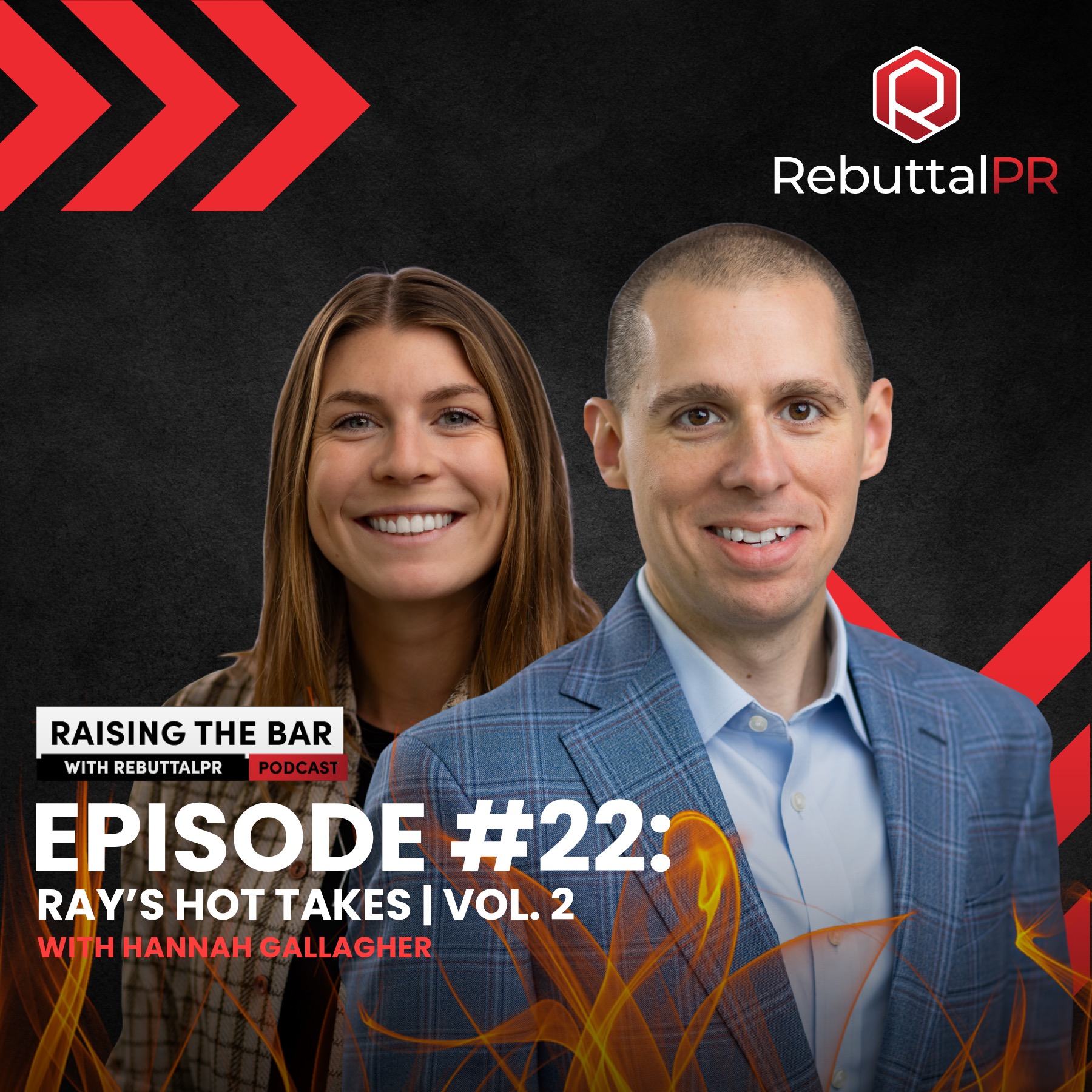
Episode 22 of Raising the Bar with RebuttalPR dives into the headlines—literally. RebuttalPR founder Ray DeLorenzi joins host Hannah Gallagher to share candid takes on where people are actually getting their news today, what counts as “mainstream media,” and why law firms need to understand both local and digital audiences to stay relevant.
Ray breaks down why saying “no comment” almost always backfires, how to engage with reporters the right way, and why press release newswires are little more than a money bonfire for law firms. The two also discuss when a firm should take a public stance on political issues, how to maintain consistency across firm social media, and how AI tools can support—not replace—authentic communication.
From pitching journalists to surviving the algorithm, this episode is a roadmap for any lawyer looking to build visibility and trust in a noisy media landscape.
Want to learn more about Ray and the RebuttalPR team? Visit www.rebuttalpr.com
Read the transcript
This transcript of Raising the Bar with RebuttalPR was generated using AI transcription and lightly edited for readability. It may contain errors, and speaker labels are approximate. The audio recording is the authoritative version.
Welcome to Raising the Bar with RebuttalPR, the podcast where we elevate the stories of the plaintiff's bar and dive into the key trends shaping the civil justice system today. I'm your host, Ray DeLorenzi, and in each episode, we'll bring you insightful interviews with leading attorneys, expert perspectives on current legal events, and in-depth discussions on the issues that matter most. Now, let's jump in.
Let's say you have a couple thousand dollars in cash and you were going to set it on fire anyway. Maybe you just use it to purchase something for a newswire. That is, I think, a useful utility. Kidding aside, that's really it. It is such a waste of money.
Ray: Hey, everyone. Welcome to a new episode of Raising the Bar with RebuttalPR. I'm your host, Ray DeLorenzi, and we're back for another hot takes episode with my co-host, or my replacement host, Hannah Gallagher. Hannah, great to see you again. Great to have you back.
Hannah: You too, thanks. I love it — podcast co-host of the year, I think, and a winner.
Ray: You may be, at least for this one, because you've been our only co-host. And the hot takes podcast we did before was incredibly popular. I think maybe it was due to my takes, or maybe it was due to your hosting abilities, but anyway, we're going to do another one. Hannah, I guess you just want to take it away. You want to let her rip? What do you got for me today?
Hannah: Love it. I've got lots of questions, both from our internal team and externally — some questions that we often get. I think the first one we should start with is the state of the media and where people are getting their news. I know we talked about it a bit last time, but where exactly are people getting their news now? I know you said there are lots of sources, but how do you determine where young people, middle-aged people — depending on the age or the demographics — who's reading news where, and what do you think is important?
Ray: That's a massive question. And I think you just did that to spin me up a bit. First, when people say "get news," what does news mean? It really is: where do people get information? And there are more places than ever for people to get information. You can call it news, you can call it whatever you want. People are like, oh, I don't trust journalists. But they are getting their information from them constantly. It just depends on the vehicle in which they get it. At the end of the day, you need to be everywhere and be ubiquitous if you're a law firm owner.
What I would start with, though, is: where do I need to be? Who's your audience? And then where is your audience getting their information? That is what I think you need to start with and solve for. People are like, oh, mainstream media is dead — what is it? I don't even know what that is anymore. And you look at the national nightly news, it still gets several million people watching it. That's not insignificant. Local news still gets big numbers. A lot of people like to talk about CNN and say, oh, I want to be on CNN. CNN, at some hours, is a lot fewer people than local news. And people get their information on their phones going to local news websites.
Some people are like, oh, people get their news from TikTok today. That is true, but where do those TikTok influencers get the topic that they want to discuss? They get it from more traditional news outlets. So I think one of the big themes is it's sort of choose your own adventure. People decide where they want to get their information from, and all that information is then filtered through that specific person's lens. Let's say people in more conservative circles want to listen to Steve Bannon's podcast, or more liberal people want to do the Pod Save America crew or Rachel Maddow. People get their information through an echo chamber that supports their views and position. But I would not undersell or understate the influence of your local TV station, your local newspaper, or even national news. While they may have huge economic challenges, they still have massive audiences of people that you can reach.
Hannah: Do you have anything that you read daily that you would suggest to people? What do you read?
Ray: What I read daily — again, most of the folks listening to this are lawyers and in the plaintiff's bar, so maybe our media diet should be sort of similar. I read the New York Times top headlines every day. It is the paper of record still. A couple million people read it. I feel like it's important. Law360 I check out every day, and I see their headlines of what's happening in the legal community, and same thing for Law.com. Then I get a variety of newsletters that give me a good media diet of what's happening in politics, which often intersects with the litigation work we do, because there's a political, litigation, regulatory kind of intersection, and that's the world we operate in.
So Politico Playbook I read in the mornings. I also read Political Wire, which is a daily newsletter that throughout the day has key headlines, so I don't have to immerse myself in Twitter, which is a hellscape — I can just get the key headlines of what's happening in the news. And then, obviously, through the work we do for law firms, we have news coming in all the time through Slack and different systems we've set up, and I read all that. My wife jokes, when's the last time you read a book? And I said, you know, it's been a while, but I read all day, every day, whether it's the news or legal filings or things like that. Then I have some Substack folks I follow — and most of those folks are people I agree with, so they're just restating my opinions. And then I have some podcasts I listen to as well. I don't know how unique that is.
And Hannah, I know you're big on podcasts — podcasts kind of shape how I take things in. I listen to my set of podcasts every morning on my walk with my dog, and that steers me in different directions. If I hear something interesting and want to go a little deeper, see who else has reported on it, that gives me an agenda of what news I want to read. Because otherwise I get overwhelmed — I'm sure other people do too — with the amount of news there is. I know it's our job, but there's so much, all the time. And I think podcasts do a really good job of consolidating that and giving me a direction to go. So that's how I do it in the morning.
Hannah: But are your podcasts timely?
Ray: Yeah, mostly. I mean, I listen to NPR's daily news dump, I listen to The Daily — the classic ones. And sometimes you can tell an interview has been recorded weeks in advance, so they're a little delayed on breaking news, but sometimes that leads me to more long-form stuff — who's doing an investigation on a plant somewhere, or what reporters are spending months investigating in some area and the problems going on there. So it varies, but I feel like it leads me down the right path. Most of my podcasts are not timely — they're more long-form, evergreen, feature-y sort of stuff. And for the timely stuff, I'm getting it on my phone in real time. Because in the world we operate in, timeliness is everything. If I don't read it then, it's like, oh, I got to this podcast three days after the news — what difference did it make?
Hannah: Well, that leads me to — obviously, we work in the legal world and legal news. Something we talk about a lot is how "no comment" is always, or most of the time, a bad response. Why don't you think lawyers use the media more often? Why do lawyers say no comment? Why is that the gut reaction lawyers think they should have when asked to comment on a case? What should they do instead?
Ray: We are experts on how to interact and interface with the media, and we know quite a bit about the legal world. We're not lawyers, but we know enough to be more than dangerous. Lawyers, on the other hand, know how to practice law. They have a bar license, they went to law school, and they don't know how to interact with the media. I think some have preconceived notions of how to do it, and that leads them to misunderstand what they can do. I think lawyers may not appreciate the importance of interfacing with the media in terms of having that trust and credibility and third-party validation. It depends on the type of work you're doing, but if you're working on big cases that are attracting media attention, I think it's a mistake to not be engaged there.
We've talked about this before — saying no comment strikes me most of the time as ridiculous. If, for example, you filed a lawsuit, there are allegations you made in the complaint that are now public record, and you can literally repeat those as your comment. You don't say no comment. And instead of saying no comment — let's say there was a situation, and again, they are extremely rare — you could just say nothing. Saying no comment shows you have something to hide, and it's never a good look. So why don't lawyers engage with the media? I think it's a matter of not having the time, not having the expertise, and also being a bit fearful that they're going to get caught in a gotcha, when in fact there's really no gotcha to be had. There's just an innate skepticism that's only grown over time. And I hate to say it, because it's obviously self-serving, but that's why they need experts like us. I think the media should be used as a vehicle to get the truth out and to get your perspective out. Particularly the work we do in the plaintiff's bar — we like to believe, and I believe, that we have the truth on our side. So why wouldn't you want to make sure that truth is getting out to the people who need to know about it?
Hannah: Yeah, I agree. If we tell the stories properly, then I don't think there's much harm to be done. But there is also a skill to it, and to making sure you frame it properly.
Ray: Yeah. And you've got to know — look, there are always risks. Life is full of risks, but you have to know how to calculate them and how to mitigate them. We never want to do anything that could hurt the litigation, but there are many ways to navigate that. And look, the corporate defendants are using the media all the time to make sure their perspective is getting out there. They're polluting the science and polluting the jury pool. If you just want to stand by and let that happen, I think that is, many times, a dangerous place to be.
Hannah: Yeah, that standing by and letting things happen. Something I've been thinking about a lot is how law firms should be talking about political issues — or if they should be. I know a lot of law firms who feel like they're under threat right now. There's a lot of political drama going on. Should lawyers respond to political issues? Do you have an opinion on how they show their public stance on an issue? How do they go about that if they feel really strongly about a topic?
Ray: It's not a yes or no answer, but it's one that, again, involves risks that you need to calculate and be comfortable with. I don't think firms should take positions that are not true to their values — that's essentially taking a position for the sake of taking a position. If they are a law firm where there is a political issue that does intersect with their values — let's say the easiest example, you're a personal injury firm and they're looking to pass horrific tort reform in your state that is going to destroy the legal rights of the people you represent — that seems like something you should take a stance on, within your values. On the flip side, understand that maybe in that state it's Republicans who are really pushing that, and there are Republicans who can get injured too, and maybe they'll have an allergy to you taking a position on it. That seems to me a risk that is calculable and worth taking.
But let's say we're talking about an issue like immigration, and let's say your firm is in an area or a practice area that does not represent an immigrant community. That is a harder call. There are firms who say, you know what, what is happening related to the immigrant community is against our values, and we're going to speak up about it. And I salute them, but they should do so knowing that there could be business consequences. There could be positive consequences — maybe there are clients out there who say, I want a firm that is going to fight for people like that, for people who are not in a position of privilege. And then there could be people who say, you know what, I'm with this administration and its deportation agenda, and now I'm not going to give my business to this law firm. As long as you know the risks, and you're doing things that are true to your values and don't feel out of step, I am generally supportive of it. But you've just got to know what the landscape is and understand the pros and cons of doing so.
Hannah: Yeah. I mean, sometimes you have to realize it's not going to please everyone. You're a lawyer who's litigating against big companies that are going to have their own political stances. Not everybody's going to like what you do all the time, but you kind of hope — going along with your values — that you please the right people, and it's all right if you upset some other people.
Ray: Yeah. There's something to be said about a law firm that has a perspective and stands for something. You can look at — let's take the big law firms that settled with the Trump administration early on. And you can say we're coming at this from the cheap seats, we didn't know what threats they felt in the internal machinations, but we do know there are clients of those firms who left. They said, you know what, if you can't stand up to them, how are you going to stand up for us? So business consequences can happen, pro and con, and some of them can also be unforeseen.
Hannah: Yeah, definitely. All right, a bit of a pivot — but something I know you have strong feelings about. We talked about it a little last time.
Ray: What don't I have strong feelings about, Hannah?
Hannah: I know, I like it — I like the strong feelings. So, putting a press release on a news wire. I don't love this, and I see it all the time, and it costs thousands of dollars, and I don't think people really recognize that. How do you feel about news wires? Is there ever a time to use a news wire? When is that time?
Ray: Yeah, that time. Let's say you have a couple thousand dollars in cash and you were going to set it on fire anyway. Maybe you just use it to purchase something for a newswire. That is, I think, a useful utility. Kidding aside, that's really it. It is such a waste of money. Here's where it's actually needed these days: if you're a publicly traded company, you often, from a regulatory and securities standpoint, have to put certain news out on a news wire.
Aside from that, if you're a plaintiff law firm — the folks we work with — there is pretty much zero reason to be paying for PR Newswire, Business Wire, and a couple of others out there. It is a complete waste of money. Honestly, when I see law firms use it, it tells me they don't know how to engage with the media and they just think that is the way to do it. Reporters do not view these things, ever. They hear from people who reach out to them directly. So a newswire — it just boggles my mind why you would use it or think it is useful. Now, many years ago, it was kind of an SEO gimmick. People would do it on PR Newswire, and then if you searched for a term that was in that press release, it would come up at the top of Google results. Google has since devalued Business Wire and PR Newswire, so that does not work anymore. It was really not a good idea beforehand, because it was like a sugar high that didn't last very long, but now it's also worthless from that perspective.
Again, sometimes in class actions you have to put a press release on the wire for class notice — that's a different ball of wax, but you're not reaching anyone. And what drives me completely nuts is you'll see the reports that get generated: oh, your press release was on 2,000 websites, it was on Yahoo Finance and whatever. Do you know how many people read that? Nobody. Literally nobody. When's the last time you clicked on a Yahoo Finance result? I don't know if I have since I was a kid. The only times are when I'm researching something and I'm like, oh, look, I found this press release from three years ago that someone put out. It is a complete waste of money. That is not news. This is not news.
Hannah: I know you talked to Alison Frankel a couple months ago at this point, and she talked about pitches — receiving pitches and receiving information. Can you speak a little to how you do it? If you're not going to use a news wire, how do you get the information to the reporters? I know we do it a lot, but I don't think other people really know that there's a way to get to reporters otherwise.
Ray: Yeah. First, you have to have an interesting story to tell. Very often it's both sides. One is they think they have the most interesting story in the world, and quite honestly it's not that interesting — or there's something about it that actually makes it interesting, and it's not what they think it is. Then you have the other side of the coin, where attorneys don't realize how interesting some of the work they're doing is — the complaint they're filing has really interesting allegations and they don't appreciate that. So first and foremost, what's the story?
Second is you have to find the reporter who will find that story interesting and compelling, and that's what they report on from a day-to-day basis. You mentioned Alison Frankel, who was on our podcast several months ago — she used to be the legal reporter for Reuters. If you were filing a lawsuit related to a motor vehicle accident in Sheboygan — not that it's not important — she's not going to report on that unless it had some broader legal implication, whatever that may be. So you have to find the right reporter. And third, you've got to get their attention quickly. It's helpful if you have a relationship with them, so they see your name in their inbox and think, you know what, they've given me useful, interesting information before. But if you've been someone who's emailed them 20 times with garbage, well, you're going to go right to their trash before they even open it. Oftentimes they just see the subject line, so make sure the subject line stands out — not with exclamation points or sensationalist garbage, but get to the point quickly.
And in the email, get to the point quickly, and then back up what you're saying. Don't say this is the craziest case, this is the greatest case. Tell it like it is, take excerpts from the filing, attach the stuff, lay it out there, and then let them make a determination. That is the way to do it. Figure out what the story is, who the best person is to tell that story, and then be succinct and to the point and back up your facts with source documents when you can. That's just to start, but that would be my initial take on how you get in front of the right reporter. We had somebody ask if they should include an emoji in a subject line, and I thought that was just wild. Are we selling something illegal through our emails? I don't know what an emoji in the subject line would do, but if I see one, I just delete the email — I assume someone's trying to sell me some weight loss product or something. When would that be taken seriously? I have no idea.
But the other thing is this idea about telling the story, and I think attorneys don't appreciate this — and I understand it, because they actually have to practice law, and the media should not be their number one focus; I think it's dangerous if it is. But timeliness. It's very difficult to be pitching a story that involves a complaint you filed three months ago, unless it has some brand new thing in there that wasn't reported on previously. Timeliness is everything, especially now — the news cycle moves so fast, there are cycles within cycles. You need to prepare and premeditate these things and then act on it in real time. You can't be waiting days; it's too old by then, and no one's going to care.
Hannah: Yeah. The only time I'd see waiting, or something to keep in mind for lawyers, is when you see a pattern within your cases. That's something we talk about a lot — when there are a lot of cases about a similar issue, or you're seeing the same defendant have a pattern of conduct that you think is outrageous and you continue to have cases against them. That's the point where some sort of investigative reporter can dive really deep into that subject and find the right thread to pull, and figure out what exactly is going on in a corporation or a defendant that is having ongoing issues. But I would agree, you've got to jump on the news.
Ray: Yeah, you raise a really good point for those long-term feature stories. Yes, you can piece that stuff together over time. But if it's a complaint about a current event, you've got to get that in real time.
Hannah: Yeah, that makes sense. Okay, a little bit of a hop. So last time we talked about social media — what's good to put on social media, how lawyers should use it, whether TikTok is cringey, which I think we decided, yes, it's a little cringey. But what about firm accounts? What should firms be posting about — not individual lawyers — to make their firms interesting, and what exactly should they be putting on their firm accounts?
Ray: Yeah, so you've got to figure out what the platform is first, and it also depends on the type of litigation you do. If you're doing sort of run-of-the-mill personal injury, I think your firm Facebook page needs to be kept fresh, and I think LinkedIn is also really important. Now, if you're doing, let's say, antitrust work, Facebook is not important — I would actually advise not to be on Facebook, for several reasons — but LinkedIn is really important for the firm page.
Here's what I think, for the most part: if you're going to have a Facebook page or a LinkedIn page, you need to commit to it and keep it continually watered and taken care of, with a couple of posts a week. Otherwise, you're sending a signal to prospective clients — and also to hires — that nobody's manning the store, nobody's home. Can I trust these people with this case? You may say, it's only my social media, who cares? Well, you could have a potential client whose only reference point is your social media, and they may not trust you if you're not there. So you have to think about it from that person's perspective. At the same time, if I was looking to hire a lawyer and they had a Facebook page with bizarre stuff on it, I wouldn't want to trust them either. So you have to figure out what the content is, what the cadence is, and whether you should be there in the first place. If you're not going to commit to it, you shouldn't really be there at all.
So, Facebook — again, it really depends on the type of firm you are. But if you're doing PI work, I think you need to be on Facebook with a few posts a week to show that it's live, and that should complement any paid strategy you're doing. LinkedIn is important because of referral sources and also new hires — they're going to look at you on LinkedIn, so being active there is really important. The one other important caveat is that on LinkedIn, especially those company pages, even if someone's following you, those posts don't come up in people's feeds very often — someone's got to go to your firm page to see them. What LinkedIn really puts in the algorithm is people. And that's also how we relate to each other — I don't relate to a firm, I relate to a lawyer at the firm. So having your lawyers engaged on LinkedIn, posting content on a semi-regular basis, having smart things to say, again sends a signal to potential hires and referral sources. Even a more sophisticated client is going to look you up on LinkedIn. I think those are important places to be.
Hannah: Yeah, I would agree. I use LinkedIn regularly to keep up with people, and I get some interesting content on there from people I don't even follow — I think their algorithm is pretty good at figuring out what I'm interested in. So that's still a good spot. One thing on LinkedIn that I've seen quite often is firms who seem to be a little lazy about their social media and maybe just rely on AI to write their content. I know we've been talking about AI a lot in our firm, and what we do and how it can help us. Can you talk a little about how AI could be helpful for law firms, or more broadly about how AI could be used or should be used?
Ray: Yeah. Look, we use it for our company's LinkedIn content, and I use it for some of my own LinkedIn content, but I use it carefully, because people are not stupid — you can sniff this AI stuff out from a mile away. And what does that tell people when they see it? That you're just using AI. Do you not have an original thought? Are you lazy? Can I trust you? So here's how I use it, and how we help law firms use it. It's great to brainstorm ideas — hey, here are some things we care about, what are some social media themes? You can use it as a brainstorm partner, and I think it's very useful. If you have it write the content, I think it's pretty bad.
What we've done, at least for our firm, is we've made our own GPT that trains on our voice and creates content. And even then, I'd say half of it's bad and we have to rewrite or rework it. But it provides a really good brainstorming partner to come up with ideas, because, again, the cadence is important — you need to be posting regularly, and sometimes it's like, what am I going to post about today? Having AI churn out some stuff, particularly the images — they've gotten better, but you still see pictures where people have seven fingers on their hands, and it's like, that doesn't look right. Again, what are you doing? People gravitate to interesting stories about people. You don't need to cut corners on this stuff. Just do it right.
Hannah: Yeah. You know, I'm super hesitant — I feel like an old person when I say I'm super hesitant to use AI, but I am, and I understand lawyers especially who don't want to use it or feel like it's a scary new tool. Do you have anything you'd say to a lawyer who's super resistant, like, oh, try it out? Or what would you tell them? Or would you say, it's all right, you don't need to use it?
Ray: You know what? Again, in this case, I actually applaud a lawyer who's hesitant about it. We've seen too many lawyers writing legal briefs with AI, and despite getting caught and getting excoriated by judges and then being in the media for it, lawyers just continue to do it. What is it going to take for the lesson to be learned? That is a completely terrible idea. But I do think there needs to be an education about what it is good for. It's good for brainstorming ideas. I use it sometimes — if I'm going to be writing an email and I write it and think, you know what, that needs to be taken down a touch, it's a little too hot — I'll ask it to rewrite it and tone it down. It's pretty good at that sometimes, not all the time. And I still review it, and I'm still putting my name on it. But people should experiment. It's worth experimenting. That's a great lesson about life: you experiment and you try things out. You don't actually have to use it. But for the love of Pete, do not write a legal brief with it. This happens like once a week now — we're seeing a story about someone doing this and getting crushed.
Hannah: Yeah. It'll have 100 em dashes in it, words nobody ever uses, and weird formats and citations — it's just like, what are you doing?
Ray: Let's avoid that. But again, I think experimenting — and these tools are just getting better and better. Maybe they'll have good judgment eventually; they have bad judgment now, and that's because they're machines, they don't understand everything involved. But oftentimes I use it to talk through problems. I'm like, hey, I have this problem, how would you think through it? And it gives me some interesting ideas. It never gives me the answer 100%, but it gets the ball rolling, and that can be really helpful.
Hannah: Yeah, that's good to think about. All right, well, I think that's all of our hot topic questions today. Do you have any other hot topics you want to cover?
Ray: I always do, Hannah, but no — you brought the thunder today. Thanks for really getting me revved up. I need to take an antacid or something, go for a walk. Well, everyone, thanks for tuning in to another episode of Raising the Bar with RebuttalPR. Hannah Gallagher, our host for today — thanks so much for pitching in and doing a great job.
Thanks for listening to this episode of Raising the Bar with RebuttalPR. Don't forget to subscribe and follow to join us next time. See you then.
Discover Insights & Trends
Featured Stories

- September 4th, 2026
- 4 minutes
- Melissa LoPiccolo
How to Vet a PR Firm: 8 Questions to Ask Before the Contract is Signed

- August 21st, 2026
- 4 minutes
- Stephanie Wolf
Aligning Your Benefits with Your Values: Parental Leave Edition