- October 19th, 2026
- 4 minutes
- Jillian DeSimone
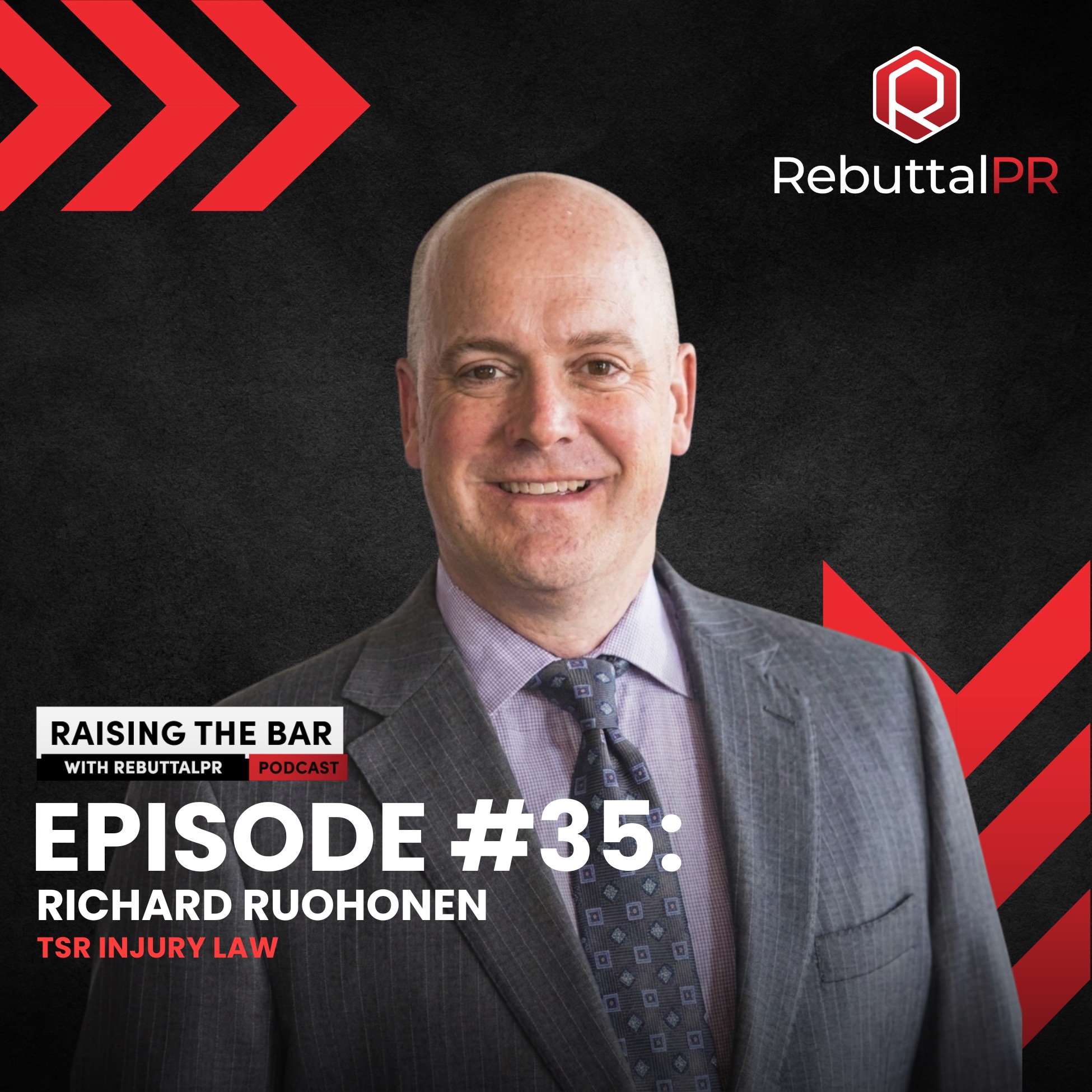
In this episode of Raising the Bar with RebuttalPR, host Ray DeLorenzi sits down with Rich Ruohonen, a partner at TSR Injury Law in Bloomington, Minnesota, whose career spans nearly three decades of plaintiff’s work in traumatic brain injury, car accidents, product liability, and premises liability cases.
The conversation digs deep into what Rich calls the parallels between being a competitive athlete and being a trial lawyer — from his firm’s “Fight Club” practice sessions for opening statements, to the sports psychology principles he applies in the courtroom, to the mental resilience required to push through week-long trials on four hours of sleep. Rich has tried roughly 90 cases and has not lost one since around 2011 or 2012, a streak that now stands at 27 consecutive wins heading into 2026.
Rich also shares the story behind his Olympic journey — eight failed bids before coming out of retirement at 55 to help a younger team through injuries, winning the Olympic trials, and then traveling to Milan–Cortina as the oldest American Winter Olympian in history, breaking a 94-year-old record. He describes what it felt like to finally stand in that arena with his family watching, and why the experience was the greatest moment of his life.
The episode closes with Rich’s account of speaking out at his Olympic press conference about ICE operations in Minnesota — a decision he made deliberately, knowing there would be death threats and backlash from the administration. He explains why he believes lawyers have an obligation to speak when the rule of law is being violated, and why free speech isn’t free if it stays in the locker room.
Read the transcript
This transcript of Raising the Bar with RebuttalPR was generated using AI transcription and lightly edited for readability. It may contain errors, and speaker labels are approximate. The audio recording is the authoritative version.
Welcome to Raising the Bar with RebuttalPR, the podcast where we elevate the stories of the plaintiff's bar and dive into the key trends shaping the civil justice system today. I'm your host, Ray DeLorenzi, and in each episode, we'll bring you insightful interviews with leading attorneys, expert perspectives on current legal events, and in-depth discussions on the issues that matter most. Now, let's jump in.
Part of that competitive spirit in being an athlete makes me want to bring in the most from my firm every year. And if I have to work harder to do it, I'll do it. If I want to do this, I've got to be able to work hard too and show people that I'm willing to have the fun of curling, but also take my job seriously.
Ray: Hey, everyone. Welcome to a new episode of Raising the Bar with RebuttalPR. I'm your host, Ray DeLorenzi. Today I'm honored to be joined by Richard Ruohonen of TSR Injury Law in Bloomington, Minnesota. Rich has been a practicing plaintiff's lawyer for nearly three decades, focusing on traumatic brain injury, car accident, product liability, and premises liability cases, with an unbelievable success rate at trial — an over 80% success rate, and going into 2026 he had won 27 consecutive trials. We're going to talk about that, but we're also going to talk about Rich's other career, in which he is a professional curler and just is back from representing the United States on the men's curling team in Milan Cortina. He was the oldest American to ever compete at the Winter Olympics, breaking a 94-year-old record. So, with that, Richard Ruohonen, thank you so much for joining the podcast today.
Richard: Yeah, thanks for having me.
Ray: So, Rich, we start these the same way, getting to know the person behind the lawyer and how you got into the law field. Of course, we're going to have to talk about the Olympics, but tell me — growing up in Minnesota, what was that like, and what led you to a career in the law?
Richard: You know, nobody in my family had ever been in the law. My dad was a teacher, my mom worked in insurance. So it wasn't a family thing at all. I used to get a hard time from my parents saying I could win every argument and I should be a lawyer, and it was kind of a joke in our family. And then, frankly, once I got into college — I went to Hamline University undergrad, which is also a law school — I think just kind of hanging around there, you have a lot of things going on on campus that deal with law and things like that, and I think it just sort of cultivated this idea that I wanted to help people. At first I felt like I'd love to be a sports agent, and you've got to be a lawyer to be a sports agent. Then I realized how tough it was to crack into that field, just because I'm a big sports guy. It's nuts. And then I just thought, you know what, I'm going to give it a whirl, go to law school. I went right from undergrad to law school at Hamline. They have a six-year program, but I took the seven-year deal just so I could finish undergrad rather than do three and three.
I just got into it, and I happened to clerk for a personal injury firm in law school. I really liked the field. I liked how they helped people. I'm sort of that kind of guy — the caretaker of the family, dealing with all the issues you've got to deal with. So it became kind of a natural fit for me. I got a job working with a personal injury firm then called Pritzker & Associates, and I became a partner there, and it became Pritzker & Ruohonen. And then in 2009, I went to TSR. We made TSR Injury Law — I joined two of my friends at the time, Terry and Slane, and it became TSR Injury Law. So that's kind of how it went. I've only been in two firms my entire life, and I've been here since 2009, so almost 17 years.
Ray: So you mentioned you're a bit of a sports nut, and I understand you picked up curling at age 10. Before getting to curling — I know a little bit about Minnesota, it's my second home, and a lot of kids grow up on the ice — was curling the first sport you got deeply involved in, or were you playing ice hockey, doing soccer, baseball, anything else? Or was curling what you got put into by your father, I understand?
Richard: Yeah, I played basketball at a young age, and it was kind of during the curling season too, in the winter here in Minnesota, so I was split between the two. I didn't really get into more competitive curling until a little bit later. I played football for a few years too, until I think my sophomore year in high school. And then I played tennis all the way through high school and into my first year in college. So curling — there was a bit of a time battle when you're playing basketball too. But then when I stopped playing basketball, I got into curling more in my late teens, I would say, and then started playing more competitively when I got into college. But still, you're going to college full-time — it's tough to be the kind of curler I was for the last 25 years, you know what I mean? You only have enough time, and you can only miss so many classes.
So I got into it pretty heavily in my college years, and then law school was a little tough to be a competitive curler, so I took a step back for a bit. I graduated from law school in '96 and went to really my first men's national championship in 1998, and then went at it hard after around 2000, started playing pretty hardcore — a lot more time away from home and traveling. Although it was different. Curling's kind of changed over the years. It's a way bigger time commitment to be one of the best teams in the world now than it was then, because now people are specializing as professional curlers, as there is in every sport. So it's a lot tougher now to play at that level.
Ray: So going back 30 years ago, you have this itch to take your curling to the next level and be a professional, but I assume at the time — and maybe still today — it wasn't like, I don't need a job, I can just be a curler and pay the bills. I assume that was very difficult. And also, you've got to pass the bar and be a lawyer. How did you balance those things, and what did that look like in actuality?
Richard: Yeah, it's hard. I'm not going to lie, I don't sleep a lot to play at this level. Back then it was a little less of a commitment. We'd just go throw rocks — that's practice, we call it throwing rocks. We practiced as much as we could, but we didn't have the other stuff. There wasn't as much of the training, the weightlifting; the sports psychology piece was non-existent back then. And the meetings you had to have — you just got four guys, hopefully, that lived kind of close, and you'd go six weekends a year and then qualify for nationals. And if you win it, you get to go to the Worlds.
Now it's far different. I'm leaving my house at 5:15, three or four days a week, going to work out at 6, getting done at 7:30 — and that's driving 30 miles to work out, because that's where our training facility is, in Eagan. Then making it to work by 8, hopefully, working a 10-hour day, coming home, hopefully grabbing something to eat, and then either curling at night or working more to get caught up for the next day, because you're going to be gone. A lot of our tournaments are Wednesday — we leave Wednesday nights and get back Sunday night or Monday — or we leave Thursday morning. Some are week-longs. They're called the slams, the bigger ones, kind of like golf — the Masters, the PGA. We have like five of those where the top 16 teams in the world play. If you're in that realm, you play in those. But they're only one-game days.
So I spent a lot of my time working in hotel rooms. The one okay thing about COVID was that the courts really learned how to do this — what we're doing right now — just having hearings electronically, on Zoom, which really wasn't allowed much when I first started. So every chance I have, if I have an hour, I need to use it when I'm on the road. I'll return phone calls and emails in between games, work late at night, work on the weekends. We might have a game at 8 a.m. and then not till 4, so we'll come back to the hotel room and I'll work for four hours to try to catch up, because it's not easy being a trial lawyer and a professional quote-unquote curler.
But the money — we're not in it for the money. If we can break even on a year, we're super happy. And we had a great year this year. We were one of the best teams in the country; we got to sixth in the world. But even though we won probably $60,000 or $70,000 in prize money easily this year, we probably spent almost all of it. And that's a great year. Also, once we got on the Olympic team, we started to get some expenses paid after that, so that helped. So yeah, you're playing it for the love of the sport, not because you want to get rich off it.
And that's the biggest problem with curling right now in the U.S. Around the world, people get it paid for, and we don't. So they'll have a salary. Now, it's going to be less than you make as a well-established personal injury lawyer, but a lot of those guys are making $75,000 to $100,000 a year, and their job is to work out in the morning, throw practice for two, three, four hours a day, then watch film, then go home. So it's their job, and then they get to keep whatever prize money they make. But it's hard to have a job and curl. You have to have really understanding people and bosses. In my position, you just have to use every moment you can to catch up. You can play in a tournament and still work 50 hours a week — you just have to work at night sometimes and early in the mornings. So I'm still able to do it. It's just not super easy, I'll tell you that.
Ray: So you're out of law school and you're a baby lawyer. It sounds like the firm was supportive — understanding that, hey, as long as you get the work done, you can pursue this curling thing. Or did they view it as, like, what are you doing? What was it like when you're younger and trying to be an up-and-coming lawyer?
Richard: Well, when I started — I passed the bar in November of '96 and started with Pritzker & Associates — back then there were about three years where I wasn't curling much. As a first-year lawyer, you were expected to be there before your boss got there and be there after your boss got there. So I was working a lot of 12-hour days. I was traveling all over the country doing litigation. We did a lot of food poisoning cases around the country and some products cases. Although most of my stuff was in Minnesota, I probably spent 20% of my time traveling. So that was kind of hard, and I wasn't quite curling competitively then. I'd play a few weekends, we'd be able to work it out. And of course, the weeks I was there when I didn't have an event, I might work 70 or 80 hours a week to get caught up, because back then there wasn't this balance of family life.
I mean, we all say we walked through three feet of snow uphill both ways to school, right? It's that whole thing — but it's true. Back then there wasn't this balance. You were expected to be there, and so it was tough. I think when I was playing in the early 2000s, I just made sure that every waking moment where I wasn't curling or with my family, I was figuring out work situations. And also, having success helps — if you're bringing in as much money as the senior partner or more, it's hard for them to be mad that you're not there when you're gone, right? Part of that competitive spirit in being an athlete makes me want to bring in the most from my firm every year, and if I have to work harder to do it, I'll do it. I think I've been pretty successful at that. I'm usually the one who has the most money in our firm, and any firm I've worked in. It's hard for people to complain when you're doing that. So it's part of that competitive spirit, right? If I want to do this, I've got to be able to work hard too and show people that I'm willing to have the fun of curling but also take my job seriously.
Ray: So at this point in your career, how many cases have you tried?
Richard: I think I've tried around 90. I don't have the exact count. I was really keeping track for a while, but I think I've tried around 90 cases or so.
Ray: Take me back to the first case you tried that was yours.
Richard: My very first case, I tried with my senior partner, and we got a couple-million-dollar verdict. But then my second case was a soft tissue case, chiropractic only. I had a lady who was a house cleaner, a really nice woman. And the judge I had was an old-school judge and couldn't believe I was bringing this case in. He's the kind of guy — I remember thinking, okay, I did a really good job of objecting during these doctors' depositions, and he's going to rule for me on all of them. And he said, "Mr. Ruohonen, do you want me to rule on these objections? Hand me the transcript." So we're in his chambers, and I say, "Okay, here you go, judge." And he flips through it in one second and goes, "They're all overruled. If you can't get around an objection as a lawyer, then you have no business being a lawyer." And I just said, "Okay, I guess that's how we're going to do it."
And he gave the other side just as much of a hard time. He was like, "Rich's boss, Fred, he's got him coming in with the helmet strapped on, on a kamikaze mission. He has no way to win this case." Those were his exact words. "And that thing you have sitting on your wall — if you lose this case to Rich, you might as well take that thing you call a JD and throw it in the garbage, because it's worthless." That's the kind of judge he was. And he was a good judge, but he just believed: I'm going to let you try your case, you've got to get around objections. And frankly, that was a pretty scary moment for a first trial for a young lawyer. And I got, I don't know, like a $30,000 verdict, which on a soft tissue chiro case back then was seen as a huge win, right? Even though it wasn't much money when it really came down to it. So that was my first trial.
And then my second trial was very similar. I lost that one, had lots of problems. And then you start moving your way up, trying a little bigger cases. At one point I think I tried 12 cases in an 18-month period, and that was pretty rough, even though most of them were small. But that's where you really start to learn and get a handle on it — these arguments just come into your head when you're sitting there, like, I can say this again. It starts to flow more naturally, and you can recycle a lot of these arguments as you're in the trial or in your closing. That light bulb kind of goes off in your head, I think.
Ray: Tell me about being a prepared professional athlete, and whether there are parallels in the preparation for a curling match — I don't know if "match" is the right word, hopefully it is — and for a trial. Do you think one has benefited the other, or do you view them as two separate parts of your brain?
Richard: Actually, you know what? That's a great question, because I've talked about this before, and there is no question that being an athlete has helped me be a lawyer, and vice versa. I can give many examples. First of all, in curling — like I told you, back in the late '90s and early 2000s, we just practiced. We thought practicing was enough. And the weird part about lawyers: they don't practice. I can't believe it. I still can't believe it to this day. Me being an athlete, all I wanted to do was go out and throw so I could go to the Olympics, right? Go out and practice two hours a day, whenever you can, any waking moment you have an hour. But as lawyers, most people walk in and give a closing argument, or an opening — especially an opening — without ever practicing it.
So what I brought into our firm — we call it Fight Club. You give your opening statement to 20 people in our firm, and you are not going to trial unless you do that. And then they don't tell you what was great about it, they tell you what was bad about it. That's why we call it Fight Club. And you go back and make changes, and then usually give it to a couple more people. I practice every opening, sometimes to the wall, but usually to my family. I've done it with neighbors, always in my firm at least once. And usually I'll go back that night, make all the changes that were suggested, and practice it again. That's something I don't think lawyers do very often, and I don't understand why. Because how do you get better? Sometimes we have the curse of knowledge as lawyers — we think we know our case, and then something we think is no big deal turns out to be a huge deal, or we didn't explain something well enough in our opening. So we have tons of great ideas coming from our staff who listen to it. All of our paralegals and admin people do a great job of saying, well, I didn't really understand this, why did you say this, this doesn't make sense, why don't you do this? And then you amend it and give it again. And you're ready — maybe two or three times.
I also think about juror psychology. I've always thought about juror psychology since I've been a lawyer — trying to read jurors, figure out how to pick the right jury and how to talk to them. But in curling, in sports really, sports psychology didn't really come into play until after 2010, not at the level it is at now. And I'd read a lot of books on juror psychology and revised how I do voir dire and how I talk in a trial. But I didn't really realize how I talk to my teammate without berating them — just saying things like, oh, this is an easy shot. To someone, that might be fine, but to some people they think, oh my God, it's easy, I'm going to miss, and if I miss they're going to be mad at me. Just things like that are so big — how you talk to people.
Now I use both, and they overlap with each other. I really believe how you say things to juries, and what you say, and how you say it, matter. I'll give you an example. If I say, "Don't think about a purple elephant" — no matter what, right now, don't think about a purple elephant — you're going to think about a purple elephant. The way our mind works, if we say something negative, you have to think about that before you can not think about it. So in curling, I don't say, "Don't be heavy, don't throw it too hard." I say, "It's okay to be light," right? "It's okay if you're short," because you're giving them that positive thought. If I'm in a trial, I don't say, "My client didn't run the red light." I say, "My client, Mrs. Jones, had a green light. Mr. Johnson over here — he says he didn't run the red light." And I guarantee you, they picture my client having a green light and their client running through a red light. So I'm already ahead. That's how you talk to a jury, and what you say to them really does matter. So I try to be cognizant of that.
And there are numerous examples like that. I also think about the general grind — we have week-long competitions where you're tired, and you have roller coasters: you win two in a row, then you drop one to a team you shouldn't, and you're down, and you've got to get out of the dumps and come back and win the next day. I remember one time at Worlds in 2018, we lost four or five in a row, and we had to win our last five. And I just said, today is a new day, we don't quit. And we won five in a row to qualify for the playoffs, including beating the number one team in the world on the last night, from Canada. And it's kind of that way with a trial, right? You're tired a lot, your work is 16-, 18-hour days. You're in court for 10 hours, then you spend three hours getting ready for the next day's cross or directs, preparing witnesses, and you go right back at it. You've got a week-long trial, and it's a roller coaster — you feel great one day, and the next day you're like, we're going to lose. I could go on forever, but those are just some of the parallels I see between the two. Being an athlete helps me be a lawyer, and vice versa, for sure, because I've learned so much about talking to people the way you're supposed to, and really getting to read people too. It's definitely made a huge difference in my success.
Ray: You know, there's a saying: if a trial lawyer says, "I've never lost a case," then they haven't tried enough. You, on the other hand, have tried over 90, and you had a 27-consecutive-trial streak going into 2026, and you're still on it. What do you attribute that to? Is it partly luck? That 27 is such a massive number. I assume there are a bunch of different factors, but what do you think has led to it?
Richard: I lost my last case in 2011 or '12, I think. I'd be lying if I said I didn't get a little lucky, because I had some bad cases, or cases I wasn't sure I was going to win. But part of it is that I believe I can win. You've got to settle the ones you don't think you're going to win. Not that I haven't tried any bad ones, because I have — cases with three prior accidents where you're going, geez, I don't have any chance to win this. But you've got to convince yourself that you can win, because the jury will see it if you don't believe it. I do think a big factor is that I'm willing to say what I think needs to be said. I think people are scared they're going to offend a jury. I will call the jury out. I'll say, this is your job. The people who don't believe in pain and suffering are gone from this jury — remember that guy who said it in voir dire? So if someone in that jury room says, hey, I just don't believe in pain and suffering, you've got to remind them that they should have been honest at the beginning. What does that do? It stops the guy who was going to say it but didn't say it in voir dire — now he won't say it. You have to remind them that they'd be going back on what they said, and that all of you said you could do it, and it's your job. Now, it's not easy.
I also think about doing things people just don't think of sometimes. This is totally a made-up statistic, but I think at least 50% of people hate needles. If I have a case where someone's got injections, I bring that needle into trial and have the doctor say, "Hey, this is the kind of needle that you use," and hold it up. And then I stand in front of the jury and hold it up to them, because I see people cower. I know people who are so scared of needles, including one of my partners — I don't think he could hold it up in front of a jury. I just think those kinds of things get taken for granted. "Oh, there's an injection" — but can they actually see what is shoved into your client's spine? Those are examples of how I'm willing to try things other people haven't tried, to see if it works. I don't want to give away all my secrets here — you'll have to come to a MAJ, a Minnesota Association for Justice, meeting or something. But you have to be willing to try things other people haven't tried, and also try some things that people have tried with success. I rip off stuff from other lawyers all the time, and I give them credit. I'll be like, hey, I got this argument from Keith Mitnick, who's awesome — I love his book, Don't Eat the Bruises, and there's a second one on those issues. I use a lot of that. I change it a little bit, but it's about trying to talk to jurors like reasonable human beings, and then using the little tricks of the trade to help convince them too, which sometimes they don't know you're doing.
I have so many peers who are just afraid to call jurors out on, like, you have to award it, it's your job. A lot of times I'll say: if people say this in the jury room, you've got to remind them that this is what the law says. It's those kinds of arguments, I think, that really make a difference — and the willingness to do what you think maybe nobody else is willing to do. I remember I tried this case — I had talked to a lawyer in Chicago, and I was going to demand $10 million. And he said, "Why not $20 million?" And I was like, I don't think we can get that in Minnesota — this is 15 years ago. And then when we came down to that trial, I convinced myself that $20 million was the number, and the jury verdict was $13 million. So if I had asked for $10 million, that would have been horrible.
And there's another case where I gave my opening statement 13 times to people, because it was that big of a case — that's how important it was. I remember giving it a week before trial, after I'd given it 10 times, and my partner says, "That sucks." And I went, "What?" I wanted to cry. And then we just changed a couple of words, and he was like, "Now it's really good." And I'm like, okay, I got it. It was literally that close. But that's the kind of dedication you have to have — 13 times on that big case, or maybe I don't win. I remember, in the middle of that opening statement — it was about a kid who was sexually abused by another kid at a daycare, who picked him up and brought him into a play-gym area to assault him — I bent down and picked up the kid just like he did. And one of the jurors got out of their chair and stared into my arms. I went back after that closing and said, "It's over, it's going to be at least $10 million," I told my partner. And we still had two weeks of trial left. I was that convinced I had them all there — it was over. And I don't get that if I don't practice 13 times, if I'm not the athlete who believes in practicing 13 times to get to that day. So that kind of stuff matters — how much you work at it. And even the visualization stuff I use as an athlete, I sometimes use as a lawyer, the day before or going into my closing or opening — I visualize what I'm going to say and how I'm going to convince these people. Those are all things... I could go on and on. There are so many parallels.
Ray: So you had eight failed trial bids for the Olympics. That's a lot. And you kept going at it. Tell me about the feeling when you got the call that, hey, you're going to Milan Cortina to compete.
Richard: Yeah, so this year, what happened was I actually came out of retirement to help a team — a bunch of guys in kind of the 24-to-27 age range — about a year and a half ago. One of them had Guillain-Barré syndrome, so he was having a lot of nerve problems and pain and stuff. So I came out of retirement to help these guys, and I played a lot the first year — like 70% of the games — because of his condition. But he got better, which is what I wanted; I was there more to fill in when he couldn't. But early on, it was a lot. And this past year, starting in August of '25, he was doing a lot better, so I played only about 20% of our games, 15%. It was more just to make sure I was getting in there and getting that experience in case something were to happen to him. And we won the Olympic trials in November of last year, 2025.
But the problem was — the year before, we lost the national championship on the last shot, and the team who beat us didn't do well at Worlds. So even though we won the Olympic trials, and even though every other year where I took second or third I would have been automatically in the Olympics, we had to go win another event called the OQE, the Olympic Qualification Event, in December. I always said the only thing worse than not having multiple second and third places would be to actually win the trials for once and then not go to the Olympics. So — I want to talk about pressure. It wasn't pressure for me so much, because the guy who had the medical issues, Danny, was doing a lot better, and I was there more as a mentor and an alternate in case something went wrong. And because 40 years of curling knowledge matters — it's huge. So we have a coach, but I was also sort of a coach slash fifth man. There's a lot of stuff we do behind the scenes that I could go into.
But to actually win that OQE, with my wife there — my kids couldn't come because they were at the trials and they go to school, but they were going to come to the Olympics — to actually win that was one of the greatest moments of my life, if not the greatest. My wife was there. It was just phenomenal after all the years. You can't help but get emotional just talking about it, because I knew that finally, in whatever role it was going to be, I was going to be there. And then to have them there when I got in to play at the Olympics, to become the oldest U.S. Winter Olympian ever — it was just the greatest. Hearing them going nuts, and you come out and get to throw a few shots. I know all the guys there — in fact, I know most of their dads, who are coaching them now, or the older guys who are their coaches. They're guys I played against 20 years ago, and now they're coaches wondering what the heck is this 55-year-old guy doing out here. But they know me, and they know how competitive I am. That was my dream. So it was truly unbelievable. It was the best moment of my life, to have my kids there with my wife, and just hearing them going wild in the crowd as you're playing. And the crowd knew it too — there were a lot of really good fans there, and they knew what was happening, they knew the record was being broken. It was just such a great experience.
Ray: You mentioned that as part of your trial practice, with the jury, you'll go places that often are unsaid. I want to talk about the press conference you gave at the Olympics, in which you spoke about what was happening in Minnesota — specifically with ICE unlawfully detaining and shooting people, awful things going on, again in a place that is my second home. I'll be curious: did you talk about that with your teammates? And did you fear the backlash that could result — even from the president of the United States, who isn't afraid to go on Truth Social, and who was attacking some Olympians for speaking out? Did you have any doubts or second thoughts, or were you all in on it?
Richard: Well, I can tell you, I was all in on it, for sure, going into it. I was a little concerned that it would be a distraction, but I thought it would be a distraction either way, because we were going to get asked. And as I told you, I'm playing with — I call them kids — 24-to-27-year-olds, right? Their job isn't to speak for a living. They would have felt extreme pressure. So we talked about it. We were training for 10 days, partly in Switzerland and partly in Italy. While we were at the village, we'd go to a curling club an hour and a half away to throw and get ready for the first few days, so we weren't going five days without practicing. And we talked about it — and we talked about it with the women's team as well, because we were all starting on the same day, and we knew we were going to be asked. And everybody agreed that I needed to be the one to say it, and that we were all 100% behind saying it.
Because we knew that if they didn't ask it at that first press conference — the day before we started practicing and playing, with our first games the next night — it was going to come as we went through this media zone. Most people don't know, but there could be 50 cameras from different stations, and you have to stop at each one that wants you to stop, whether it's CNN or ABC or NBC or whatever. So we knew we were going to get asked, and we all agreed we needed to say something. As Minnesotans, we can't ignore what was happening. We were all 100% behind it.
And the other thing is, we get a lot of stuff. I think a lot of people are surprised when you tell them we get a lot of negative things just about being an athlete — especially the women. They get comments about their bodies. They get comments like, "You just had a baby, why aren't you at home in the kitchen?" This kind of stuff happens every day to these guys. I've known the women's team since they were kids — I'm a little bit older than them, kind of a lot, actually — and I know their parents. And I thought I could take the brunt of it, because we knew there was going to be backlash. I knew there'd be some threats — I had some death threats and things like that after talking. So I felt like I was the one who could deal with it best. And also, because I was the alternate, it's less of a distraction if I'm dealing with it versus them. I thought, if we say something, we can deal with it now, and then hopefully it won't be as big of a deal during the week, because it can be a distraction, right?
I didn't really prepare anything. I had a couple of notes. I said thank your family, and we love the USA — because we do. We love the USA and we love the flag and what it's supposed to represent. We are Team USA, we love playing for Team USA. But we're not playing for people who don't have the same values we do and don't believe in empathy and compassion and the rule of law. And as lawyers, we also have an obligation to speak out on the rule of law, I think. I can't believe more people haven't. There are a lot of lawyers in Congress right now, and they're just being quiet about what's going on, and to me it's absolutely ridiculous. So I felt strongly that I wanted to say something. And frankly, I don't care what happened afterwards.
I did get some death threats. I got a lot of comments like, "Your wife and daughter should be raped," and things like that. And when JD Vance, the day after, said that if you're an athlete and you're going to speak out, you should expect backlash — a minute later, I started getting emails again. They had slowed down. It was like he was telling his cronies to give this guy some crap. And I just dealt with it. It's fine. But I think any reasonable administration would have said, you know what, we have freedom of speech — I don't have to agree with what Rich Ruohonen said, but he has the right to say it, and that's what's great about our country. I can guarantee you that's what most administrations would have said — any of the last 20 years, other than... you know what I mean. Honestly, I had hoped Trump would go after me on Truth Social like he did to a couple of the athletes. I would have taken it as an honor. I was kind of disappointed.
And a day or two after I spoke, they said they were pulling ICE back out of Minnesota — not fully, but the surge was gone. And they asked me — I got stopped in the media zone a couple of times — "Why do you think that happened?" And I said, I'd like to think it had something to do with what I said and what other athletes said. So I try to give the credit to our athletes for speaking out, because I do think it matters, I do think it makes a big difference. Free speech isn't free if it has to be in our locker room, because that's what JD Vance wants, right? He doesn't want it out in our society for people to hear it. And I don't care who's saying it — if I don't agree with it, that's still what's great about our country: we're not getting locked up for saying stuff. Although apparently we are now, but that's not the way it's supposed to be. And what was happening in Minnesota was wrong. It was black and white, there were no shades of gray. And I think we're seeing that now, because it's definitely gotten better. It's not perfect in Minnesota — there's still stuff going on every weekend — but it's far better than it was. So I think as lawyers, we have a duty to speak out. And I don't care what side you're on: when the rule of law isn't being followed, and the Constitution isn't being followed, we should be speaking out. I'm stunned that it's not happening more.
Ray: Rich, you've been very generous with your time. I want to end by asking — obviously you're back home from the Olympics. What has, we'll call it your newfound fame, meant for your law firm? Has it changed how individuals who have been injured are calling you, because of your celebrity status? And what's next for you?
Richard: Well, I definitely think it has brought a lot of attention to our firm — most of it good, 90% of it. We did have the same kind of threats come through our emails and our website and stuff. But overall it's been great. We've had people call and just say, hey, thank you for speaking out. I've gotten lots of emails: "If I ever need you, I'm going to call you, don't worry, I'm telling everybody about you." And I think we've definitely gotten some cases out of it, no question — people who want to work with a lawyer who has compassion and empathy, because I think you have to have it to be, especially, a good injury lawyer, right? You have to understand what other people are going through. So it has been good. I've been on multiple podcasts, I've been interviewed in local papers and even on the news a couple of times since, about what happened and about my adventure there too. Some people just like the fact that their lawyer is an athlete and made the Olympics. I don't tell my clients that very often, but I've probably had half my clients call or text me and say, "I saw you, that's awesome." So it's been great.
For me next, I go to the Senior World Championship in two weeks in Geneva, Switzerland. So I'm the only guy to ever go to the Olympics and the Senior World Championship, other than as a coach — some guys have done that. So that's kind of cool. We took second in the world and third in the world the last two years for that. And then I've got to decide. I think at 55, my curling career from the standpoint of playing at an Olympic level — there's a point where it slips off. I feel like I can throw them as good as I used to, but it's harder every day. So I really have to make a decision: do I stay on with these guys as their fifth? They probably could look a little younger now. And Danny's better. But they're like my best friends too, so part of it is I would miss them a lot. So I've got a lot to think about after I get back from the Olympics — do I want to try another year or two in that support role? It's also more difficult because I want to work a little bit, and I'd like to take a couple of fun vacations with my family rather than — no offense — most of the places we go in curling are in Canada, cold in the winter. It's not that fun all the time when you're in, no offense, Saskatoon, Saskatchewan, freezing at 20 below in a blizzard. So I've got to make up my mind on that.
But I want to work a few more years. I want to try a few more cases. Right now it's hard to get into trial sometimes — and part of that is a factor of being successful and winning, because they know which lawyers are going to try cases, right? But I'm looking forward to finishing out my career in the next five or six years, I'm hoping, and then retiring and maybe doing some coaching. I'd love to do some coaching. I'd love to go back to the Olympics as a coach. It was truly such a great atmosphere, such a great place. The athletes are all wonderful, and they don't hold anything against us for being from the U.S. In fact, I got so many compliments on what I said in that press conference from other athletes around the world. It was really a fun group, and people care around the world, they really do. They want everybody to be successful, and they want our country to be what it's supposed to be, because I think they love the U.S. too.
Ray: With that, Richard Ruohonen of TSR Injury Law in Bloomington, Minnesota, and U.S. Olympian — thanks so much for joining the podcast today. It's been an honor.
Richard: Thank you. It was my pleasure.
Thanks for listening to this episode of Raising the Bar with RebuttalPR. Don't forget to subscribe and follow to join us next time. See you then.
Related episodes
- Pete Weinberger on Trials That Change Systems
- Josh Koskoff on Defying the Odds in High-Profile Trials
- Khaldoun Baghdadi on Finding Purpose in the Courtroom
See how RebuttalPR builds a trial communications strategy for cases that matter.
Discover Insights & Trends
Featured Stories

- October 13th, 2026
- 5 minutes
- Ray DeLorenzi
What AI Actually Cites When Someone Asks for a Recommendation


- October 7th, 2026
- 5 minutes
- Ray DeLorenzi
The People Using AI to Find Lawyers Are Not Who You Would Guess