
- September 4th, 2026
- 4 minutes
- Melissa LoPiccolo
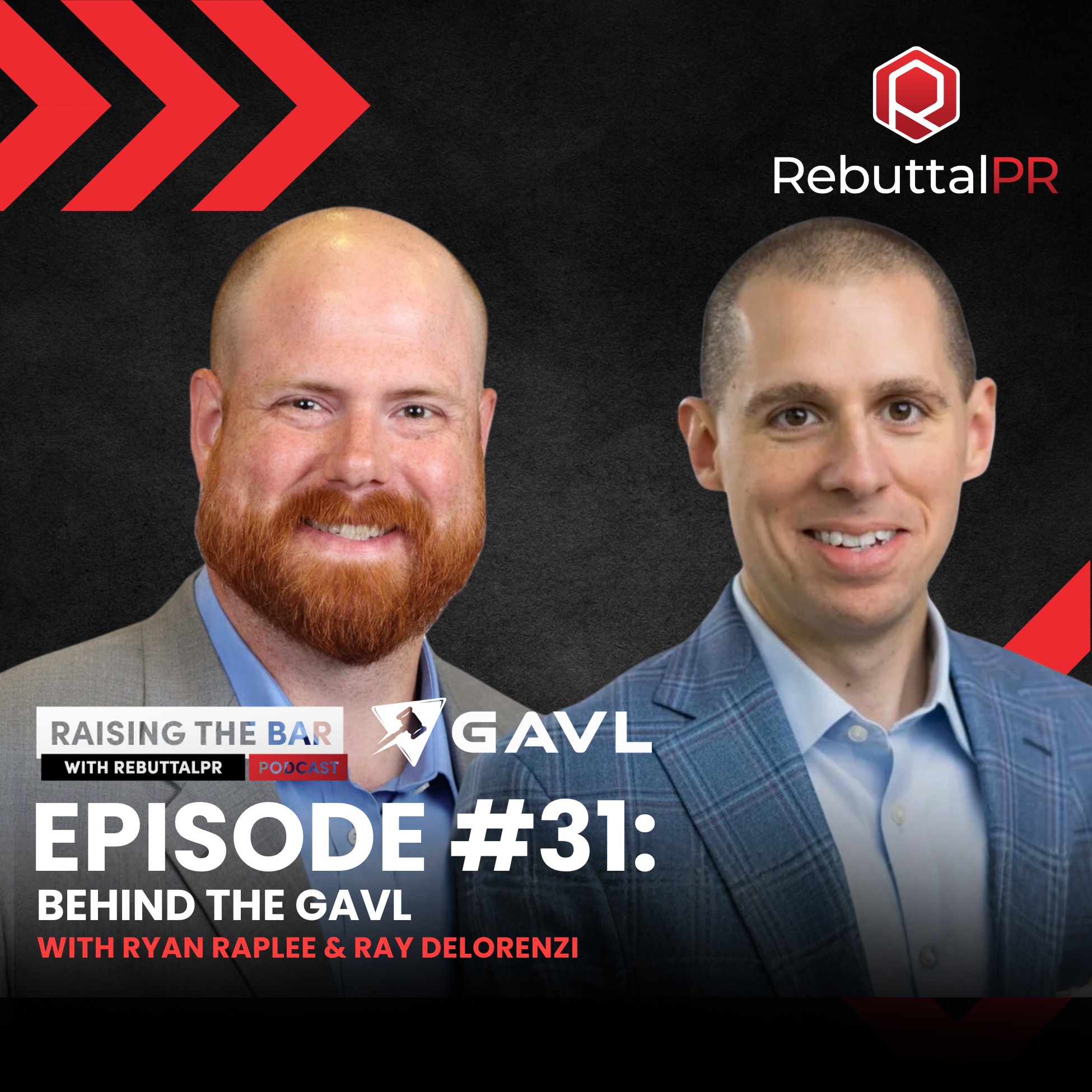
This week on Raising the Bar with RebuttalPR, we’re doing something a little different.
Instead of our usual format, we’re sharing Ray DeLorenzi’s recent guest appearance on GAVL’s Behind the GAVL podcast, hosted by Co-Founder and CEO Ryan Raplee.
In this wide-ranging conversation, Ray breaks down why plaintiff firms should be thinking beyond advertising and investing in reputation, credibility, and earned visibility.
Ray and Ryan also explore how the rise of AI and large language models is changing the way law firms are discovered online, with third-party validation and brand mentions becoming increasingly important.
It’s a candid look at where legal marketing is headed and why firms that prioritize credibility and consistency will have a clear advantage.
Read the transcript
This transcript of Raising the Bar with RebuttalPR was generated using AI transcription and lightly edited for readability. It may contain errors, and speaker labels are approximate. The audio recording is the authoritative version.
Welcome to Raising the Bar with RebuttalPR, the podcast where we elevate the stories of the plaintiff's bar and dive into the key trends shaping the civil justice system today. I'm your host, Ray DeLorenzi, and in each episode, we'll bring you insightful interviews with leading attorneys, expert perspectives on current legal events, and in-depth discussions on the issues that matter most. Now, let's jump in.
Ray: Hey, everyone, welcome to Raising the Bar with RebuttalPR. I'm your host, Ray DeLorenzi. Today, we have a special episode. I had the pleasure of being interviewed on a podcast that's done by Gavel, a very popular legal vendor in our space that does websites, SEO, and digital advertising. Gavel is a good friend of ours. They also created RebuttalPR's website and did an amazing job with it. Ryan Rapley with Gavel had me on his podcast. It was a really great, fun, interesting conversation. And today we present that episode to you unedited. So please sit back, listen, and enjoy.
Ryan: Welcome to another episode of the Behind the Gavel podcast. I'm your host, Ryan Rapley, co-founder and CEO of Gavel. Gavel is a legal digital marketing agency. We specialize in websites, search engine optimization, paid ads, high-end cinematography, you name it. We help lawyers get connected to clients and help their brands. Today is a very special episode. I am joined by one of my good friends, and actually their client, but good friend, someone who's been in this industry for a long time, Ray DeLorenzi of RebuttalPR.
He is a strategist who has helped shape the narrative in some of the most high-profile mass tort and class actions of the past 15 years. From the halls of Congress to the courtroom, Ray has led communications campaigns tied to verdicts and settlements totaling tens of billions of dollars. He's worked alongside disabled former athletes, sexual abuse survivors, and individuals harmed by defective products, building media strategies designed to help clients secure justice in the most challenging circumstances. A five-time Lawdragon Global 100 leader in legal strategy and consulting, Ray previously served as communications director for the American Association for Justice and was a partner at a DC-based public affairs firm. A graduate of the George Washington University, Ray now lives in the New York metro area.
I met Ray several years ago at AAJ conventions and have gotten to know him better over the years. Great client of ours. We have several clients of ours that work with Ray and his team at Rebuttal. They do phenomenal work, and I'm very excited to chat with him and learn more about PR, more about the intersections between PR and generative optimization, large language models, and how all these things are coming together. You guys know I don't like using the keywords or the buzzwords AEO and GEO, but today we're getting into it a little bit, it is kind of a thing. So I'm going to embrace it as much as I can. Yeah, let's dive in and talk to Ray.
Ray DeLorenzi, welcome to the show. Welcome to the 5th episode of the Behind the Gavel podcast. Very excited to have you on the show today.
Ray: Thanks so much, Ryan, for having me. I feel kind of depressed for you that you couldn't do better than me, but here I am. I am sort of honored too.
Ryan: It was no easy feat. I mean, I actually had to go through a lot of red tape to get you. There were a lot of emails, a lot of different people. You got like your own SWAT team over there at RebuttalPR. So kudos to you.
Ray: Oh, I appreciate it. They protect me from myself.
Ryan: Little do they know what you're in store for today. So, for people meeting you for the first time, let's just share a little bit about yourself and why lawyers should care about PR right now.
Ray: Yeah, sure. Let me do a little windup. I started RebuttalPR at the end of 2020, out of the pandemic. Like a lot of folks, I had an existential crisis of what I wanted to do with my life. But to really take it back, from 2008 to 2012, I was communications director for the American Association for Justice. So that's how I got to know the plaintiffs bar. And I left AAJ to go into communications consulting on the plaintiff and defense side. I did that for nine years, and it was great to learn how the defense side works, but it also wasn't my passion. So I started RebuttalPR to focus strictly on the plaintiff's bar, because we were seeing a need over time for plaintiffs' lawyers to burnish their reputation in a way that wasn't dependent on advertising.
You don't build a reputation based on advertising, you build brand recognition. And that's a paid way to do it. But PR is really how you earn it, telling the story of the work you do. We also do work on specific pieces of litigation, telling the story of what the defendant failed to do or how they may have injured someone. So defense firms and corporations have used PR in a pretty sophisticated manner for decades. The plaintiff's bar has been behind that in some respects, but we've been trying to fix that.
Ryan: Why do you think that is? Just out of curiosity. Why do you think the plaintiff side has been so far behind? I know, even on the AI side, the defense side has had tools for so long that the plaintiff side has not had. But on the PR side, why do you think that is?
Ray: You know, I don't think there's one reason. I think corporations just have sort of this built-in apparatus to have reputational concerns more top of mind.
Ryan: Protection budgets, that kind of thing.
Ray: Yeah, that. And also, again, you're talking about a company that may be spending like hundreds of millions or billions of dollars in paid advertising. So protecting their reputation with PR, it's like a hedge to protect against that, almost insurance. And on the plaintiff side, there was just historically this attitude of, we'll just buy our way to more leads. As the economics of the plaintiff's bar has changed and there was more competition, and now there's a fear of consolidation, I think law firms are asking themselves: hey, how do we set ourselves apart here? Because we can't spend tens of millions of dollars a month on leads or billboards or TV ads. So let's do something different. And they have found that, especially when we're in an information ecosystem where people don't know what to trust, PR is a way to earn that trust that can't be bought through a lot of paid media.
Ryan: You and I both know, on the plaintiff side of law, the marketing spend for some of these firms is astronomical. The value of cases is high and everything. But for you guys as PR, I see that being a big part of it for the big guys. But do you have any clients who don't necessarily market or spend, and they're just kind of referral-based, but still where PR is very important to them?
Ray: Yeah, that's a good question. Most, if not all, of the law firms we work with are not advertisers or big advertisers. If they were, I think they have different business models in which, typically, and I don't want to say across the board, they don't value PR as much. They're like, you know what, we're doing billboards and TV ads and radio and Google ads and social spend, and we're just going to get our leads that way. And those are more volume businesses. But we work with firms that could range from one lawyer or two lawyers to 50 lawyers. Some of them do advertising, but they also appreciate that they need different levers to reach clients. And sure, paid is one of them, but they also know potential clients are looking them up on Google. A website is super important, but it doesn't provide the third-party validation that being in the news can provide.
Sometimes they'll work on a case where they know they represent one victim, but they know there are 10 others out there. And the news media can help tell that story. It also sends a signal to referring lawyers or even judges that, hey, this is a serious lawyer who knows how to handle these cases. And their reputation in those forums is really important. So, again, big advertisers, not necessarily the ones that would be interested in us, but we do work with firms that do a medium amount of advertising, a significant amount, to ones that do none and view PR as a more sustainable and unique way to get the types of cases that they're really interested in when they're not operating on a volume basis.
Ryan: I like that. And not only that, but what you guys do also helps the cases. It helps the victims. It helps the industry as a whole, which I think is good for everybody. So you guys are kind of behind the scenes, but also helping even the playing field and get eyes on certain cases that may not have been on them before, which is really great.
Ray: No, I appreciate that, Ryan. Look, we're true believers. And most of our clients are too.
Ryan: I mean, quite honestly, I've had some negative experiences with law firms, family experiences, even before I started Gavel over a decade ago. So when I got into this side of marketing, I was a little hesitant at first. But then once I got into this group, like the AAJ group, the Injury Board group, it's like these are the who's who, the attorneys who are in it for the right reason. So we're not just blowing smoke up people's ass when we're pushing some of these agendas out there. It's real stuff and it's real valuable stuff. And there are real victims, and there are real things on the line. They're not numbers. A lot of the big advertising firms where they get a lot of case flow, to a lot of them, the clients are just a number. Whereas most of the clients we work with, they become family.
Ray: You know, I was at the gym yesterday, which I admittedly hadn't been to in a while. And they have all the TVs there. I looked up, and there was this TV ad for some lawyer I never heard of. I don't even know if they're really a lawyer. They might just be an advertiser. And it had the word "windfall" on the screen. And I nearly lost my mind. I care about these issues. I work with lawyers who care about these issues. And if they didn't, I wouldn't work with them. But who is injured and sees the compensation they get for that injury as a windfall? And also, that's not how the courts work. They're just doing a disservice to the whole plaintiff's bar.
Ryan: That's right, yeah.
Ray: There are corporations that are trying to destroy people's rights left and right, and you're just handing it to them, like, hey, use this windfall ad to paint the whole plaintiff's bar with an ugly brush that isn't representative. And I don't want to drop names, but there's one top attorney out there, I'll call him the top dog attorney, which maybe that's his name, I don't know, but he always has like stacks of cash as if it's a phone or something. I mean, it's disgusting, quite honestly.
Ryan: It may get the phone ringing, I guess, but you're gonna have—
Ray: Oh, yeah, it's gonna have disappointed clients, and it hurts the industry.
Ryan: Yeah, it hurts. It hurts people that need it the most. Let's even backtrack just a little bit. We've kind of been just talking here for a bit, but for folks that don't know, what is public relations? What's the elevator pitch if we meet in an elevator, and I'm like, hey, what do you do? And you're like, oh, I'm in PR. What is PR?
Ray: Yeah, we work with law firms to elevate their profiles amongst the audiences that they need to reach. That's really what it is at its heart. And there's not a one-size-fits-all solution for every law firm, but that's what they're looking to do. I think some folks may have this preconceived notion, like, oh, I need PR when I'm in trouble. Quite honestly, if you're in trouble and then you call us, it probably would have been better to call us before you're in trouble. But again, it depends on what the law firm is and what they're trying to achieve. For the firms that we typically work with, they are trying to expand their notoriety either in a specific geographic area or a specific practice area, which may be irrespective of geography. Or it could be both.
They are trying to find unique and interesting ways to do that outside of just spending tons of money on advertising, when they also know they have competitors in their backyard who often aren't real lawyers, they're just referring lawyers. And they're like, how do I break through that? By finding ways to inject yourself into the public dialogue and conversation, working with reporters to tell the story of the cases you're filing or the results you're getting, or finding ways to comment on news of the day that is specific to your law practice, or getting more speaking engagements amongst the potential audiences that can bring you cases. Those are the sorts of things that we work with law firms on. Again, to elevate their profile and bring them more cases and more opportunities to help the people that they know they can serve.
Ryan: Nice. And this is where I start to get, you know, I look at things from a different lens sometimes as a marketer, but now I see PR being more important than ever. And this is why I will refer folks to you, and I will say, hey, look, we do SEO, we do great websites. There's this, I won't say a shift, but it's a whole other kind of way of thinking now with these large language models, right? So historically, with SEO, the big driving factor is earned backlinks. And with PR, it could help do that, which was great. But a lot of times you get mentioned in an article and you don't get a backlink because it's a news site, and historically there wasn't much value to that from a pure SEO standpoint. Sure, brand reputation management, all that stuff, great. But now we're seeing where brand mentions are the new fuel for being in the consideration for visibility in the large language model results. So people throw around the word generative engine optimization, GEO. You have AIO, answer engine optimization, or AEO. You guys now are at a pivotal point where you are even more valuable, more important. Are you guys seeing this, like more leads coming into you where people are just talking about AI overviews and getting brand mentions? What do you guys see out there?
Ray: Yeah, it's an interesting time. And everything you said is correct, where more and more potential clients are using AI to find a law firm. Just put aside the law firm for a moment. We've had more people call us interested in working with our team. And I always ask, hey, how'd you learn about us? And oftentimes it's through AAJ, or another lawyer referred us. More and more, it's that they found us through AI, which is really fascinating. We've seen that tick up in the last probably six months.
There was a study, and I can send it to you after this. If you have show notes, you can put it in there. There's this company called Muck Rack, which is for PR professionals, it's like a database that helps you get contact information for reporters. It's one of our tools of the trade. And they put out a report a couple of months ago that looked at how AI was ranking different types of websites based upon someone's query. And the amount that AI is using journalistic sources is far more than Google typically would. Google would really rely on someone's own website. AI weighs that with some value, but they are really looking for third-party references to find who makes the most sense. And you're seeing certain news outlets come to the top. Reuters and Axios were two of the ones that ranked really highly. But the Washington Post and New York Times are outlets you would think would be high, and the models are pulling in and vacuuming up that data. And they are relying on it much more so than self-created information to decide how they're going to answer a query.
There's a law firm we worked with, they had a big verdict like two weeks ago, and within probably three days of that, if you asked, hey, who's the best law firm if I've been injured, and we put in their geography, they were number one, and the citations were to that verdict that happened less than 72 hours prior. And then if you're asking about that specific product, there was a product case they did, they were coming up at the top. Again, in the earlier days of, let's say, ChatGPT, when the GPT-3 model came out, which is really the first public model, you would often get results that were like a year or 18 months dated. You're now seeing that they're crawling fast.
Ryan: Oh, yeah.
Ray: And it's just a whole new world. And again, it's not like your website isn't important. I mean, we have, I think, a really good one. Our developer was pretty darn good.
Ryan: Oh, yeah, you're welcome.
Ray: Yeah, David did an incredible job on it. So it's still important, because I think a more sophisticated client is going to go check out your website and make sure, hey, are these people legit? But you're seeing the models rely on third-party stuff tremendously. The last thing I'll say, Ryan, before I shut up, is I think there was this idea from, let's say, companies that were trying to do some tricks and gimmicks to get backlinks or references on garbage websites. I'd often see it done on like Forbes or Entrepreneur, this pay-to-play garbage. The AI models are not falling for it. They are interested in a lot of the ranking sites I've seen, like Super Lawyers and things like that. Those awards, again, not all of them, but some of them, we are seeing come to the top. But if someone's trying to buy some crummy backlink on a site you would never read in real life, the AI is not going to read it either. So the AI really has no care in the world how many backlinks your website has. They really care about these brand mentions.
Ryan: And also what your brand is mentioned by, what are the keywords surrounding your brand? Brand search now is helping drive SEO as well. So there are so many different things that are at a crossroads right now and intersecting. There are still a lot of firms out there where, if you just search their brand name, they don't necessarily show up on page one or even in the overviews. Whereas PR, what that is doing, and honestly what we're doing too, I mean, we build backlinks for our clients, but we're also building brand mentions. We're building things where, if we can get mentioned on a site, not necessarily get a backlink, we're still happy as long as we can get it next to the keywords that make sense. Obviously, we don't want to have XX law firm next to Legos or something like that. Relevance still matters. On the SEO side, relevance matters, but still, I'll take a backlink on Lego.com and that'll drive a shitload of value to the website. We're seeing this too. Like if you Google search something and the AI overview pops up, they'll show, and this has been forever now, you never know if the brand or the firm name is going to be a hyperlink to the website. You don't know if it's just going to be text, or if it's going to be a hyperlink to a Google search for that brand name. And it's kind of crazy. Now I think we're starting to see a little more where they're hyperlinking to it, but still, brand is the most important thing right now. I mean, brand's always been very important, but from a straight digital PR standpoint, brand is so important.
Ray: Yeah. And you saw firms, I think, for a while that just had this idea, hey, we can just spend our way and get leads that way, and brand is not important. And I think you're seeing that the tide has turned. And look, this is a case study of one, so take it with a bit of a grain of salt. But for my firm, we don't do any pay-per-click, anything like that. We are not a law firm. We have a very defined audience of the plaintiff's bar that we are trying to reach. And we have a great-looking website. We support various organizations in the civil justice community because it's the right thing to do. I have no idea if they give us a link or not. Oftentimes, of course, we sponsor AAJ, for example. I used to work there, it's home for us. We're supporters of Public Justice and other great organizations. I suspect they have our logo on their website. I don't know and I don't check. But if you go on Claude or ChatGPT and ask, what's the best PR firm for a plaintiff's law firm? It answers us. And it's the brand mentions. It's not because there are all these backlinks about us. Now, if you do that in a Google search, I'm curious what would come up. I haven't done it recently. And again, it's not how we are necessarily trying to reach people, but it underscores, again, case study of one, your mileage may vary, but it's certainly interesting how the landscape is evolving.
Ryan: Yeah, no, it's wild. I mean, if anyone's listening to this who is not doing PR now, I literally get emails every week from people asking, hey, how do we rank better in the large language models? And I'm like, well, you need to get brand mentions. You need to get out there. Actually, it's kind of crazy. One thing that we're going to start offering here as a service is podcast management, basically a white-glove service for podcast management. And this is not how everyone else is doing it. Everyone else, all these other law firms, are creating podcasts to talk about the law. We are going to be creating podcasts to talk about your local community, bring in your local business leaders, your local entrepreneurs. Don't even talk about your law firm. Distribute it through your law firm, but don't talk about it, because then you get brand mentions hyper-local on social media, on their websites, and you're not selling your service, because that's not the whole point. You're going to uplift your community, but you're also going to get rewarded by all these brand mentions. I mean, it's also reciprocative, I made up that word, but reciprocal, I guess, is the better one.
Ray: I forgot to mention, we have a podcast, plug for Raising the Bar.
Ryan: Thank you.
Ray: That probably had a good deal to do with our LLM ranking and appearance, and I shouldn't have dismissed it or not mentioned it earlier. Again, I don't know for sure, but our podcast, it's not talking about the work we do. We bring in really amazing trial lawyers to talk about their practice and how they became lawyers. And we do it because it's interesting and people really enjoy it. And there's one trial lawyer, I won't mention who they are, but they are an incredible trial lawyer. Everyone knows who this individual is. And if you search this person's name in Google, our podcast comes up first, not even their own website, which is wild. I knew they needed some SEO help.
So, I mean, let me tell you, they are not struggling. They are in demand and they do amazing work. I think it's great you guys are doing that, Ryan, because, especially, I think the approach is right. Let's say you are trying to do more in Sheboygan. Sheboygan's always my "town USA."
Ryan: Where is Sheboygan? Hold on, is that in Wisconsin?
Ray: I believe it's in Wisconsin. It's mentioned in Home Alone when they rent the U-Haul.
Ryan: Oh, yes. Yes. My only frame of reference for Sheboygan.
Ray: You know, let's say you really want to be the go-to law firm in Sheboygan. Doing a podcast where you bring in leaders from the Sheboygan community, and you're not talking about your law firm, you're just talking, that is a way to become part of the community in a way that I think is unique and valuable.
Ryan: Giving before you're getting.
Ray: Yes.
Ryan: I'm actually setting it up right now. I'm going to be starting mine as a proof of concept. So right behind me, I've got four podcast mics set up. I've got a nice new neon over here. It's going to be set up to where I'm going to have an awesome local show, because I live in Williamsport, Pennsylvania. There is no local podcast here, no one, and we have so many great stories, and there's this rich history. I hope Tad and Mike are listening to this because they're going to laugh, because I like to talk about Williamsport so much. And they've both been here a couple of times. And I don't know if they walked away as delighted as I told them it was going to be, but it's got to be close, right? So I'm going to do this as a proof of concept. And I already have buzz around the community. People are like, hey, when are you going to get that going? I want to be a guest. And I'm like, if you can provide value before you get, it's going to be huge. It's just the best thing. We used to see this in the SEO world, where we would try to get creative on how do we get the local auto repair guy to give us a backlink, right? We would always be thinking about these things. We're in this age where it's like, man, if you just shift your thought process and give value before you get, hyper-local, I mean, sky's the limit.
Ray: Yeah. The one thing we hear from clients, they're like, oh, I want to do a podcast. And I think this is true of anything you do, whether it's a podcast, you're doing SEO, you're doing PR work, you have to be consistent. And you have to have intent behind it. Like that's the thing too. Everyone's like, I just want to do a podcast, everyone's doing a podcast. All right, so what's your intent? Why do you want to do it? You can't just do something to do something. You have to have a reason behind it.
Ryan: Yeah.
Ray: Our podcast, I came up with the idea. It was just one of those random things that I screamed out, and people were like, huh. It took us a year from the time we thought of it to airing the first one. And it's not like we were dragging our feet. It was like, what do we want to talk about? What are the design elements around it? And also, we always ask, when someone's like, I'm going to do a podcast, I'm like, okay, how often are you going to do it? They're like, once a week. And I'm like, are you going to carve out that amount of time? Because it's not easy.
Ryan: No.
Ray: And consistency, the podcast doesn't need to be a plus-plus-plus. It should be very good. But being very good and consistent is a lot better than being a plus-plus and not being consistent. Because if you're going to commit to it, you need to see it through. Otherwise, it's not worth the trouble.
Ryan: I mean, I'm only on my 5th episode for this Behind the Gavel podcast, and I've already learned a lot in just five episodes. And the more you stay consistent, the more you're going to get better, the more you're going to feel relaxed. And it's just so rewarding too, because it gives you a reason to get into your community, talk to these people. Next thing you know, no one necessarily knows you when you go down to the pub, but now you're going to go down and somebody's going to come up and say, hey, thanks for talking about my friend, you know, Mary Jo, who's the local pasta maker, or something like that. It's just small-world stuff. And most of our clients are living in communities where not everyone's in Chicago and the big cities.
Let's keep moving, because I have a couple more questions for you. So, does it matter, and we just kind of talked about this, does it matter whether the coverage is national or local media? Who are you trying to reach?
Ray: Of course it definitely matters, but one is not worse than the other. We've worked on cases that, let me try to give an example. Oftentimes, and I mentioned this before, there's a victim that a law firm is representing, but there are 10 more or 20 more in that community. Let's say, and you often see these, unfortunately, in abuse cases, or you could have a doctor who's committing widespread med mal on a patient population. It makes national news because it's such a horrific set of circumstances. And the national news can be important for that lawyer and that law firm. But in terms of reaching potential plaintiffs and other people who have been injured, the local news often drives that more.
The interesting thing about the media environment, there is this notion, which is totally incorrect, that, oh, the media is dying, blah, blah, blah. A lot of news outlets have huge business problems, don't get me wrong, but there are more ways than ever for people to get information. And that is not shrinking, it is only going to keep growing and growing. It's very much choose-your-own-adventure in terms of how you want to get your news. You can go to a local news outlet. Local TV still gets huge numbers, I think people are dismissive of that. People can go read a Substack. There are a ton of ways for people to get information. So again, sometimes we work on something and there may be an audience of like five people. It could just be the defendant and their general counsel you're sending a message to. That's my long-winded way of answering: it matters, but one is not better than the other.
Ryan: Yep, yep. So here's a question for you, actually, that just came to mind, because we were talking about LLMs and stuff. But if you get a client, say, on local news, do you get rights to reuse that content, like that footage, whatever was aired, or no?
Ray: No, no, that's owned by the news outlet. I would say an exception to that is if you're on something that isn't part of, I'll call it the quote-unquote corporate media, which is such a loaded term, and I don't mean it in that way. If you're on someone's podcast, you can usually ask permission to be like, hey, can I put this on my website? And usually the individual is okay with it. But if you're on the local NBC or ABC or CBS affiliate in your community, it's not going to happen. They're never going to let you do that.
Ryan: Now, the only reason I ask is because the number two cited source in these large language models is YouTube. So if you could get that video and then re-change the title, change the description, change things about it, where all of a sudden that becomes an influence in somebody's query in an LLM, it's just one extra thing you could do with that asset.
Ray: I've seen, and look, I am not, go consult a media lawyer on this. But if you are doing commentary over that news article, that video, let's say, does it create sort of a fair use? You're turning it into a creative kind of work. Maybe. YouTube may still take it down. They may get a copyright notice to take it down. TikTok doesn't take it down, because I know there's this one lawyer who's got like a million-plus followers, and that's what this guy does. I mean, it's ingenious.
Ryan: Yeah, that would be the avenue to do it. Like, as in a TikTok style where you have your face talking over a news article.
Ray: So that'd be a way to do it. But also, I've never seen TikTok come up in the models. And it seems like they have no care for copyright law.
Ryan: So, yeah. What's for dinner tonight?
Ray: Sushi. My older kid wanted sushi tonight, and he's been asking for a couple of days.
Ryan: What motivates you more, competition or curiosity?
Ray: Competition. It really should be curiosity. But yeah, I'm also a curious person, but at the end of the day, competition motivates me. I love winning.
Ryan: Same.
Ray: You know, I am very curious, though. I go down so many rabbit holes. My team laughs at me, the amount of rabbit holes I go down. I'll be working on one thing, next thing you know, I'll send them something, and they're like, I thought you were working on something else. And I'm like, I am, at the same time, but I also have 10,000 tabs open and I'm vibe coding stuff. I'm doing all kinds of crazy stuff. So as I've gotten older, it has definitely swung in the way of curiosity. And I think that's a good thing, at least for me.
Ryan: What's the last book you actually finished?
Ray: Notes on Being a Man by Scott Galloway.
Ryan: Do you think that could help me?
Ray: It could. I think you're a great gentleman.
Ryan: I think Oscar and Catherine are laughing their asses off right now.
Ray: Yeah. So Scott Galloway, he's a business guy. He has a podcast with Kara Swisher that's very popular. I'm not the biggest fan of his, and he would admit it, he's like a huge egomaniac. But he writes about, and the book comes with some controversy, so I take some of it with a grain of salt, but it talks about, especially if you're raising boys, how you can help make them productive members of society. And it's a really good and interesting read.
Ryan: Yeah. All right, I'll check it out. What's something you're looking forward to this year, business or personal?
Ray: In April, well, probably two things. One is I coach both kids' baseball teams that start next month.
Ryan: Sweet.
Ray: So yeah, it takes a ton of time, but I also love it. But based upon the snow situation, we may not play till like August. I don't know how the fields are going to be ready. But anyway. And then we're going to Portugal in April. So I'm excited for that too.
Ryan: Sweet. How old are the boys?
Ray: 10 and 7.
Ryan: Bring them here to Williamsport and we'll take them to the Little League World Series.
Ray: My older kid, he is on a travel team, and we're already exploring sort of a weekend, whether it's Cooperstown or Williamsport, or Ripken has a facility in Maryland.
Ryan: Well, here in Williamsport, we have a brand-new facility that opens this year. It's called the Williamsport Lumber Yard Seven Field Complex, and tournaments are already filling up crazy fast. I'm on the board for it.
Ray: So I could tell. Are you on the Chamber of Commerce for Williamsport?
Ryan: I am on the board of directors for the Chamber. It's not, well, it should be, they don't pay me anything. In fact, I don't even have any local clients. So what am I doing?
Ray: You know, but it's on my list. I'd love to go out there.
Ryan: You should. I mean, it's awesome, because we've got a great museum, and then three hours away you could scoot up to Cooperstown. I mean, it's lovely.
Ray: You've sold it.
Ryan: Thank you for being on the show. It was a pleasure. I learned a lot. I think the people listening learned a lot. Don't sleep on what is happening right now. The world of AI and PR and media, everything is changing so fast and so rapidly. I think you're doing yourself a disservice if you don't reach out to Rebuttal, talk to Ray, talk to his team. Talk to us, talk to somebody. You have to make sure you are aligned and talking to someone who's staying ahead of the curve and staying ahead of this stuff. It's changing all the time, and you've got to get creative people that are doing this stuff for you, because everyone's trying to do the same thing, and you have to have an edge and a way to do something that not everyone else is doing. Obviously, you guys are doing something good because you've grown pretty rapidly. Great job, Ray.
Ray: Thank you. You can invoice me for that.
Ryan: That's fantastic. I appreciate it.
Ray: And I mentioned before, Gavel does great website work. Ryan's the man. So we're huge fans here.
Ryan: Thank you. I've got to give the credit to my head of websites, Luke. Luke's good people too. He banged his head on a lot of walls for that site. But look at him now.
Ray: Yeah, look at him now. All right, see you, man. Appreciate you. Be well. Thank you so much. It was great to do this.
Ryan: You're welcome, Ray. Take care.
Ryan: That was a phenomenal chat that I had with Ray. I learned a lot about PR. I learned a lot about where we're going with the industry. I could just talk to Ray for hours and hours. He is so knowledgeable in this industry, and his team is bar none the best in the industry. I would recommend everybody listening, as I already said during the show, to reach out to Ray. And even if you don't think you're in a position to need a PR firm right now, I think it's definitely worth the conversation and putting it into your business plan on where you want to be. As Ray said before, some folks have tried to hire him when things have already happened, at the wrong time. So being ahead of it, you can never be too early. And I think the future is going to be very volatile, and having folks like them in your corner is only going to help you out.
I also thought it was very interesting that such a curious-minded person loves competition so much. But as a business owner, as a lot of you listening are, I think it makes a lot of sense now that we're talking about it, because competition, I think, drives curiosity, because we all want to win. We all want to be the best we can. I know I wake up every day and get out of bed knowing I want to do the best for my clients. I want to do the best for the industry. I want to be the best in the industry. Obviously, we have some great competitors out there, but that is what fuels us. What's the fun of being the only fish in the sea? It's good to have competition. So with that, I appreciate you sticking around this long. And it was another great podcast. I look forward to the next one. So, until next time. Thanks for watching.
Thanks for listening to this episode of Raising the Bar with RebuttalPR. Don't forget to subscribe and follow to join us next time. See you then.
Related episodes
It’s exactly why litigation PR matters for plaintiff firms — the work RebuttalPR does every day.
Discover Insights & Trends
Featured Stories
- August 21st, 2026
- 4 minutes
- Stephanie Wolf
Aligning Your Benefits with Your Values: Parental Leave Edition


- August 17th, 2026
- 5 minutes
- Blake Tousignant
In the Legal Space, Design Is Not Decoration. It’s Strategy.