
- August 6th, 2026
- 5 minutes
- Ray DeLorenzi
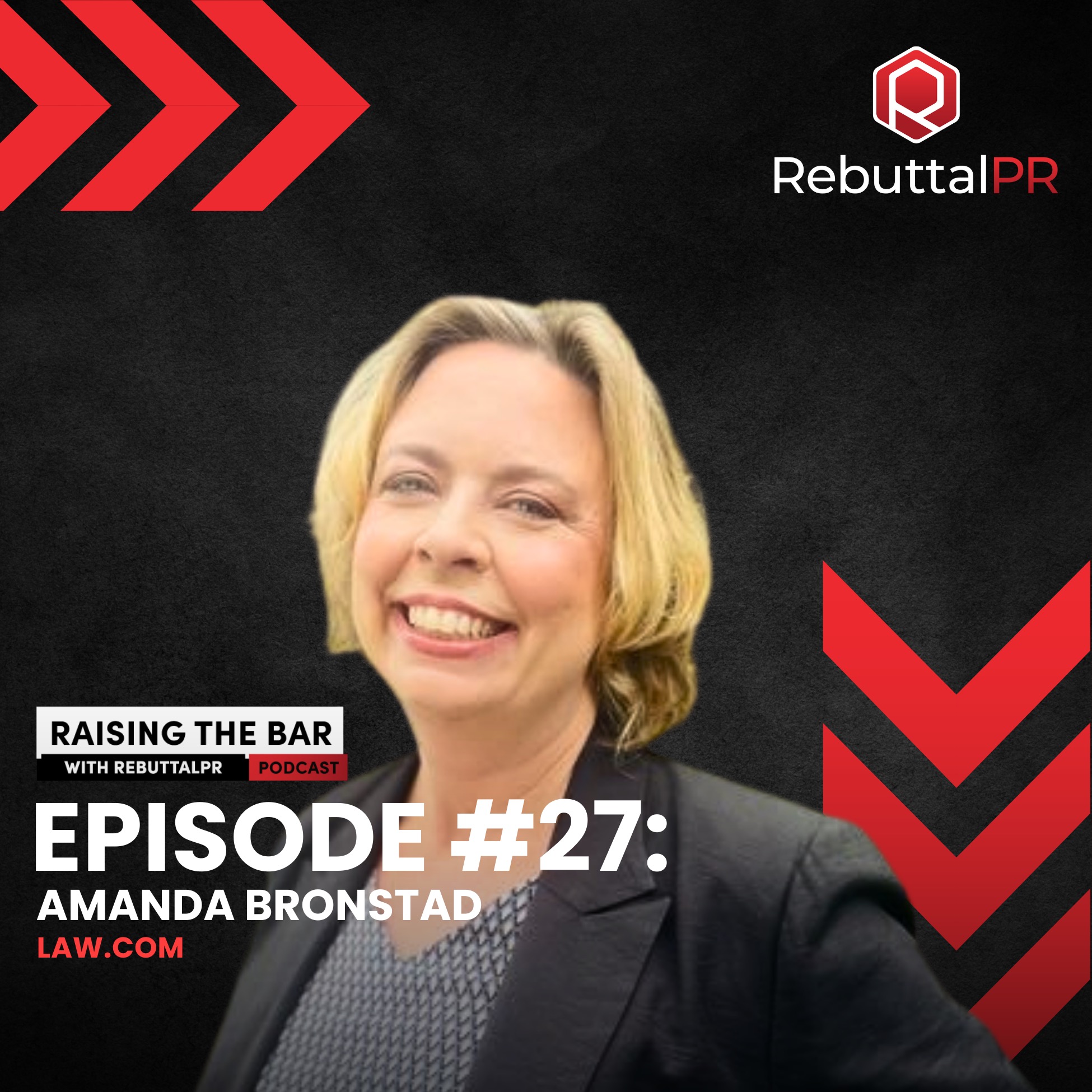
In this episode of Raising the Bar with RebuttalPR, host Ray DeLorenzi sits down with Amanda Bronstad of Law.com, who covers class actions and mass torts nationwide. Based in Los Angeles, Amanda has spent more than two decades reporting on the legal industry and is the author of Law.com’s widely read email dispatch, Critical Mass.
Amanda shares her unconventional path into journalism, from early business reporting to becoming one of the most trusted voices covering complex litigation. She explains how she learned to navigate legal language as a non-lawyer, why mass torts and MDLs drew her in, and how the beat has evolved over the past 15 years.
The conversation explores how judges, lawyers, and juries influence the stories she tells, what drives readership in legal journalism, and how scrutiny of MDLs, settlements, and litigation finance has intensified. Amanda also offers insight into emerging trends, including antitrust cases, data breach litigation, and growing lawsuits involving claims administrators.
Amanda closes by discussing what makes lawyers effective sources, how she tracks dozens of active cases at once, and what she is watching closely in 2026.
Learn more about Amanda Bronstad:
https://www.law.com/author/profile/amanda-bronstad/
Read the transcript
This transcript of Raising the Bar with RebuttalPR was generated using AI transcription and lightly edited for readability. It may contain errors, and speaker labels are approximate. The audio recording is the authoritative version.
Welcome to Raising the Bar with RebuttalPR, the podcast where we elevate the stories of the plaintiff's bar and dive into the key trends shaping the civil justice system today. I'm your host, Ray DeLorenzi, and in each episode, we'll bring you insightful interviews with leading attorneys, expert perspectives on current legal events, and in-depth discussions on the issues that matter most. Now, let's jump in.
I don't think anybody, lawyers included, understands how fast we have to come up with a story. You know, I'm not in the magazine business, I'm in the news business, and so there's obviously breaking news, whether it's a verdict or a filing. And we pump out a lot of stories. So, as soon as that happens, we're on to the next thing.
Ray: Hey, everyone, welcome to Raising the Bar with RebuttalPR. I'm your host, Ray DeLorenzi. Today we have a special guest, a different kind of episode than we typically do. Today we are joined by Amanda Bronstad with Law.com. For those who follow the legal industry and particularly follow mass torts and class actions, which we talk a lot about here on the podcast, Amanda is at the front lines reporting on those issues, and she is probably the preeminent journalist covering that space today.
She has been with ALM for 20 years, and as I mentioned, a longtime journalist at Law.com, also the author of the Critical Mass newsletter, which is, I think, must reading every Wednesday. If you haven't subscribed, please do so. So I gave you a plug there, Amanda, to increase that subscriber base. But truly, it's a must-read amongst my team, and I know a lot of lawyers I speak with. So, in any event, thank you so much for joining the podcast today.
Amanda: Thank you for having me.
Ray: Let's take it sort of from the beginning, Amanda. Did you grow up wanting to be a journalist covering mass torts and class actions? I assume not. And then how did you sort of fall into it?
Amanda: No, I actually didn't even have a newspaper at my high school, which is kind of strange. But I did work on the yearbook staff, and I did a lot of writing at home. But, you know, this is growing up some time ago. When I was a kid, if you said you really loved writing, the counselors would say, well, you can't do that for a living. You need a real job. Think of something you can do that's more practical. And so I went into college with a plan to be a history professor, because it was respectable and I was going to have to go through a lot of school, but it seemed like a good idea.
But when you major in history, you spend a lot of time in the history department and you see the professors all holed up in their offices, studying and not getting out much. And I decided, as a sort of self-proclaimed extrovert, that that's not the career I wanted. And so I fell back on the only thing that I enjoy doing, and it was writing. And I got on the school newspaper, and it kind of went from there. So it's always been kind of the only thing I really like doing. And I always say to people, I can't believe someone pays me to write.
Ray: So how did you get into the legal sector? And I know earlier in your career, like a lot of young journalists, you go, you know, smaller papers, business papers, trades. And then about 20 years ago, you ended up at an ALM publication, then American Lawyer Media. How did that happen? What was that evolution?
Amanda: Well, it was kind of strange. I actually started off in business journalism. And the reason was because I took a summer job at the Fort Worth Star-Telegram, and they gave me these really exciting stories, like interviewing a clown on July 4th and doing the man-on-the-street interviews where I got to interview people about gas prices. And I thought, oh my God, I can't spend my career writing about this kind of stuff. So I wanted something more intellectually challenging. And there was a business journal in Fort Worth, where I went to college. And that's how I started covering that. And then I kind of segued into Austin and covered the tech industry. And when I came to LA, they gave me an option: you can cover the law or banking. And I said, that's easy. So I covered legal stuff for the LA Business Journal for several years. And that's how I got to know ALM really well, and decided I really liked covering legal journalism, and that's all they do. So that's where I wanted to work.
Ray: So you are not a lawyer. What was your process to get up to speed? It's like I'm not telling you anything you don't know already. It's a different vocabulary, a different lexicon and pace. How did you learn that over time, to sort of speak the language that lawyers speak?
Amanda: Well, I spent a lot of time going to conferences and hearings and hearing the lawyers talk. And the first interviews I did with lawyers were very much along the lines of, can you please put that in English for me? What are you saying? And I would try to get them to decipher it. And I spent a lot of time reading the legal briefs. So you start to learn the patterns of the language. I also, in 2009, went to the Loyola Law School Journalist Law School event. And the whole purpose of that event is like a one-week crash course on legal education for reporters who are constantly covering legal cases. So everyone from written to broadcast, all kinds of different legal cases. It wasn't just mass torts. But I remember taking a class there where it was all constitutional law. And boy, I didn't know anything about that. So I definitely learned. And it's just been trial and error for the most part.
Ray: So, obviously, covering a legal beat is massive. And now you've niched down into the mass tort, class action, PI space. How did that develop over time? And how did you decide where your interest and curiosities lie?
Amanda: Well, yeah, so I got hired at ALM to cover Los Angeles. So I was not hired to do mass torts at all. And in fact, I don't know that they had someone necessarily on that beat. I kind of created it, because what happened was one of the big cases in LA at the time was the Toyota Sudden Acceleration MDL. It got coordinated to Santa Ana in front of Judge Selna. And I made the drive all the way to Santa Ana to go to the hearings. And I remember the first hearing, it was the one where they're figuring out who's going to be in charge. At least I think it was the initial hearing. And I walk in there and there's over a hundred lawyers, standing room only in this courtroom. And I'm thinking, what kind of a case is this where you have all these lawyers, most of them on the plaintiff side and like five defense attorneys? And I started to listen to the hearings, and I would learn that there's a distinction between a mass tort and a class action, because they were actually both in that MDL. And the lawyers who do them are different people. They had different personalities. They had different arguments. And I just kind of got hooked after covering that case, because it was just like, wow, this isn't just one case. This is everyone's Toyota. It's just going to be huge numbers, and whatever the settlement ends up being will be huge.
And then I found out about MDLs, and I went to my first JPML hearing. This is very memorable. The hearing was in Boise, Idaho, and they were going to hear the case on BP oil spill litigation. So here I am in Boise, Idaho, no idea what this is like, because they're not televised, they're not recorded, you never see what the panel is doing. But you get to see it in person and you can see the red light, you can see the panel sitting up there all very high. And these guys have five minutes to make their case, and they're all flown in from Louisiana because they're doing the oil spill from the Gulf of Mexico, and they all had the strong accents up there arguing in front of the judge. I thought, this is really cool. So that kind of solidified it for me: I've gotta find out more about these mass torts, and then get more into class actions too, because it's a bigger impact than just one case.
Ray: So if you go back to BP, that's, I forgot the year, probably 2010-ish.
Amanda: Yes, that's right, 2010.
Ray: So we're talking more than 15 years. How do you feel the field has evolved over that time period? And in turn, how do you cover it?
Amanda: Well, when I first started covering it, if I went to the MDL hearing, the night before you would hear the lawyers who were going to be the players, who were going to make the arguments, and they would duke it out over drinks and dinner. And almost all of them were white men. And they all knew each other. I mean, it's a very collegial type of industry, but it was even more so back then. And so I feel like that's changed a lot since the first days I was covering it in 2010. It's a much larger span of lawyers and much bigger diversity. And in fact, one of the stories where I first started to see a lot of changes was a story I did in 2015 about the lack of women getting appointed in these MDLs. And a lot of that conversation started taking place, and then you started to see a lot of changes. So that part has definitely changed.
I also think there's a lot more scrutiny of both class actions and mass torts. I mean, when I started covering this, you had the political side of "class actions are bad, we're going to hem them in." That didn't, I mean, they're still there, so clearly that didn't solve all the problems on the defense bar. But I think you see judges more, instead of it being a political argument, you see judges saying, hey, did the class get a fair amount of compensation here? Do we know what's happening with this money? Do we know about these fees? Is this necessary? So that part's definitely changed a lot.
Ray: I'm curious about, and of course not asking you to reveal your sources here, but if you had to think about where you get stories from, do you hear more from the plaintiff side or the defense side for ideas, or is it about 50-50?
Amanda: Today it's about 50-50. I think for a long time I got more pitches from the plaintiff side, but I see more on the defense side now. I mean, it's not really an apples-to-apples thing, because for the plaintiffs, they can talk about their case. They've just publicly filed it, and they often have a client who's more than willing to talk. Whereas for the defense, they've got a client that doesn't want them to talk to me at all. And they want to say the successes they've had, but they're kind of more hamstrung. So I feel like they've broken into that a little bit more. So now it seems more evenly split to me today.
Ray: At the same time, do you feel like criticisms come more from the plaintiff side or the defense side of your coverage, or is it about the same as well?
Amanda: Oh, I get evenly criticized, but I don't get that many. I really don't get that much criticism, to be perfectly honest. I don't want to toot my own horn, but I really don't. But the ones I do get, yeah, it's pretty even, I'd say. And if it's a criticism, it's not like, oh, you're biased. It's more like, you know, I wouldn't have written it that way, or something along those lines. Or maybe I got someone's name spelled wrong or something like that. That's the most criticism. I've never been told that something sounded like a biased article to the extent where I really had to check myself, you know?
Ray: Do you ever hear from judges?
Amanda: I do sometimes. Not as many examples as I would like. I would love to have these huge conversations with judges all the time, because I think I would learn so much. Since I don't hear from them that much, I like to listen to them in the hearings. But sometimes they know I'm in their hearings all the time, and so they've reached out to me because they're reading what I'm writing about the case in front of them. But they're also hamstrung, they can't really talk about the case in front of them. So on general topics, yeah, they will talk to me. But it's all kind of down to the judge. Some of the judges don't want to talk to media and some do.
Ray: Got it. Do you ever feel like, being in the courtroom, or not even being in the courtroom, just following a case more closely, do you get the sense that the court, in addition to the lawyers, is also following your coverage?
Amanda: It depends on the case. I mean, one of the things I've noticed that has changed a lot in journalism is you go to a court hearing, and there just aren't that many press there. They've cut back so many journalists that when you go to a hearing, you're like, oh, wow, there's someone else covering this. Whereas in the old days, I think you saw regulars showing up all the time. It was a very different vibe. I don't know that they know there's a couple of reporters sitting in a courtroom. I mean, that's not their top priority for the most part. I do notice it more in, I'm in Los Angeles, I did notice it more in LA Superior, because they have celebrity cases and so forth, so they're more aware of media coverage. But generally, no, I really don't think they pay a whole lot of attention to us.
Ray: Now that you've been covering the mass tort and class action world so much more, do you feel like lawyers treat you differently or have more respect for what you do? And has that evolved over time as you've earned their trust, or perhaps they realize that this weekly newsletter you put out, in addition to your reporting, carries a lot of weight in the industry?
Amanda: Yeah, definitely. I've actually been asked to speak many times at conferences and events. And sometimes the topic I always laugh at is they want me to talk about what the trends are in mass torts. And I'm like, you guys are my sources. Why am I telling you, right? But I think I have the distinction of, I've learned, that lawyers have their pocket of cases and their region that they cover. And it's a certain limited number, and they're busy doing their cases. Whereas I have the luxury to sit back and see the bigger picture of all the cases and what's happening in all of them. But I don't have to litigate them, I don't have to deal with the deadlines, I just have to keep track of what's happening in them. So I think that's the information they want to hear from me.
Ray: I want to actually ask you about trends, and I was going to wait till later, but you just brought it up. I recall it was probably two years ago you predicted that there would be a decline in MDLs in terms of volume. I think that bore out. I think you may have predicted a little too early, but it was probably six, eight months after your prediction that you started seeing that. And now I think you've seen that come out. What are you seeing now over the next 12 to 18 months as it relates to MDLs? Are there any trends you're following or have an eye on?
Amanda: Well, you know, you say that. I did a story about six months ago saying, oh my gosh, there's only six motions in front of the MDL panel. It's the lowest ever. And then literally right after my story came out, people started filing motions. So, yeah. Well, they even canceled the JPML hearing this year, which I don't know the last time that happened. So there is something to that. That's why I did that story, because I thought, I don't think I've ever seen that before. They had nothing in front of them at all.
So, yeah, the defense bar has been very vocal for years about their criticisms of MDLs. I mean, their position is that when you create an MDL, it just invites the not-so-prestigious plaintiffs' firms to be filing a bunch of the same cases just to get into the game, right, for the money of it. And so they've been more than vocal about the criticisms, and they tried to get changes done with the MDL rule that just came into place this month. But the administrative side of things, the rule that they did pass was definitely more limited. And so they just weren't going to have the kind of changes I think they wanted. The defense bar continues to criticize meritless cases and things like that, and litigation finance backing a lot of these cases.
But as far as the cases themselves, I have heard some on the plaintiffs' bar say it just is cyclical, there's sometimes just no product out there that's causing the litigation that you would need for an MDL. And I can be proven wrong. As far as a prediction, I hate to make another one. But I would say the type of cases and MDLs have changed. So I don't see as many product liabilities. I do see a lot of class action consumer and a lot of antitrust. Antitrust is very hot right now in front of the MDL. And it doesn't seem that the MDL panel wants to reject a data breach case either. So those obviously are going to keep happening. So I don't want to make another prediction. I think it's going to stay kind of the way it is, until maybe we'll see how the MDL rule makes any changes, if that's going to have an effect on the numbers. So we'll see.
Ray: I'm curious, getting back more into how you do your day-to-day work and your interaction with lawyers and sources, how do you believe some lawyers may misunderstand how you work, or how you report, or what you find interesting?
Amanda: That's a tough question. I don't think anybody, lawyers included, understands how fast we have to come up with a story. You know, I'm not in the magazine business, I'm in the news business. And so there's obviously breaking news, whether it's a verdict or a filing. And we pump out a lot of stories. So as soon as that happens, we're on to the next thing. When you get back to me two days later, it's kind of a moot point at that point. And I realize most lawyers are very busy. They may be in a courtroom where they can't even reach me at that moment. But everything's just, I mean, there's cases that go years, right? And so I think they work in a much more elongated type of practice than something like a journalist. And I think most people do, to be honest. So that's one thing they probably don't understand.
And also, you know, I usually know what they're talking about, but most journalists are not lawyers. So lawyers have a tendency to always want to argue their case in front of the journalist. And so you have to stop and go, I'm not the judge. I'm just trying to understand what's happening here. We're not the judge. You're not supposed to win when you talk to us, you're just supposed to inform. So I'd say that's one thing that probably still gets them sometimes. But I would say lawyers are getting far more savvy with the media than they were before. So I guess there's more of us out there, I don't know.
Ray: By savvy, what do you mean? Because I do think there's always sort of, I think people would say, oh, lawyers are already pretty savvy in how they deal with them. And the fact that you think they're getting savvier is kind of interesting. In what respect?
Amanda: Because I think there are more people who think they're journalists. So there's an interest in legal cases in particular. If you throw in some celebrities or some big dollar figure, it's not just folks like me or like the Wall Street Journal. It's someone who has a blog or someone who's got their podcast, right? So anyone who wants to cover this is going to want to talk to the lawyer, whether in person or on a phone call or whatever it is. So I do think there's a lot of interest. It may not be the cases that lawyers are necessarily interested in themselves. But when the public's interested in a legal case, there's just been a lot more of that, I think, than there used to be.
Ray: I wonder if you ever reach out to a lawyer and you're like, hey, I'm writing on this, can I have a comment? And the response is like, why do you care about this? Do you ever get that?
Amanda: Yeah. Well, not as much as I used to, but yes, I do get people asking me that. I mean, I have a little bit of a different readership. Our readers are lawyers themselves. So obviously, when I'm calling, it probably is some kind of precedential case or a case of first impression, or something like that. One of the stories I always laugh about is that we keep track of our metrics, right, to see how our stories do. And one of the highest-rated stories I've ever written, which blows my mind, was back when Tom Girardi made an appearance on the Real Housewives of Beverly Hills because his wife was on the show. I just called him and asked, are you going to be on the show? What kind of role are you going to have? It was so corny and so dumb and so not what I normally write. And it was, like, blown out of the water popular.
Ray: I thought, putting aside any Real Housewives references, what type of stories drive eyeballs? And does that also impact in some way what you decide you need to report on, to sort of feed the audience's interest?
Amanda: Well, the answer to the second question is for sure yes. The first question, because in the mass tort world, there's a fight oftentimes over who leads the case. Those are very popular. People like to hear about the fights. And unfortunately, they like to know when lawyers get dinged by a judge. They definitely want to hear what a judge has to say. I try very hard, it's getting harder and harder, but I try very hard to attend hearings either virtually or in person, because I want to hear what the judge has to say. And people want to hear what the judge has to say. It's one thing to write about legal documents, they're a little dry, they don't really have the same feel. But when a judge gets up there and goes, counsel, let's talk about this issue, it's really bothering me, and she's got something completely different that she wants to discuss, I think that's definitely of interest to a lot of people, hearing that perspective.
It depends on if you're talking about the defense or the plaintiffs, I think, on their interest level. But people are very interested, when I go back to judges, in the scrutiny of class action settlements. Whether or not the fees are reasonable, or whether there's litigation financing involved. Is the judge concerned about that? And generally, the most important thing is for me to look for the most recent conversation. What are people talking about? That's the new thing, the new problem, the new mass tort, the new issue that everyone's discussing. And I try very hard to attend webinars and conferences so I can hear what lawyers are talking about, because that's what they want to read about as well.
Ray: Is there a particular topic, or even a particular lawyer, if you want to mention it, that you love reporting on, that you find super interesting, even though it may not be so interesting to your at-large viewership?
Amanda: Well, I really like covering verdicts and juries. I've done a couple of stories about a jury and why they came back the way they did. One of the most interesting stories I thought I did, but I'm not so sure anybody else was as excited about it as me, was right after COVID-19, I started hearing a lot of people talking about mistrials in some significant mass torts. And I asked about the jury deliberations. What did you ever hear from the jurors? What happened? And there were a lot of instances where you had a juror who got on the jury somehow, and he just wasn't going to budge. He wasn't going to listen to the evidence. He wasn't going to listen to the other side. He walked into the room going, this is what I think, and I'm sticking to it. And I remember thinking, well, that's a little like the way this country is kind of going right now, right? You hear a lot of people who stick to their views on something, and you've got to think that's got an impact in the deliberations room, where they're supposed to be open. And I listen to the jury instructions when the judge reads them and I go, that's a tall order today, to be open-minded.
Ray: I mean, you recently reported on that opioid trial.
Amanda: Oh, good example, yes.
Ray: And I was reading that, I mean, it was at least a story a day about a jury that was interesting. I don't know another word to put on it. Do you want to take a minute just to talk about it for those who may not have followed this?
Amanda: I mean, that's a really good example of what I'm talking about, because I really, really liked covering that. Not because of that topic or the case, it was more like the jury deliberations part of it. And this jury was deliberating for, I think it was like 11 or 12 days or something like that. It was getting really long. And they had gone through the Thanksgiving holiday. And the defense, this is an opioid trial, so the defense was three pharmacies, Walgreens, Walmart, and CVS. And the plaintiffs were a whole bunch of hospitals that were asking for over a billion in damages for creating the opioid crisis in Florida. And this is in Florida state court. And the defense attorneys kept saying, look, these jurors may not even know that they can tell you they're deadlocked, because clearly something's going on in there, right?
And I think it was on day 13, they came back and there was finally a note that said, well, I don't know how to describe it. One of the jurors had written a note that said she felt threatened, she was being assaulted by another juror. This other juror was talking to defense attorneys in the men's bathroom. It was over the top, and it was typewritten, and then it had blue ink and black ink. It was like she had just hodgepodged all this together. And it started that morning, and the judge had to listen to these lawyers just freaking out about what to do. And the judge brings in this juror, and I did not see her interview with the juror, but she dismissed the juror who wrote the note. She said it was written with AI, it had no foundation, the stuff we don't think happened at all. But she brought up a point that the other juror just wasn't going to listen to the folks on the jury, that this other accused juror was stuck in his position, which is what I was just saying, right?
And then that was on a Friday. The following Monday, they came back and said they were deadlocked. So it never ended up anything. But if you could sit in that room and listen to what happened there, I think you'd get a pretty shocking view of how jury deliberations happen today. I wish I knew more, because they're very secret about it. But I think that's a very good example of the concern that lawyers should have about that.
Ray: So you're in LA and that trial is in Florida. What's your process for reporting on something like that, which seems to be moving so rapidly? Are you emailing every lawyer under the sun, burning up their phone? How are you getting that information in as close to real time as you can? It's a huge high-stakes trial involving very bizarre issues.
Amanda: Yeah, I mean, I get a little help from Courtroom View Network, which broadcasts state court trials. Not all of them, they have to ask for permission, but when they do have access to one and it's something I'm interested in covering, I'm able to watch that way. They don't broadcast any jurors, so there are certain limitations to what you're able to see. And it kind of is up to the judge how much they want a camera in the courtroom. And some of them just don't. And so my fallback is, yes, I do bother the lawyers on their cell phone while they're in the courtroom. And they're pretty accessible. I mean, they will write back if they're lawyers who know me. And you get like the truncated message that says, "sure, dismissed." And so you try to get more details from the docket or anything you can get. But yeah, it's difficult. It would be a lot easier to be in person. But I think at least we have that courts are actually broadcasting their trials now. So, like, LA Superior just started LACourtConnect or something, where most of the judges have a camera in there. And since COVID, some judges have really kept on doing that. So that's helped a lot.
Ray: For lawyers who want to be thoughtful and helpful and useful sources to you, what makes someone genuinely helpful to someone like yourself?
Amanda: Well, I have a little Excel spreadsheet that has all the cases I'm trying to follow. And if someone can give me a heads up that this hearing is happening on this date, or I'm going to file this on this date, that helps tremendously, instead of me finding out that it was filed three days ago and then I can't really do much about it. So giving me a heads up so I can put that in my planner, so I can go back and check and see if they filed it. If it's a state court case, I'm always very receptive to having the court filings sent to me, because not all courts are very good at scanning documents. And even then, some are very expensive. So if there's anybody who can send me, hey, I filed this, here's the document in a PDF, that's kind of a game changer for me. It really helps.
Making themselves available. I mean, I know that's hard, especially when you write about some of these big mass torts. These guys are really busy. But I find that many of them, if it's important enough, they will get back to me after hours or during a lunch break or whatever it is, because they want to get their position in the story.
Ray: So how many lines are on that Excel spreadsheet of yours right now?
Amanda: I don't want to talk about it. Well, some get deleted because the cases are long gone and I don't need to worry about them anymore. But there's probably a good 50 or so cases that I'm covering on a regular basis. It's usually a mass tort, so then I'm dealing with the individual cases within the mass tort, if there are bellwether trials or something like that. And then there might be a state court version of the federal version, and I'm trying to put both of those as one. So 50, plus a lot of extra stuff.
Ray: So what are you looking towards in 2026? Things you're keeping a close eye on, any predictions you want to make as we close out here?
Amanda: No more predictions. But I will say, in terms of what to look for, I'm going to be doing a story on this, so I'm kind of giving it away a little bit. I'm very interested in what happens with the lawsuits against claims administrators. They're looking at RICO and antitrust allegations against them over financial arrangements that they have with FinTech companies that do digital class member payments. And those are lawsuits, I think about 10 now, that are brought by some pretty big name lawyers. And those were just coordinated by the JPML. So that's just starting, so it'll be interesting to see how those play out.
I'm also watching, there's a lot of cases that were filed over the last year involving, again, racketeering, but it's corporations suing plaintiffs' lawyers. Ford has sued, Uber has sued, 3M has sued, over plaintiffs' lawyers that they feel are hitting them with lawsuits that are just meritless, and there are all these issues with these cases, or they're charging fees that are exorbitant. And so those are, I think, kind of a high bar to bring. But I do think it's interesting that they still are continuing to file them. And those are just now hitting dismissal stages. So that's something also that I'm going to be watching for the next year. And a lot of bellwether trials.
Ray: With that, Amanda Bronstad with Law.com and author of the Critical Mass newsletter, thanks so much for joining the podcast. Really appreciate your time.
Amanda: Thank you. Thank you for having me.
Thanks for listening to this episode of Raising the Bar with RebuttalPR. Don't forget to subscribe and follow to join us next time. See you then.
Discover Insights & Trends
Featured Stories