
- September 21st, 2026
- 8 minutes
- Ryan Litner
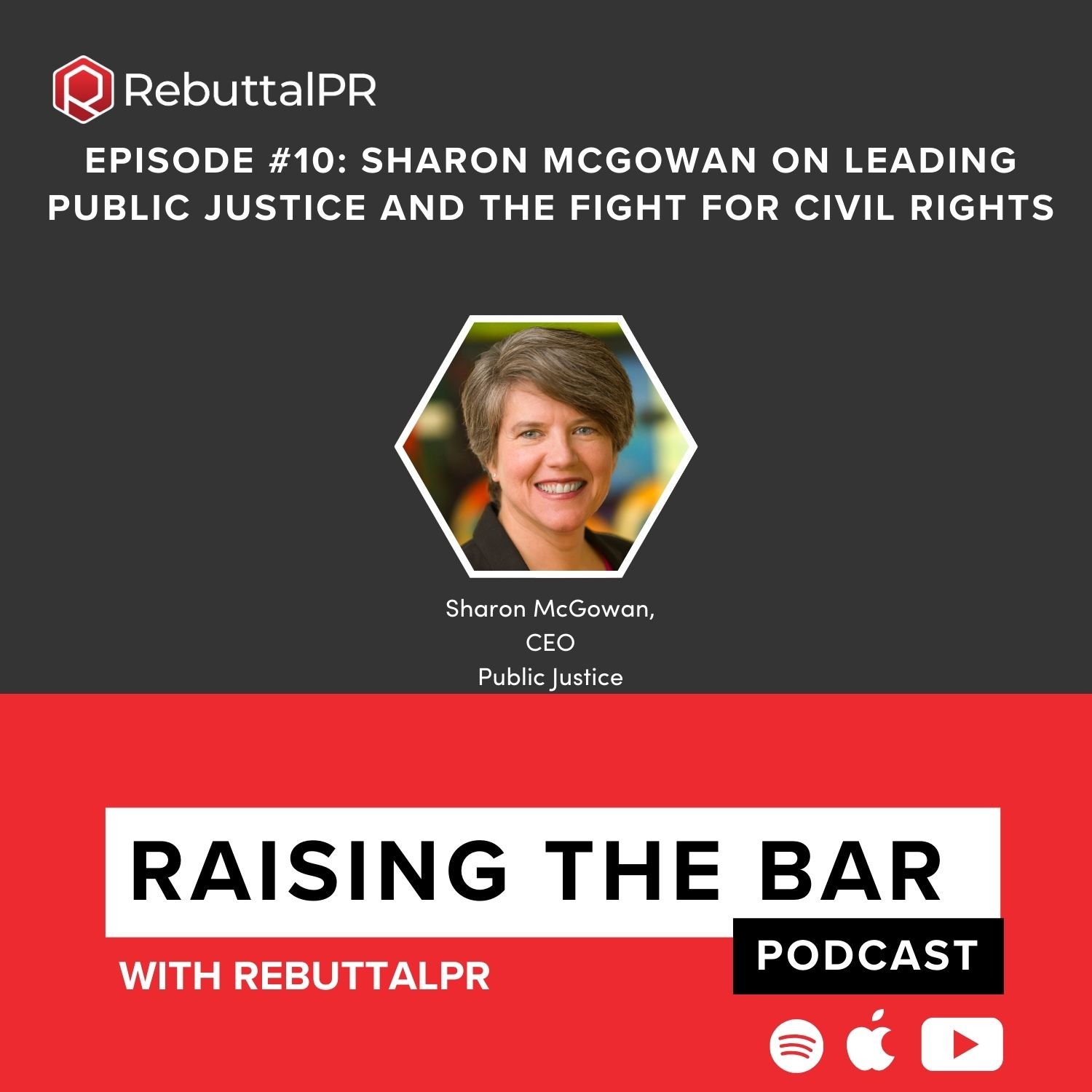
In this episode of Raising the Bar with RebuttalPR, host Ray DeLorenzi sits down with Sharon McGowan, CEO of Public Justice, to discuss her impactful career advocating for civil justice. From her early days organizing political actions to her leadership of Public Justice, Sharon shares her insights on the importance of fearless trial lawyers, the unique challenges in fighting for marginalized communities, and why private enforcement is crucial for justice.
Sharon delves into her journey from political activism to legal advocacy, her role in fighting for civil rights, and how she continues to push forward in today's difficult political landscape. Tune in for an inspiring conversation on how Public Justice stands at the intersection of law and social change, working to protect consumers, workers, and communities from corporate abuse and government overreach.
Learn more about Sharon McGowan and Public Justice: https://www.publicjustice.net.
Read the transcript
This transcript of Raising the Bar with RebuttalPR was generated using AI transcription and lightly edited for readability. It may contain errors, and speaker labels are approximate. The audio recording is the authoritative version.
Welcome to Raising the Bar with RebuttalPR, the podcast where we elevate the stories of the plaintiff's bar and dive into the key trends shaping the civil justice system today. I'm your host, Ray DeLorenzi, and in each episode, we'll bring you insightful interviews with leading attorneys, expert perspectives on current legal events, and in-depth discussions on the issues that matter most. Now, let's jump in.
Knowing how meaningful it is to be able to stand there with a client, because even if you don't always win, the fight is so important. There's an element of just helping to give people agency over what's happening in their lives that I think is so important. And I know that I'm doing it with some of the best and most amazing people in the country, so I feel very, very lucky.
Ray: Hey, everyone, welcome back to a new episode of Raising the Bar with RebuttalPR. I'm your host, Ray DeLorenzi, and today I'm joined by Sharon McGowan, the CEO of Public Justice. For any lawyer there at home who's not familiar with Public Justice, you need to get out from under your rock, I'd say. Public Justice has been around for more than 40 years and is one of, if not the premier, nonprofit legal advocacy organizations in the United States, and is doing incredibly important work for civil justice and justice issues generally in a very important time in our nation. So, Sharon, thank you so much for joining the podcast today.
Sharon: Well, thank you so much for asking me to join you.
Ray: So, let's just start with — again, for those, and I sort of scratch my head: if you're not familiar with Public Justice and you're in the plaintiff's bar — why don't you tell those listening at home, or on the run or in the car, a bit about Public Justice.
Sharon: Absolutely. So, Public Justice has been around for over 40 years, and we were founded at a time when — this is going to sound cute and maybe even a little bit quaint, but the fear was that then-President Ronald Reagan was just going to hand the keys over to the corporations and let them run roughshod over the little guy. And so this was a fierce band of trial lawyers who knew that certainly the government has a role, but the government's never going to save us. In some ways, we really need the ferocity of fearless trial lawyers to make sure that rights on paper actually are meaningful rights in people's lives. And so that was the genesis of what was then called Trial Lawyers for Public Justice.
Now, the organization is known as Public Justice, but in many ways our mission is not only the same, but perhaps as vital as ever, because now we don't necessarily have somebody handing the keys — although they are handing the keys, they're actually handing the passwords over to some of the richest and most powerful people in the country. And so our organization continues to exist to make sure that we are working on behalf of consumers and workers and students and families, and protecting the environment from those people who would get away with whatever they could if there wasn't somebody watching. And so we're there to make sure that we fill that gap.
Ray: A little bit later, I want to get into the work that Public Justice is doing today, particularly in — let's call it — an interesting time in our nation's history. But I want to talk about you and your background first, because you have such a fascinating background. You were a practicing lawyer at Katz Banks Kumin, which is a tremendous plaintiff's-side law firm. You were at the ACLU, DOJ, OPM, and I'm probably forgetting one or two other just amazing achievements in your career that led you to today becoming CEO of Public Justice. I'm curious — when you were young, was there a moment where you were like, advocating on behalf of individuals is what I want to be doing in my life? Tell me about how you got to this moment.
Sharon: Yeah, it was funny. I was thinking about that. On the one hand, some of this I attribute to being a middle child of four. And people are always like, "Don't you realize that four is an even number?" But when you're the second child who gets bumped by twins who come after you, you need to figure out how to claim the stage a little bit. So I think I found my voice there at an early age to make sure that I didn't get lost in the shuffle of an Irish Catholic household with a lot of kids running around.
And I also think it was very funny because my profile isn't necessarily one that would lead you to expect someone to wind up being a plaintiff's-side civil rights advocate. My father was a New York City police officer. The grandparents came over from Ireland, and we can make a nice little pub song out of the whole thing. So we had a bit of a law-and-order vibe in the house when I was growing up. But even when we were watching Law & Order, my dad maybe would be leaning into the "order" side, and I'd be the one being like, "Wait a minute, didn't they just search that homeless guy's shoebox? Isn't that his private property?"
And so from an early age, I think there was enough of a law vibe going on in the house that I discovered I had an enjoyment for standing up for the little guy — whether it was my dog, maybe, who got himself in trouble for bringing in a toy that he wasn't supposed to bring in, and then my father was accusing me of being a counselor, which was maybe used as a dirty word in our house, but which I've come to take on as a badge of honor for somebody who would defend the hard cases. And so from that point on, I think being engaged both politically, but also just finding those different ways to find my voice, is what set me on a path of advocacy, even if I didn't necessarily call it that when I was growing up.
Ray: When you were going through university and law school, were there specific civil rights leaders who really inspired you and reinforced this passion?
Sharon: You know, I was thinking about different memories that I have — political memories. I would say, in many ways, I came of age politically when I went to undergraduate, which I would always describe to people as my first experience living abroad. Because here I am, this kid from Queens who went to the University of Virginia in Charlottesville, and had the opportunity to meet people from not only different parts of the country, but frankly even from different parts of the state of Virginia. For those who know the demographics of Virginia, you have the Northern Virginia folks, the military folks down from Virginia Beach, the more conservative folks from Southwest Virginia. And so I found myself learning about different perspectives that I didn't have exposure to growing up in a very different but still relatively blue-collar, conservative background in Queens.
And then, toward the end of my first year of undergraduate, we had the Rodney King verdicts that resulted in the unrest. And that was my first time experiencing what I would describe as a major political event away from home. I remember sitting with colleagues and friends of mine who were African-American students from Gary, Indiana, and from Los Angeles, kind of looking at me as this Irish kid from Queens whose dad was a cop, and we started to really engage in these conversations about what was happening, what it meant, and what kind of world did we want to live in. So, again, I always think it's funny to have my background and do this work, but then also to say — and then I went to the University of Virginia and came out this raging progressive. People are like, "That's not usually how that works." But when you are plugged into the events of the day and you surround yourself with really smart people who want to challenge you to grow beyond the experience you had up until that point, I always feel like that was absolutely one of the pivotal moments.
And then, leading into that summer, one of my first political memories was seeing Barbara Jordan at the 1992 Democratic National Convention. At that point, I didn't know that I was someone who identified as LGBTQ. I certainly didn't know that Barbara Jordan was somebody who was LGBTQ, and that was not a prominent part of her identity publicly at that time. But I still remember seeing her coming out onto the stage in her wheelchair and addressing the convention. And even looking back and watching that speech, there's a lot about it that is very much of that moment in time, where our politics are very different. But I think of those two events really as my political coming of age, and the opportunity for me to not necessarily just be beholden to where I came from, but actually make the choices about the life that I wanted and the community that I wanted to build.
Ray: So, earlier in your career, you were a staff attorney with the LGBT and AIDS projects of the ACLU. I wanted to ask about when you went there — was it a much different time than today? Was it terrifying? Was it empowering? What were the emotions involved in being in that role when, again, Americans' views of gay people were so different? I mean, people forget — Barack Obama hedged on it until Joe Biden forced it. So it's just a much different era. I'm curious what that experience was like.
Sharon: Coming out right before I started law school, in many ways, really defined the path that I expected to take. Because there were folks who were like, "I'm going to go work at the Justice Department." I'm like, "I'm an openly gay person, I'm not going to go work at the Justice Department, that's not for me." And even in the choices that I made, I was one of four out people in my class of 500 at Harvard Law School, because it was so outrageous — you couldn't possibly expect to get a real job if you were out. So I always look back and think, my 1L summer, I spent part of it at the ACLU with the First Amendment Project, and then part of the summer with the National Center for Lesbian Rights. And then for my 2L summer, I was going to show them that an openly gay person could get a job in big law. So I went and I summered at Cravath. I really showed them. And look, I had a great experience at Cravath, learned a lot, and there are really some amazing civil rights advocates who had a little moment of driving through the Cravath experience. But I remember being like, "Okay, this is not where I fit either."
But I think I'd always known that an advocacy role — because of just how marginalized my identity was — was inherently going to be where I was likely to dedicate my energies. When I first got to the ACLU, I was very fortunate in the sense that my experience prior to that had been as an associate at Jenner & Block working on the Lawrence v. Texas case — one of those right-place, right-time things. In many ways, that was this incredible sea-change moment where the Supreme Court had finally struck down the remaining criminal sodomy bans in the states where that still existed. So we were in that moment of feeling like, okay, we had finally freed ourselves from this badge of inferiority, and now we were charting a path going forward.
But I will say, those first couple of years — even when we started to experience some victories — and then in 2004, we saw the wave of constitutional amendments basically weaponizing the political process to bring out the more conservative base. I was very despondent and went in to talk to some of my colleagues, and they said, "Look, this is how it goes. We litigated through the '80s, when we were losing our colleagues — they were dying because of government indifference." And so now I feel like, in some ways, I draw on that experience, knowing that we're now facing another one of these incredible experiences of retrenchment, and knowing that guidance that was offered to me as a baby lawyer of how this is part of what we do. We pick ourselves up and keep going. But you're right, it was definitely a time that was both exciting, but we were at a very different place, even in terms of public awareness and public acceptance of the issues that are much more mainstream now.
Ray: Talk about your role in the Billington case. It's a landmark Title VII case — it established new protections for transgender individuals against employment discrimination. I'm curious what your approach and thinking was when litigating that case. And then I want to talk about — and you touched on this a little bit in your last answer — do you feel like some of this stuff is getting litigated again today, but publicly? It's like what's old is new again, in a kind of horrific way.
Sharon: Yeah. Just to that last piece — one of the things is that, again, you have to be somewhat of a perpetual optimist to keep sticking your finger in the electric socket and know that you're going to keep getting zapped, but you're kind of steeled for it a bit more every time you do it. But I do take comfort in knowing that every time I see the other side's argument need to change, that is a sign of the fact that we're winning. Because you think about the ways in which arguments about LGBT people, trans people in particular, have evolved over time. It used to start from a place of just being able to say the most outrageous, horrific things — and again, we're sort of back where some of that is back in the mainstream. But as those arguments have changed over time, you recognize that that's a function of not only the legal victories that you've won, but the larger narrative change that you've been able to accomplish.
And so — that's a picture of me standing at the podium with Diane Schroer when we finally survived our three motions to dismiss and our motions for summary judgment, and had our opening arguments in the district court here in DC. That case was so important because when I had the chance to meet Diane — this is somebody who had had an incredibly accomplished career in the military, done all of the special forces things, was hunting Osama bin Laden and doing all these things. When she knew that she had reached the point in her life where she needed to transition and live as her authentic self, service in the military wasn't an option at all, but she thought that she could bring those skills into civilian life at the Library of Congress. And then there was this notion that they wanted all of the skills — as long as they thought they were getting the man that they thought they were getting, and not actually Diane, who had all of the same things in her brain and all the same life experiences. This is one of those moments where — thank goodness for the paperwork of government hiring — because we could actually point to the fact that Diane had been the top person for the job until she disclosed this aspect of her identity, and all of a sudden she wasn't a good fit.
So it was really wonderful to be able to have somebody with such a compelling life story to carry forward these legal claims. She herself was somebody who had two master's degrees and was able to be a partner with us in thinking about some of the choices that we made along the way. But we also had to litigate that case in many ways with a recognition of where the law was at that time. We were really leaning into an area of the law that focused on how a failure to conform to stereotypical beliefs about gender is a form of sex discrimination. But we also knew that there was an element of that going on here, in the sense that Diane wasn't somebody who the Library of Congress hiring official thought of as a real man or a real woman — but at the end of the day, it was her being trans, which was this huge issue. And so we tried to figure out a way to make sure we could litigate it to give us the opportunity to chart that path forward, while also grounding ourselves in the more established legal claim that we knew had been forged in Price Waterhouse back in 1989.
So being able to have both of those things going on at the same time, and building a record that really gave us the chance to make the more vanguard ruling but also have this alternative basis, wound up being really important for us — when we won the case, and we were no longer litigating against the George W. Bush Justice Department, but were litigating against an Obama Justice Department. We were able to say, "Look, we've won this case, we've got a number of bases that support the ruling — maybe you should just take your marbles and go home and let Diane get on with her life." And we were able to accomplish that for her, which then put us on the path toward Bostock, which is, again, a huge victory, but still something that we're still litigating what it actually is going to mean going forward in people's lives.
Ray: You talked before about, "I'll never go to the Justice Department," when you were in law school, and you just talked about litigating against the government — and then you, of course, went to the Justice Department. Did that terrify you? Did you feel like you were going to the dark side?
Sharon: Oh man. I really did. When I made the decision to go to the Justice Department, I really thought of it as essentially hanging up my hat when it came to LGBTQ advocacy. Because at that point — it's very funny, you don't often audition for a job by beating your future employer in court — but it was one of those things where it was like, okay, I had this hope that maybe this would be something that would help the government move forward. But at the end of the day, the Civil Rights Division at that point didn't have any statutes that explicitly authorized enforcement action with respect to LGBT issues, other than the Matthew Shepard-James Byrd Hate Crimes Act. That was the only law that provided any explicit protections for LGBTQ people.
So I went thinking, look, there's this whole other range of civil rights issues that are extremely important to me: race discrimination, sex discrimination, housing, employment. And the fact that I was going to be in the appellate section was going to allow me to work on all those things. But then six months into the gig, we saw a ruling come out of the district court in Massachusetts striking down the Defense of Marriage Act, where of course the government — and OPM specifically — was the named defendant, as the agency that was not granting marital benefits. All of a sudden, I kind of got this knock on the door, and I was like, "Hey, I know something about this. And if you're interested in the Civil Rights Division perspective on this, I could probably crank out a pretty awesome memo within some short time." So the process from that point on, of being able to be on the inside and help turn the ship on that, was far beyond anything that I ever anticipated. I had really thought I was going to the Justice Department to work on other areas of civil rights that were important to me, but the fact that I was able to be someone who brought that expertise inside the government and helped be part of those conversations that, in my mind, brought the Justice Department into greater alignment with justice as most of us would define it, was really an incredible opportunity.
Ray: As someone who has been outside of government — I think people have that view: why can't the government just do the right thing? What takes so long? And then you go inside. How did that inform your perspective of how — even at Public Justice now — you approach the government, litigate against them, and know the world of what is possible?
Sharon: Yeah. It's so interesting, because when I first was thinking about how we could leverage the Schroer decision and the fact that this Justice Department had decided not to appeal — we had an Obama administration where we had good people in different offices. Elaine Kaplan was there as the general counsel of OPM. And my little brave self wrote Elaine a letter and just said, "Well, look, since the government has not appealed this case, and this is clearly the right interpretation of Title VII, maybe OPM could just issue guidance and tell everybody in the federal government to stop discriminating against trans people." And she was like, "You're so cute. That's really funny. That's so not how this works." But that piece then resulted in work that was happening over at the EEOC. And to the extent that the EEOC has adjudication authority over the federal-sector workforce, they were able to do their piece, and we were able to put all those things together.
And it's interesting because at Public Justice, we don't necessarily litigate against the government in the way that I had at the ACLU, where we kind of go after government wrongdoing. But I do think it's important to recognize that when you're litigating an entity like that, there are these really interesting entrenched institutional interests that often really stand in the way of justice. It's like, "Well, if this person wins, then other people might win too." And of course, from our perspective, it's like, right — that's the point. If all of these people are experiencing discrimination, how about we fix it for all of them, and not force us to litigate it one person at a time? But yeah, it was one of those funny moments where I had this vision of, well, we'll just win the case and then the government will do the right thing — and it was like, oh no, it's a lot more complicated than that.
I do think, as well, it showed the importance of having the storytelling going along with the stories. Because it's one thing to say that this is the right rule of law, and it's another thing to have a story out there about the case and about the principle that is so compelling that you have people being like, "Well, why isn't that the law? That actually is the right answer. That was the right outcome for Diane. She served her country, and the idea she's not going to get a job just because of this thing that maybe I don't even understand — give me a break, that's not fair." You need that piece too, because there's the political side of this as well as the just logical, legal side of it.
RebuttalPR is a strategic communications firm that works exclusively with the plaintiffs' bar to market their firms and win high-stakes litigation. For more than 15 years, the nation's leading plaintiff law firms have turned to RebuttalPR to create winning communications campaigns, ranging from billion-dollar mass torts and class actions to positioning attorneys in their markets to grow their businesses and make a bigger impact. What sets RebuttalPR apart is the unique skill set of our team, which combines legal knowledge with public relations expertise. Our team's ability to understand the facts and law of a case, as well as the media landscape, means we can develop compelling, narrative-driven campaigns that resonate with key stakeholders and support your firm and legal strategy. Visit our website, rebuttalpr.com, to learn more. Now back to our episode.
Ray: For those just tuning in, we are here with Sharon McGowan, the CEO of Public Justice. Sharon, I want to pivot a little bit now to your journey to get to Public Justice. So — you're at Katz Banks Kumin. Do you just get a call one day, like, "Hey, you interested? You want to come in and talk?" And what was your view of Public Justice at the time — what you knew about them, your impressions, and what made you want to go down the path?
Sharon: Yeah, it was so interesting. I remember when it first came on my radar screen that Public Justice was in the market for a new leader — that Paul Bland, who had done an amazing job as executive director of Public Justice, had done the right thing in terms of giving people runway to let them know that he was planning on making this transition so that they could do a fulsome search. And I think it was a few months into that before it even really popped on my radar screen, because it wasn't necessarily something I was looking for. I was doing really meaningful plaintiff's-side employment work with Debbie Katz and Lisa Banks and the entire great team at Katz Banks Kumin.
But I did know about Public Justice, in particular from my time as legal director at Lambda Legal, when I spent five years leading the LGBT advocacy program there. Public Justice was always this organization that not only you could count on to write these really whip-smart briefs, but they were so smart, so solid, and obviously aligned with us on issues. Yet they also had this other piece of their work that, if I hadn't gone to Katz Banks, I don't know that I necessarily would have really registered in the same kind of way. Because after two years doing individual representation of workers who experienced discrimination — recognizing that the first question you need to ask, or maybe the third question you need to ask, is, "Hey, did you sign an arbitration agreement?" — I don't know that that would have been as front and center in my mind, understanding the importance of that part of Public Justice's work, in a way that some other parts of Public Justice's work, around the student civil rights area for example, had been much more prominent for me based on the areas where I had litigated.
So I had always found myself, and really identified with, this side of the "v." Public Justice in many ways was righteously aligned, but then also, when I was able to see the areas of work that they did, and the fact that they were also identifying a different swath of bad actors that really impact our lives — that it's not just all about the government as the only bad guy. There are ways in which corporations, left free to their own devices, will run roughshod over people. And I loved that fighting spirit of it — of, "We are going to be the David versus the Goliath here." So I knew that there were some parts of my background that completely aligned substantively. I knew that there were other areas of our work where I didn't have as much deep substantive expertise, but I knew that the mission, the goal, and the fight was something that very much sang to my heart. And I always say, now, seeing where we are today — if I hadn't found Public Justice almost a year ago, I would be knocking on the door of Public Justice, asking them to let me in so that I could be here and be part of the fight with this great group of people.
Ray: So now it's been almost a year that you've been CEO, and you came in as a litigator, a fighter — and now you're running an organization. How has that transition been? Do you view it differently — like, "I need to let the fighters fight, and I need to have a more global view"? What's that been like for you?
Sharon: It's really, in some ways, like the best of both worlds for me. Because we are still an organization that is small enough that we have these conversations about where it is that we're going to be dedicating our limited resources, our limited bandwidth. There's no lack of incredible things that we could do — it's just finding the places where we have the best opportunity to do it. And so to the extent that I still get to be engaged in those substantive conversations, that feeds my soul. And to the extent that I don't have to be the person who tries to shave off that last thousand words to get the brief under the word limit, I also feel very liberated by leaving that to someone else. And then I get to read the amazing end product at the end of the day.
But the other thing I really enjoy about this role is: I get to still be in the legal world, but I also get to share the good news beyond. To be the person who is there and says, "Look, you don't need to necessarily know every last nuance or every last footnote of the court's most recent Rule 23 decision — but let me tell you why this matters." To be able to be what I describe as the cheerleader-in-chief, as much as the chief executive or staff leader of the organization — that to me is really the place where it is fun. And what I have to sell is so awesome. For some people, the idea of having to go out and, whether it's raise resources or garner support — I said, look, when I was doing plaintiff's-side work, I would be writing demand letters to people who hated me, hated my client, and thought we were all pieces of, you know. Whereas now I actually get to go and tell people — is that okay? Sorry, hopefully a little freshness in the podcast. But now I get to go out and try to convince people to give me money, where I have something really great that they want to be part of and that I can sell. So that's fun. That is fun too.
Ray: So, lawyers listening to this probably have a perception of Public Justice, and you obviously must have had a perception before going inside of Public Justice. What surprised you once you were inside those four walls about the way the place operates, or how it makes decisions about the issues that it's going to advocate on?
Sharon: You know, it's interesting coming to an organization after it has gone through its COVID transition. I was leading Lambda's legal department while we were in the midst of that and trying to deal with it all in real time. And so now, to be at an organization like Public Justice — where we're kind of figuring out, what do we keep from the changes that we had to make post-COVID, and what are the things that we're going to try to recapture — I think that's been something that's been really interesting and enjoyable to me: to watch the ways in which the staff, and frankly our board as well, has tried to find that balance of staying connected in both personal and intellectual ways, recognizing that we now have a staff that is spread over half of the states in the country. So that's one of the things that's been really interesting to think about, just work in general, in our post-COVID environment.
But the other thing — this is something that I didn't really expect — at the ACLU, we had our network of state affiliates, and those were kind of like our eyes and ears on the ground. I don't know that I fully understood or appreciated the way in which the incredible network of thousands of lawyers who are part of the Public Justice family are kind of like that equivalent for us, on the civil side. They're out there telling us, "Hey, we're starting to see this tactic," or, "We're starting to see this language in our contracts — are you guys on it?" And so to be able to have all of this spread throughout the country, and to have a hub where we can bring it together — to figure out how do we, as an organization that doesn't necessarily have to figure out whether or not every case is going to pay the bills and keep the lights on, be there and strategically come in to make sure that the brave and fearless advocates out there have as few obstacles in their path to seeking justice for their clients as possible.
Ray: You're one of the, I'd say, more vocal organizations related to the work of the Trump administration currently. And I'm curious — how do you make a decision, with all that that administration is doing, of what are the battlegrounds we can fight on, and what are the ones where the cause is righteous, but we have to cede that for the moment?
Sharon: Yeah. This is where I think it's important to engage in partnerships with other organizations that predate the crisis that you're in. And I'm so proud that Public Justice has been both a leader and an active member of a number of coalitions. For example, we're part of the Leadership Conference on Civil and Human Rights. There are a number of consumer coalitions. We've got great partners in the National Consumer Law Center, NACA, and other organizations like this, where we can figure out: okay, what are the things that are happening that are really within our sphere of expertise, that we have the ability to lean in on — and what are some of the things that are happening that potentially impact the rule of law as a whole, that isn't necessarily Public Justice's core expertise, but where we have a role to play, whether or not it's getting letters to the editor in the right places to prevent some member of Congress who's a key vote from repealing a CFPB rule that everybody wants and there's no reason that anybody should be destroying?
And then I think there are some other places where we always have this calculus of — Sharon McGowan, citizen, is deeply distressed and disturbed and concerned about things that are happening. But whether or not Public Justice's voice or expertise is the one that's going to really move the needle — and what do we not do if we run and pile on to an area of work that is already being well covered and well tended? As long as we know that the phone line remains open, so that we can get the call for the amicus brief or the support or the communications work — that, I think, is the way in which we're trying to navigate not abandoning the part of the field that everyone is relying on us to defend. Because the two worst things we could do are either, one, abandon the areas where we do have this expertise, or — a problem that all of us are facing — just curling up in a ball and being overwhelmed with despair, because then they get to just run the field.
So I think being able to be expansive in thinking about the ways in which we can bring our expertise around a number of the procedural issues that we work on — standing, for example, like who gets to get in court — that is a place where Public Justice has been doing that work really meaningfully for many, many years, and it's likely going to be coming up in some of these cases going forward. So we don't necessarily have to be the organization that runs in and files the complaint to have a role to play in part of the larger work that's going on to defend our democracy and the rule of law.
Ray: What are the one or two issues that you're hearing most about from trial lawyers, that they're saying to you, "Public Justice needs to be in the ring on these"? I know by the time this gets published, it could be completely different issues, and it's only a couple of weeks away, because so much is happening. But I'm curious what is in the zeitgeist right now.
Sharon: Well, I mentioned standing, in part because I think that's one of those issues where it feels really abstract to some, but when you really translate it into, like, who actually gets to get their foot in the door. We have seen this play out in the context of federal decisions really trying to constrain this notion of who has standing for Article III purposes — making sure that we are limiting that, but also making sure that that doesn't then have downstream effects into state courts. Because a lot of the cases that our members are litigating are in state court. And somebody once said to me, standing is the new black — it used to be qualified immunity as the way to keep everybody out of court, but now actually a lot of that energy is shifting to standing, to standing doctrines. So that is a place where, again, it's not necessarily the sexy front-page news story, but if you can't actually get past that first step, the ability to vindicate all of these other rights that are substantively so important is going to completely shrivel up and diminish in really significant ways.
And then obviously we know that class action practice is constantly under attack, because it is such an effective vehicle for being able to vindicate rights — particularly in the scenarios where the corporations get to do these nickel-and-dime sort of things and enrich themselves, but it's not worth any one person taking that on. We know that the Supreme Court is going to be considering a case where we'll really need to see how much damage may happen there. And I think it's really incumbent upon us to make sure that we are engaged in not only the legal advocacy, but the public advocacy around the importance of this tool. I think those things are going to continue to be the places where our members are going to look to Public Justice to continue to play the role that we have — both as partner and leader — in terms of beating back these attempts to basically shut down access to justice, not only for our clients but also for the public as a whole.
Ray: So you mentioned not wanting to curl up in a ball, which I think is a completely normal reaction. But you've taken on all these battles, really on the side of David versus Goliath. And you've probably heard, "Sharon, why are you doing this? This is not the right time." What gives you hope every day to keep going?
Sharon: You know, I think there are a couple of things. One is knowing how meaningful it is to be able — and I just think of that picture behind me — to stand there with a client. Because even if you don't always win, the fight is so important. The fact that we are able to, not only ourselves at Public Justice with our clients, whether it's a trans student in South Carolina or a woman who's gotten ripped off by a company trying to literally sell her a bill of goods — there's an element of just helping to give people agency over what's happening in their lives that I think is so important.
But then, I also am a mom of two kids — my 12-year-old and eight-year-old. I look at them, and this is not negotiable. I don't get to just curl up in a ball and hope that it'll all be fine by the time they're adults. My eight-year-old was saying, like, "Why don't I get to vote in the election? It's my life. These things are all going to affect me." And I was like, "100%. And we can have a conversation about that, but let's go and knock on some doors and do some voter education and get people out." James Baldwin and so many other authors talk about the fact that we just don't have the luxury of being able to give up. It's not our job to complete the work, as one of the famous scholars will say, but shame on us if we don't do our part when we have the opportunity to do so.
So that's kind of how I — I'm not saying I'm in a great mood every morning, and sometimes I just need to turn off the newsfeed and go build Legos with my kids. But whatever it is that you do for your self-care, I feel really lucky that I get to get up every day and have a job that lets me channel that energy. I don't have that moment of, "I don't know what to do." I know what to do, and I know that I'm doing it with some of the best and most amazing people in the country. So I feel very, very lucky.
Ray: Sharon, I really appreciate the time. To close this out, I would like you to send a message to trial lawyers who, for some reason, are not members or haven't supported Public Justice in the past. Please make the pitch and encourage them to do so.
Sharon: Oh my goodness. Thank you so much for that, Ray. Look, Public Justice is an organization that believes in the power of the trial bar to build a better world. And we believe in you and the work that you're doing, and we are here to help — but we can't do that work without your help. So whether you're a class action practitioner, a mass tort practitioner, somebody who's doing individual employment cases or personal injury cases — whatever it is that you do and that you care about, I guarantee you there's a part of what Public Justice is doing that is affecting and hopefully improving your quality of life as a lawyer in this space. So please learn more about us, and certainly please support us if you can.
Ray: Sharon McGowan, the CEO of Public Justice, thank you so much for joining the podcast. We really appreciate it.
Sharon: Thank you, Ray. Thanks to everybody at RebuttalPR. You guys are great. Thank you.
Thanks for listening to this episode of Raising the Bar with RebuttalPR. Don't forget to subscribe and follow to join us next time. See you then.
Discover Insights & Trends
Featured Stories

- September 4th, 2026
- 6 minutes
- Melissa LoPiccolo
How to Vet a PR Firm: 8 Questions to Ask Before the Contract is Signed

- August 21st, 2026
- 4 minutes
- Stephanie Wolf
Aligning Your Benefits with Your Values: Parental Leave Edition