
- August 6th, 2026
- 5 minutes
- Ray DeLorenzi
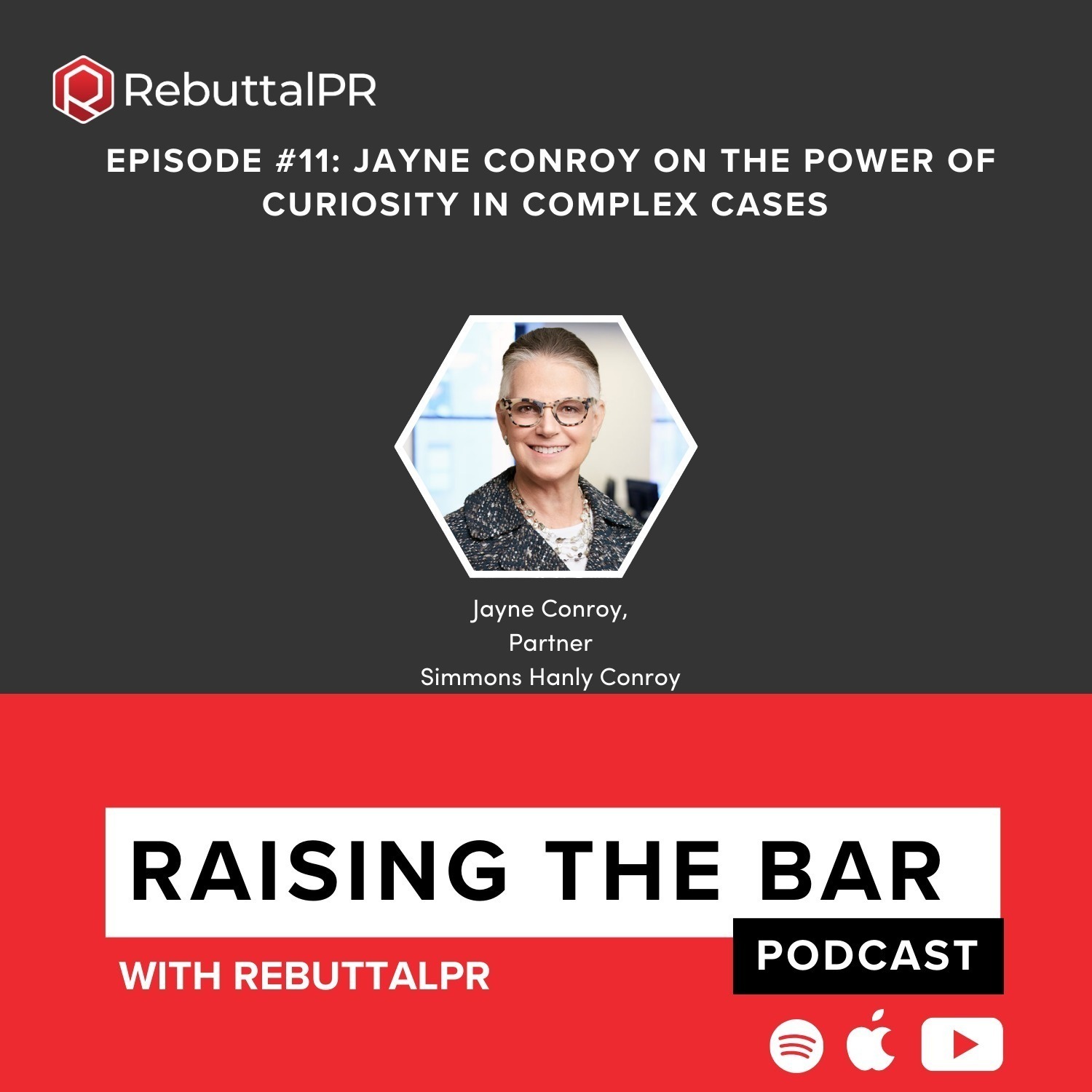
In this episode of Raising the Bar with RebuttalPR, host Ray DeLorenzi is joined by Jayne Conroy of Simmons Hanly Conroy. Jayne shares her incredible career trajectory, from growing up in a town deeply impacted by toxic waste to working as a defense lawyer before fully transitioning to the plaintiff side.
She discusses her pivotal role in landmark cases such as the opioid MDL, her experience leading teams in massive multidistrict litigations, and her personal philosophy on what makes a good trial lawyer. Jayne also talks about how she mentors the next generation of lawyers to chase the story and make a meaningful impact.
Learn more about Jayne Conroy and her firm here: www.simmonsfirm.com.
Read the transcript
This transcript of Raising the Bar with RebuttalPR was generated using AI transcription and lightly edited for readability. It may contain errors, and speaker labels are approximate. The audio recording is the authoritative version.
Welcome to Raising the Bar with RebuttalPR, the podcast where we elevate the stories of the plaintiff's bar and dive into the key trends shaping the civil justice system today. I'm your host, Ray DeLorenzi, and in each episode, we'll bring you insightful interviews with leading attorneys, expert perspectives on current legal events, and in-depth discussions on the issues that matter most. Now, let's jump in.
I just think the most important thing you have to have is curiosity about what you're doing. I think you'd actually be successful as either a plaintiff's lawyer or a defense lawyer if you have curiosity about how something came to be. And I see that spark in our young plaintiff lawyers, too, when they finally get to the documents and they can start to say, I see how this happened, I understand what was going on here.
Ray: Hey everyone, welcome to the latest episode of Raising the Bar with RebuttalPR. I'm your host, Ray DeLorenzi, and today I am joined by Jayne Conroy of Simmons Hanly Conroy, one of the most celebrated, esteemed, accomplished mass tort lawyers. Jayne, thank you so much for joining the podcast.
Jayne: Well, thank you, and thank you for that. I'm not sure it's all true, but thank you.
Ray: Well, now you have to live up to it in the next 30 minutes. So let's see. So, Jayne, we were talking beforehand. I said that we can talk about all the cases you've worked on and we can go all day on that, but I'm always interested in learning about the person behind the cases. So why don't you just tell me — where did you grow up? Tell me about your family growing up. I'm always interested in the points that made you who you are today.
Jayne: Sure. I grew up in Woburn, Mass, of A Civil Action fame. You're probably too young to remember that book and that movie. So I grew up very aware, before the Erin Brockovich movie came out, about toxic waste and that sort of thing. But I never really thought about the legal end of things, because no one in my family is a lawyer or had been a lawyer when I was young.
Both of my parents grew up in Woburn. Both of their families are longtime Woburn residents. Woburn is just outside of Boston, which you'll probably hear when I speak, with that Boston accent. And I'm the oldest of five daughters in my family, and now there are two others that are lawyers. One is one of my partners. My daughter's a lawyer. A lot of spouses that are lawyers. So we went from some no legal knowledge to quite a bit. So I always kind of harken back to Woburn as an interesting incubator for the kind of work that I do.
Ray: At the time, when you were growing up, was that pollution or contamination something that was known about in the town and informed you? Or is it just, looking back, one of those ironies?
Jayne: I know it was very known. My dad worked in a leather factory. And for 100 years, Woburn had an odor to it — it was a tannery town. We were the largest tannery town in the world. There were so many tanneries. So toxicity was always sort of well known, and there were places where you couldn't have a ball field and things like that growing up.
But I think what we did see was a major expansion in the 60s and the early 70s into areas of town that had never been populated. And that's when those leukemia plumes came in. And so I think people — frankly, my neighbors, my family, my friends — everyone was pretty sure that the culprit was some sort of toxicity. It turned out it wasn't the tanneries at all; although they smelled the worst, they weren't what was providing the toxicity. So there was a little bit of detection that went on there. But it was very, very well known.
Ray: So I understand you went to college thinking you were going to be a doctor.
Jayne: Yeah, I did.
Ray: How'd that work out?
Jayne: Well, I was a biology major, which I think has informed a lot of what I do now. But I was very interested in science — love it, still do — and was very committed to being a physician. And then once I was more of a junior or senior, I started to think about, did I really want to work in a hospital? Because I had done a lot of volunteer work in hospitals, and I just didn't really like the environment all that much. So when I graduated — back in the day, the day after I graduated — I started working for a family friend who had just started the DES, or diethylstilbestrol, litigation.
Ray: I'm familiar with it, yeah.
Jayne: Yeah, he really needed somebody that could read the scientific studies. And so I was right there. And I worked as a — I guess you'd call it a paralegal; it wasn't really even a word then, but I worked as a paralegal. And that was my first introduction to a law firm, or the law. I mean, I would tell you, I didn't even know the difference between a plaintiff or a defendant when I started in the law firm. And I loved it. I just thought, this is terrific. Every day is different.
Ray: How long did you do that before you went to law school?
Jayne: I applied to law school right away. I loved the job, and I had a lot of student loans to pay back. So I went nights to law school in Boston. So really, almost right away, I went to law school. It was great.
Ray: So I assume by the time you get to law school, you've learned who a plaintiff is and who a defendant is. And when did you decide there's one side of the V I want to be on versus the other?
Jayne: I didn't really think a lot about that. My job — the firm that I worked for was a defense firm. And that's where my paycheck came from. And so I didn't really feel like I had a choice. And even now, plaintiff firms — young lawyers often don't start at plaintiff firms because they're much smaller. And frankly, plaintiff firms really need someone who's had a little bit of experience in what's going on. So I worked for a defense firm, and we had some really big cases. We were a very small firm in Boston, but it was interesting. We had some really big cases and I had great opportunity to work on them. But it wasn't until years later that I made a hundred percent switch.
Ray: What was the impetus for that?
Jayne: The firm that I was working for, and my boss at the time, Walter Murphy, was chosen to try the first asbestos property damage case in the country. And we tried that case in Boston and we got a defense verdict. At the same time, a case had been filed by Chase Manhattan Bank in New York against the same defendant — the largest asbestos manufacturer in the world. So it wasn't like an insurance coverage case or anything like that. It was a kill-the-company-directly case. And so I, having been very involved in the trial of the Prudential building, was asked to come down and be on the trial team for the Chase Manhattan case, which was unusual at the time. I was commuting between Boston and New York, in New York City during the week. And then we tried that case and received a defense verdict there as well.
And that basically was the end of property damage asbestos. At the same time, personal injury asbestos cases had really started to skyrocket. And so my partner Paul Hanly, who was the lawyer in New York, and myself took over all of the personal injury defense work for the company that we represented. And again, no insurance coverage. It was a British company, so we had a lot of autonomy in the United States. We managed that litigation until that company — and then another iteration of that company when it was purchased — went into bankruptcy. And at that point, we became 100% plaintiff lawyers. We had always taken plaintiff cases because we didn't have any conflicts — one-off cases. But in 2001, we became 100% plaintiff.
Ray: So you're representing companies and manufacturers. It sounds like it was a slower transition to going to the plaintiff side. But was there ever a moment doing the defense work where the passion sort of petered out, or was it just where the momentum at the time drove you?
Jayne: I would say that because we were national counsel, dealing with cases throughout the country, the efforts we made were primarily to be sure that the mesothelioma victims received the actual settlements. And we tried to tamp down asbestosis — things that were taking settlement monies away from the mesothelioma victims. And I don't mean to sound like it was some lofty ideal, but we tried to keep the company liquid for as long as we could and to be careful about how the money was spent every year.
And that actually served us very well, because when that company went into bankruptcy, it was the other plaintiff lawyers — the ones we were very used to trying cases against and doing very large settlements with over time — which gave Paul and myself a very different perspective about how large cases can be managed and settled. And frankly, all the people we knew were the people in the plaintiff's bar. That's who we dealt with all the time. So it was a very easy transition.
Ray: I've heard from a lot of litigators, particularly someone like you, very much accomplished, who talk about that defense-side experience and how it helps build the skills to be a really fantastic plaintiff's lawyer. Do you agree with that sentiment first? And is it something you look for in your current firm when you're looking at talent?
Jayne: I think I do. But I think what it primarily does is it creates that seeing-the-forest, not-just-the-trees perspective. If you are in a position where you are trying to manage the liabilities of a large company — I try with my lawyers to get them to see what a defendant is dealing with. There are so many things that, as a young lawyer, I'm worried about: taking a deposition, finding the right documents, doing that sort of stuff.
And I think what working on the defense side, and the position I worked in, gave me was a perspective that it's not just the liability story. If you want to actually close the case, it's the financial health of the company, it's the stock price, it's what the board looks like, what kind of information is getting to the board — all sorts of different pressures and tensions that come into managing a really large litigation. Now, that's a little bit different than a single car wreck case or something; my experience is more in the larger cases. So to me, having that corporate understanding of what's going through a defendant's mind is really helpful in trying to leverage a plaintiff's case in the correct way.
Ray: I don't want to dwell on this too much because the cases are in many ways still pending. But you were lead in the opioid litigation, which has recovered more than 60 billion, I think, at this point, at the time we're taping — which is an incredible achievement. How did you first get involved in that case? Do you remember the moment where someone's like, hey, opioids, we have a massive problem here?
Jayne: Well, actually, it goes back much further than that. When the company that we represented as a defendant went into bankruptcy, we were approached by a plaintiff lawyer in Atlanta whose wife had become addicted to OxyContin. And this was 2001. OxyContin had come on the market at the very end of 1996, and so you were starting to see problems. And so Paul Hanly and myself — in hindsight it was kind of crazy — began a lawsuit against Purdue Pharma for the addicting qualities of OxyContin and the failure to warn about that. As it turned out, it was a killer for us. We had about $200 left in our checking accounts when we finally settled that case, but we did get the label changed.
And in our case, we joined up and provided documents to the Department of Justice for about six years. The general counsel, the medical director, and the CEO were all indicted and pled guilty to federal charges. And that was in 2007. We recovered on behalf of 5,000 individuals who became addicted to OxyContin taking it under a prescription. And Paul and I thought we had solved the opioid problem. What we had done, in hindsight, was establish the bar — what it was going to cost a company if they got into the opioid business.
And so, fast forward, we moved on, we did many other cases, figuring opioids were behind us. And in 2016, I received a letter — an actual piece of paper letter — from the Assistant General Counsel of Suffolk County in Long Island. She had been to a conference and was hearing about people looking at public nuisance for a lawsuit because of the epidemic and what it was doing to communities. Within a month, we were deep into round two of the opioid litigation. So I've basically been dealing with Purdue since 2001.
Ray: Well, you'd had that break there. I'm curious — when you get the letter, is your reaction like, you know there's something here, or is it, oh, not again, or how did we not see this years ago? What goes through your mind in that moment?
Jayne: Maybe all of it. Yeah, a little bit of all of it. But it was interesting to me, because we were all very aware of the rising death rates and all of those sorts of things. And I was particularly aware of the misleading messages that were provided to physicians over the years and the misunderstanding of what addiction was. But I had not focused, until I received that letter, on not just the personal tragedy of the epidemic, but what it was doing to communities. For example, why a school system couldn't get new books, because they were busy dealing with emergency vehicles and coroners and all the things that are associated with the epidemic. And I don't think I had put it into that perspective until I got that letter. And from that point on, it just clicked. It was like, okay, I understand what this is all about now.
RebuttalPR is a strategic communications firm that works exclusively with the plaintiff's bar to market their firms and win high-stakes litigation. For more than 15 years, the nation's leading plaintiff law firms have turned to RebuttalPR to create winning communications campaigns, ranging from billion-dollar mass torts and class actions to positioning attorneys in their markets to grow their businesses and make a bigger impact. What sets RebuttalPR apart is the unique skill set of our team, which combines legal knowledge with public relations expertise. Our team's ability to understand the facts and law of a case, as well as the media landscape, means we can develop compelling, narrative-driven campaigns that resonate with key stakeholders and support your firm and legal strategy. Visit our website rebuttalpr.com to learn more. Now, back to our episode.
Ray: Again, we're joined here by Jayne Conroy of Simmons Hanly Conroy. Jayne, I want to ask you — a few opioid cases have gone to trial. You've been lead trial counsel. What is your preparation like in this type of case, where you're representing a governmental entity and they have their own army of attorneys? You guys, though, are neck deep, or worse, in documents. What is your process?
Jayne: It's a total immersion. Over the years that you're working up the case to get to trial, you're building trust with your client, getting to know them, and your clients are getting to know the people on your team. It takes a massive team to do this. And what we found in the opioid litigation was particularly successful. I've been in a lot of these multi-district litigations where we get a group of lawyers from different law firms together, and basically what you need to do is form a new law firm with all these different firms from around the country. We were particularly successful at that in the opioid litigation.
And I think in part, it was so devastating to the communities — it was such a difficult case, it was a new legal theory — that we really worked together. Everyone, whether in person or in conferences, was together 12 hours a day for years. So in preparation for trial, it really was just a continuation of the way we had worked all the way through. Because when you are a team of lawyers suing 16 or 18 different defendants who have all hired the best defense firms in the country, it's a 24-7 operation. Everybody is trying to kill you, trying to kill your theory, trying to kill your witnesses.
So by the time we got to trial, we would select a trial team. We had the best support for getting the exhibits prepared and the deposition designations ready. There's just so much behind the scenes that takes place in order to have a trial in front of a jury and a judge be seamless — so that your story is solid, and that you're in the right. And so we were very fortunate to have everybody in the boat rowing in the same direction, the best lawyers on the plaintiff's side that I've ever worked with.
Ray: Going back to the resolutions you obtained to date, and your earlier discussion about knowing how a company works, what's your philosophy? How do you land the plane on these? I mean, these are massive companies. What was your thought process to even figure out, like, how big is the table going to be? It's extremely complicated, and you really do need mediators to sort of help you through this.
Jayne: You need financial firms that will help you work through the numbers. Because — first of all — there was never a desire to ban opioids or to bankrupt those companies that were willing to come and talk about settlement. What you really need to do is set something up that keeps those companies alive but has them paying the most that you can wrestle from them. But then it's very complicated. The opioid litigation itself is the most complicated I've ever seen, because we have states seeking abatement dollars, and we have counties and cities seeking abatement dollars.
And we had the problem that some had sued and some had not sued. But if you were going to actually make a difference with respect to the epidemic, you couldn't just abate a couple of counties in a state, or a couple of states in the country — it had to be everything. So every single state and county receives money in the opioid settlement, whether they sued or not, as an effort to stem the epidemic, which I believe it has done. But that took months. We did a handshake deal with the three distributors, and it took us probably 16 months after that to figure out how to actually pay the money fairly, where it would go, and how it would go. Every state had to come up with what percentage they should get, how they would divvy up the money among all the counties, how you would do it over time, and what kind of protections to have in place — just super complicated, and a recognition that when you do something like that, you need help from big financial firms to do that math.
Ray: Yeah. In preparing for this episode, in addition to opioids, you've done Volkswagen diesel, Deepwater Horizon, the DePuy hips, 9/11 cases. One case I want to ask you about, which I was not familiar with, was your representation of a group of Haitian boys against a school in Connecticut. I've seen a lot of these cases, and this one just sort of jumped off the page. I was wondering if you'd take a couple of minutes to talk a bit more about that.
Jayne: Sure. And that was a heartbreaking case. Fairfield University had a program where they had a school and orphanage set up in Cap-Haïtien, Haiti, which is on the northern coast of Haiti, north of Port-au-Prince. And they had put an individual there who was abusing the boys. He was funded by Fairfield, and that's why it ended up in Connecticut. The case began when Interpol in Haiti got involved and arrested the man that was abusing and raping the boys in the school, in the orphanage. And then when that happened, we were called.
From Boston, I know Mitchell Garabedian quite well, and he had received a phone call and he called me. The case was in federal court, which is very unusual for a sex abuse case, but because Interpol had been involved — and he practices in state court and knew that I did a lot of work in federal court — we got together, traveled to Haiti, met with many of the victims, and saw that, in fact, 12 victims had come forward in the very beginning with Interpol. As the case progressed — and it took many years to do this — we had over 100 boys that were raped at the orphanage school. And basically what we said is that it was known to the university and to the Jesuits what was happening there. And it was just a tragic case.
Haiti is a tragic place. When we were there, we traveled commercially and spent many years going back and forth, doing all the depositions and such of the boys. But now we can't travel there, and we have sporadic contact with the boys, who are now men, because of the conditions in Haiti. Even when we settled the case, it was impossible to have the settlement dollars kept in Haiti — they had to get bank accounts outside of Haiti to hold that money. So it was a tragedy all around. These young men were all orphaned, street children. Some of them had never even learned to read. So we were able to get them significant compensation that changed their lives, but they lost their childhoods.
Ray: What's your approach to a case like that? When we just talked about another case dealing with sophisticated municipalities — I mean, how do you go about it? What are the parallels, and how do you approach that case? You still have to litigate it, but you're dealing with such a unique set of clients.
Jayne: Sex abuse cases are very difficult anyway. And here we had clients that spoke a different language and culturally were very unfamiliar with us and what we did. It just took time and trust to work with each and every one of the boys as we developed their story. It took us a lot of time in Haiti. My team was there even more than I was — many more days, many more months than I was. It's no different than a case in the U.S. It just has more complications: language complications, travel, all that sort of thing. But essentially, once the liability is there and you're able to get that story out to the court — we didn't have to try that case, but we certainly laid bare what was happening.
Ray: Yeah. You've done all these varied types of cases. What do you look for now, when you've accomplished so much? And I don't mean to keep blowing smoke your way, but what's next? What excites you when you see a potential case where you can make an impact?
Jayne: I'm very involved right now in the social media cases, trying to really appreciate the business and how it's impacting our children and what that looks like. I'm pretty sure of the liability story, but it's a little difficult to navigate as we try to figure out — you know, courts have lots of different decisions, in many different courts, about trying to wrestle with these issues. So that to me is where I'm spending a lot of time. In addition, we're still in the opioid litigation; we still have the pharmacy benefit managers that are defendants, Optum and Express Scripts. So that's taking a lot of time, but that's a business I understand after all these years in the opioid litigation. The social media, and the algorithms, and the failure to verify age — those types of things are very interesting to me.
Ray: Jayne, to pivot a bit more to the personal, I understand your daughter now practices with you.
Jayne: She does. My younger sister does too, actually. It's kind of funny — they're closer in age.
Ray: Did you want her to follow in your footsteps? What is that dynamic like?
Jayne: You know, I never really thought about it. I wasn't really sure that she would ever be interested. And with all the travel and the craziness of my career, it wouldn't have surprised me — I have two daughters — if both of them were like, forget it, I don't want anything to do with the law. My youngest is an emergency room nurse, so she went in the science direction, and she's very good to have around; it's very good to have a nurse around.
Mildred, my oldest, decided to go to law school after college, and it's very funny — she's very well suited to it, I must say. And she chases the story. It's been fun for me to see someone grow in the business. But she didn't work for my firm; she worked for Mark Lanier for about five years, which was a great training ground. So I'm very happy she's with us now and, unfortunately, on the road all the time doing the kind of stuff that we do.
Ray: Curious — does she ever ask for advice from you, or does she go elsewhere for it?
Jayne: I'm not sure. I don't know whether, when she asks me for advice, it's just to make me feel good, or she didn't like the answer she got somewhere else. I don't know. But in my firm — because of the kinds of cases we do, and the fact that we work in teams — we have a lot of conversation all through the day. And we're in different parts of the country, so people just get on Zoom. And so there are a lot of ideas and thoughts that are floated all the time, which is a very fun way to practice, I must say — to be able to rely on different people's expertise about things. It's great.
Ray: You know, with so much discussion, particularly in the big law community, about how their firms are responding to the Trump administration, and some maybe looking to get into the plaintiff's bar — what advice do you give to young attorneys who are thinking about wanting to be a plaintiff lawyer?
Jayne: Well, I just think the most important thing you have to have is curiosity about what you're doing. I think you'd actually be successful as either a plaintiff's lawyer or a defense lawyer if you have curiosity about how something came to be. It's particularly useful for a plaintiff's lawyer, because you need to know what your liability story is. That's separate and apart from how you're going to close the case, or figure out how to settle it, or try it and chase appeals. But at the very core, you need to know what the story is — what happened, and why, and what that bad conduct was.
And so to me, that was always very appealing. And I see that spark in our young plaintiff lawyers, too, when they finally get to the documents and can start to say, I see how this happened, I understand what was going on here. And that's really gratifying. So that's what I always hope to see in my younger lawyers — when they finally get it, and I see that passion, and then they're going to chase that story.
Ray: Jayne, thanks so much for joining the podcast today. Really have appreciated the conversation. And again, thanks for being so generous with your time.
Jayne: Great. Thank you, it was fun.
Related episodes
- Hunter Shkolnik on Credibility, Risk, and Leading Mass Torts That Shape Public Justice
- Bryan Aylstock on Creativity, Collaboration, and the 3M Fight
- Chris Seeger on Building a Premier Mass Torts Practice
Discover how RebuttalPR builds a media strategy for complex cases driven by curiosity.
Discover Insights & Trends
Featured Stories