
- September 21st, 2026
- 5 minutes
- Ryan Litner
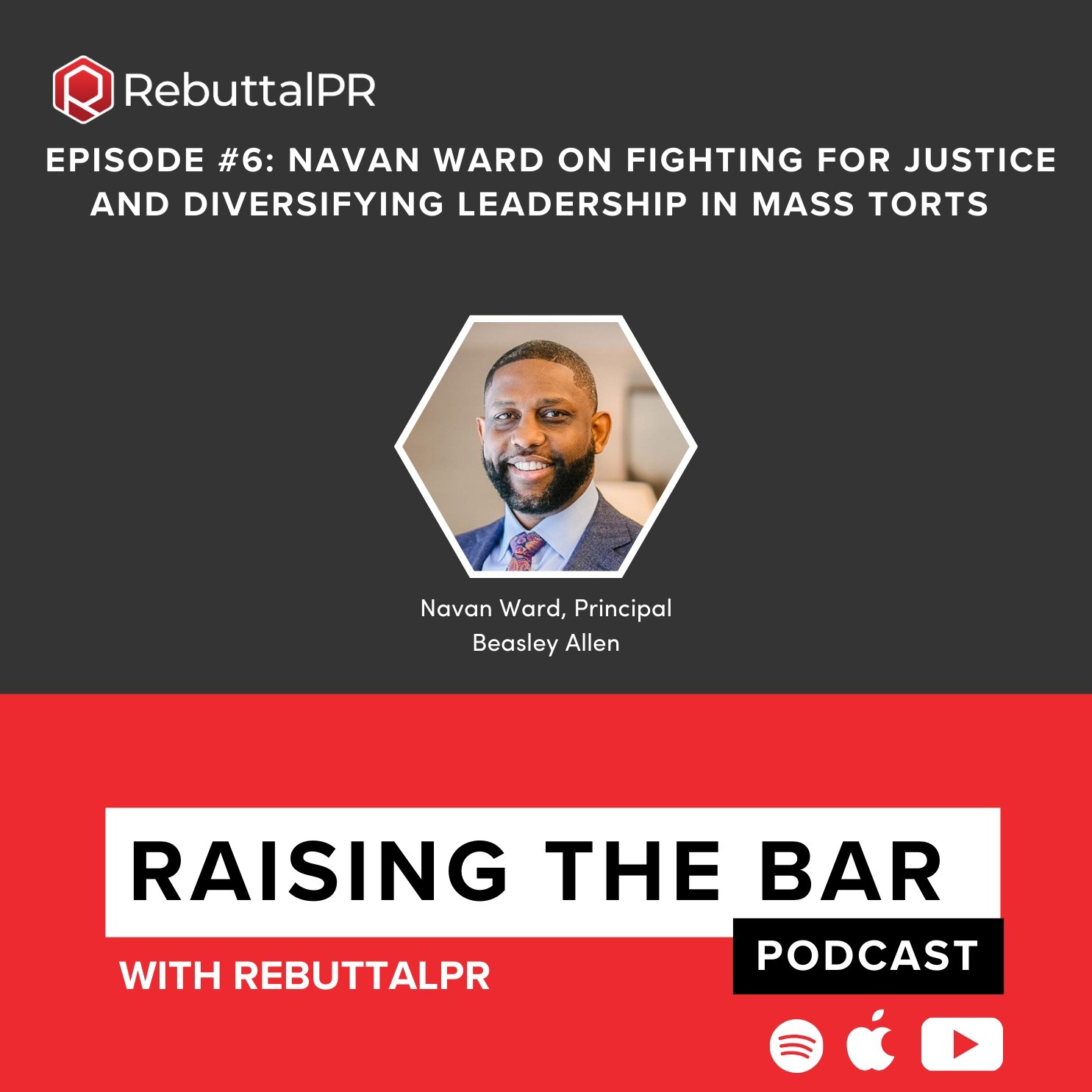
In this episode of Raising the Bar with RebuttalPR, host Ray DeLorenzi sits down with Navan Ward, a seasoned plaintiffs’ attorney, and nationally recognized leader in mass tort litigation. Navan shares how childhood debates with his sister—and a well-timed push from his mother—set him on the path to becoming a trial lawyer. He discusses breaking into the mass tort world, the challenges of MDL leadership, and how his early experiences in insurance defense shaped his approach to advocacy.
Navan also reflects on his tenure as president of the American Association for Justice and his work with Shades of Mass, an initiative aimed at increasing diversity in mass tort leadership. He speaks about the evolving legal landscape, the importance of mentoring, and why he remains optimistic about the future of plaintiffs’ work, despite the daunting challenges ahead.
Tune in for an insightful discussion on the strategies, philosophies, and firsthand experiences that drive one of the most influential attorneys in mass torts today.
Learn more about Navan Ward’s work here: https://www.beasleyallen.com/attorney/navan-ward/
Read the transcript
This transcript of Raising the Bar with RebuttalPR was generated using AI transcription and lightly edited for readability. It may contain errors, and speaker labels are approximate. The audio recording is the authoritative version.
Welcome to Raising the Bar with RebuttalPR, the podcast where we elevate the stories of the plaintiff's bar and dive into the key trends shaping the civil justice system today. I'm your host, Ray DeLorenzi, and in each episode, we'll bring you insightful interviews with leading attorneys, expert perspectives on current legal events, and in-depth discussions on the issues that matter most. Now let's jump in.
What makes a plaintiff's lawyer a plaintiff's lawyer is because they have that empathy, they have that understanding. Again, whether they represent one or thousands, each case, each person, that case is significant and real and has impacted their life and probably is one of the most impactful things in their life they've had to deal with. And that's to be taken seriously.
Ray: Hey, everyone. Welcome to a new episode of Raising the Bar with RebuttalPR. I'm your host, Ray DeLorenzi. Today I have the pleasure to be joined by Navan Ward, a principal with Beasley Allen, who specializes in mass torts. He's led some of the biggest mass torts MDLs in the last 10 to 15 years. He's also a former president of the American Association for Justice. It's a real honor to have Navan with us. Again, thank you for joining the podcast.
Navan: Hey, Ray, it's an honor to be here. Thank you for inviting me.
Ray: So, you know, as folks who have seen these episodes before know, we dabble a bit in touching on the law and your practice, but really try to get to know the people behind these big cases. People see your name on leadership appointments, and it's like, who really is Navan? And I know people who work with you closely get to know you well and know you're a tremendous lawyer and an even better person. But in doing some research for this, I saw a quote that talked about how your mother said that you arguing with your sister was what set the foundation for you to become a lawyer. So I'm curious, you know, there's some folks who are like, I was born to be a lawyer, and some who are kind of late bloomers, and they figure it out after college and are like, okay, maybe I can do this. So what was your path to becoming a lawyer, and let alone a plaintiff's lawyer?
Navan: Yeah, well, you know, Ray, there was no one in my family that was a lawyer, so I really didn't know what this whole legal field was about, not to mention on the plaintiff side. My mom was a nurse, my dad was a meat market manager for Jewel-Osco in Chicago, and again, we just didn't have anyone in our family that were lawyers. You know, the whole perception of lawyers, they like to argue, they argue a lot. And I definitely had a very good sparring partner growing up in my sister, much to the dismay of my mother. And I guess, you know, after one too many arguments between me and my sister, she threw that out there and started throwing it out there more and more, which kind of caught on. I didn't really know what lawyers do, but I felt like I beat my sister on most of the arguments. So I figured I probably would be good at doing this for a profession.
Ray: So you said you weren't surrounded by any lawyers. You're getting in arguments at home, mom's like, you know, you should be a lawyer. What became your frame of reference for who a lawyer is and how you would go about even doing that?
Navan: Yeah, well, you know, representation matters. I mean, there was a popular TV show, L.A. Law, back in the late 80s, early 90s. And Blair Underwood played a character on there that I gravitated to. You know, I saw myself in him one day when I grew up. He appeared to be helping people, solving problems, and his colleagues had respect for him, and he seemed to be doing things the right way. And so that was my frame of reference, since I didn't know anyone in person. And I think the first lawyer I met actually was in law school, where it was a building full of lawyers, professors. So that was my frame of reference, coupled with the seed that my mom implanted in me with regards to my ability to argue. And I guess both of those put together has led me here.
Ray: I think to be a lawyer, particularly a trial lawyer, you have to have a certain level of confidence, or at least project it. And so you go to law school, again, your frame of reference being a TV show. And then you said you met your first lawyer in law school. What was that experience like? Did you feel like a fish out of water, or did you feel like you had a command of it, like, I got this?
Navan: Well, you know, I tell you, you don't know what you don't know, right? And I'm pretty confident in most things. But I remember distinctly, University of Alabama undergrad, I applied to a lot of law schools. I'm from Chicago, so I was trying to really get back to Chicago, to two or three law schools in Chicago. And I remember very distinctly, it was about 6:02 p.m., I'm leaving the apartment with a couple of my roommates. We're about to go get something to eat. And I was, you know, quite frankly, kind of hungry. But I remember very distinctly there was a call on our apartment phone. I picked it up, and it was a student at one of the law schools that I had applied to in Chicago. He essentially said they were on a committee, they were responsible for calling incoming students or candidates and answering any questions that we may have. And again, I was trying to get out the door to eat a hamburger or something, so I definitely didn't know what questions to ask. I wasn't prepared to ask any questions, but I remember getting off the phone about 8:33 that night and laying down on my bed thinking, wow, all of these questions I didn't even know I had were answered.
It really actually gave me confidence. It kind of gave me a roadmap, what to look for. And it was so random. If I ran across that person today, I wouldn't know who he was, what he looked like. But what he did for me was so instrumental in helping me navigate at least those waters early. And so part of that is, you know, throughout my career, I've done a lot of mentoring of certain groups. I've done law school interviews and mentoring in that capacity, and that's part of internally me requiring myself to do what was done for me, being able to reach back, whether it's to a law school or younger lawyer or even a colleague, whoever is reaching out for help, because I know how beneficial that was for me. And that also has helped me navigate those early waters, even the later waters that I deal with today.
Ray: So when on your journey, you know, like you're in law school and you touch on bankruptcy and patents and property and all sorts of stuff, when, or was it even before that, were you like, I'm representing people who are injured? When did that click for you, or did it even click? Was it kind of just a natural process?
Navan: Well, you know, unfortunately, law schools do not focus on plaintiff's law as much as they should. They just don't. I was at the University of Alabama, and I'm coming to realize and appreciate even more that it is a little more unique than others, but they did happen to have a future trial lawyer organization there, and I happened to join it and be a president of that student organization. So I had a concept of what was going on on the plaintiff side, much more than probably many do now and many do at possibly other law schools. We also had professors who did a good job of talking about both sides, not necessarily talking negatively about either side. Now, the Career Service Center is heavily inundated with the big law firms coming to interview. And as a result, I did start with an insurance defense firm very, very early on. And, you know, I tell you, Ray, those Monday morning meetings where we discussed the new cases and how horrific those injuries were, but in the next breath, doing what they're supposed to do, figuring out how to get the insurance company off the hook, it was only so much of that that I could take. It just didn't sit right with me.
And so when the opportunity came for me to join Beasley Allen here, and even before coming here, from my professors and just from the general legal community, knowing how good of a reputation Beasley Allen had, it was a no-brainer to join the firm and to allow me to be on the plaintiff side. Now, with that said, Beasley Allen has about five or six different sections, and we do slightly different things, from class actions to single product liability to mass torts to nursing home back then. And so, you know, the luck of the draw luckily put me in a few sections to allow me to get a wide swath of experience on the plaintiff side that in its totality is concentrated in the mass tort and single event product liability section. But the cards just happened to unfold that way. And definitely being able to see the hardships and the experience I had on the defense side is just something that I could not see myself continuing to do, for all those reasons.
Ray: So were you looking to get out of that world, or was it serendipitous that you got approached and someone said, hey, is this something that interests you?
Navan: There is, and still is, a really good attorney. I don't even know if he knows this, but I was at the defense firm. We had just come from a workers' comp hearing, and, you know, we kind of beat up pretty bad on the injured worker to limit the amount of injuries and/or percentage of coverage he would get on whatever injury he had. I remember the way the people in the gallery were looking at me as I walked out, like, oh, how could you? And all that. As I mentioned earlier, it was Monday morning. It was really just starting to really get to me. And so I walked back into my office, and Walter McGowan, who's in a plaintiff firm in Tuskegee, was in a mediation at that office. He was coming out of the bathroom. He was a few years older than me. He definitely is an early mentor. I saw him, we exchanged pleasantries. He asked me, how am I doing? And most people ask, how are you doing? Yeah, I'm doing good, you know. But he grabbed my arm and said, no, no, how are you doing? And it's almost like he knew that there was some conflict and some unhappiness and some just not doing what I believe I'm supposed to be doing. And I don't know what I told him, but that did tell me that I could not continue doing this. And then again, obviously, the opportunity with Beasley Allen came shortly thereafter.
Ray: So I feel like every trial lawyer has, when they become a plaintiff's lawyer, it's not necessarily their first case, but an early case where it all clicks and it's like, this is what I was meant to do. Is there a case like that for you that really stands out in your early days at Beasley Allen where it just all sung?
Navan: Yeah, you know, there are a lot of moments like that. But I can think of one, a nursing home case, and I can't even remember how successfully it resolved, if it resolved or not. I believe it did. But I remember doing a mediation. And of course, when you are in the fight, you're taking depositions, you're sponsoring the discovery, you have the most compelled battles, you have all of these different battles, and you get to a point where you go to mediation. And in this nursing home case, we dealt with the family members, because unfortunately our clients are deceased or passed away because of the negligence of the nursing home. And, you know, in this particular one, we had about two or three of the family members there, and the family members were fairly consistent with going to visit their mom, the victim in this particular case. And we do our openings before we get to the meat of the mediation. And after our openings, when we were showing all the evidence that we've been able to find up to this point in time, the defendants gave their spiel. And we went to our separate rooms, our separate breaks. One of the daughters came to me and, with tears in her eyes, said thank you, thank you so much for explaining to us what had happened. Of course, we communicate with them throughout the time, but actually seeing the medical records on the screen, where different staff members went back in and filled in the chart saying that they provided care for their mother, when in actuality their time charts showed that they were out on vacation, it made sense to them why what they were seeing didn't line up with how their mother was going downhill.
And so whether we won or lost wasn't the point. The point was the family was so appreciative of having a lawyer on their side to find out the truth and to at least attempt to hold the wrongdoers accountable. You know, the sincerity with which she thanked me, and how humble and how, quite frankly, saddened she was to see it. In these cases, you see in the medical records the victim, the family member, your client, you see them go downhill. Saddened to see it, but it made sense, and it further convicted them in their decision to move forward with the lawsuit and, again, make sure that this did not happen to someone else.
Ray: How does that experience on the insurance defense side, back then and maybe even today, inform how you approach cases, approach your clients, and also how you bring a case forward and estimate what the right damages are? How does that influence your approach?
Navan: Well, you know, and again, I learned a lot from that insurance defense firm, and they weren't bad people. I learned a lot from them. They're good people. Those attorneys did what they were tasked to do, and so I understand what they're tasked to do. I understand that out of all the cases I worked on, I don't really remember talking to the actual client. I remember more so interacting with the insurance company. So I understand that the defendants, regardless of how inherently good or bad they are, have that barrier that they have to go through. I understand that in assessing the case, I have to definitely speak to the decision maker, the true decision maker, and provide whatever evidence that we're compiling that would speak to that true decision maker. And also just knowing that, hey, inherently there are some really good people on that side. And from a human standpoint, one of the early lessons I learned is that being able to have good relationships with your colleagues on the other side is instrumental in being able to have the best results, not only for your side, but also for their side.
Ray: I want to pivot a bit and talk about your transition into the mass tort and MDL world, which, you know, some people have described can be a bit clubby and not easy to break into. What was your process and journey to start doing that?
Navan: And people who think that aren't entirely wrong. You know, again, I had the fortune of being a part of Beasley Allen, which has been not only doing single event product liability type cases for a long time, but doing mass torts. My law partner, Andy Birchfield, leads our mass torts section and is well respected. So many of our law partners in this section and beyond are so well respected around the country. And so it helped me to open a few doors just with the relationships that others in my firm, as well as my firm's reputation, have with others around the country. But also putting in the time, putting in the work of not necessarily being in leadership for the first one or two, but still doing the grunt work, doing my part, others being able to see me do my part. And eventually, when a couple years got under my belt and new litigations came about, being able to constantly raise my hand and say, hey, I want to be a part of this one.
And then, you know, once you are able to get a part, of course, you still have to do your part and continue to build relationships. It helps as you continue to grow. But the overall process for people who, hey, maybe are doing criminal, maybe doing personal injury, maybe want to start entering into the mass tort world, it may not be as easy for them. And granted, there are some unique things about mass torts that are not natural to the normal or regular medical malpractice, personal injury, or whatever other discipline that you may be doing. But there certainly are barriers. Unfortunately, there are certain barriers for others to get in. And that's why there are a lot of organizations, one of the ones that started with Ben Trump, Diandra Debrosse Zimmermann, and others, called Shades of Mass, that really speaks to that barrier to entry in mass torts. There are other organizations that somewhat do the same thing with regards to introducing mass torts to other lawyers, so whether they want to get in on the entry level or all the way to the leadership level, at least they'll have tools. And in addition to that, a lot of the judges nowadays are instituting initial orders that require more development among the leadership, so new voices can, of course, help and assist whatever litigation it may be.
Ray: With mass torts, you know, obviously in one instance you're representing one person or maybe a small group, and in a mass tort you're representing hundreds or thousands of people. How do you stay grounded in the experiences of the people you're representing when you're leading a litigation of that scale?
Navan: It is simple. I mean, for me, a couple things. Number one, I know that none of us are immune from either taking a pill, using a medical device, or driving down the street and a wrongdoer making a bad decision that hurts us. None of us are immune to that. And so I know that no matter if I'm representing one person or a thousand people, their injury matters to them. And the fact that, unfortunately, my family had a very devastating loss in a product liability case, where I had to make the call to a close family member and give them updates throughout the litigation, I know that that feeling is what all of my clients feel. And I know it because I felt it, because it was my family member talking to a family member who lost his son.
And so I never forget that. None of us are immune to it. And I think, to a certain degree, and I'm willing to speak definitely for everybody at my law firm at Beasley Allen, I think I'm safe to say that what makes a plaintiff's lawyer a plaintiff's lawyer is because they have that empathy, they have that understanding, again, whether they represent one or thousands, that each case, each person, that case is significant and real and has impacted their life and probably is one of the most impactful things in their life they've had to deal with. And that's to be taken seriously.
Ray: You know, in these mass torts, you have a group of lawyers who are appointed. You have lawyers who may have clients who are not appointed, you could have multiple defendants, a lot of wrangling. And I saw in an interview you did, you talked about your leadership style as leadership by consensus. I'm curious how you implement that in an MDL, also knowing that you've got to move it forward to trial or resolution. How do you get consensus? And also, is there a limitation on consensus?
Navan: Yeah, so leadership, in my opinion, there's several different roles or capacities to leadership. One is recognizing and understanding that the people you have in your room with you are very intelligent, capable, smart people. I may very well be leading or co-leading in this litigation, but in the next litigation two years from now, another one of my colleagues is a co-lead, and I'm following their direction. I understand that there are highly skilled and intelligent people that always are around you, and it would be nonsense to not take their guidance and not hear the various insights, recommendations, suggestions, and thoughts that they have. To ignore that would be foolish. But the other part of leadership is to be able to take that advice, and the differing advice, and make a decision on which route you have to go. And that way everyone is heard, everyone is valued, everyone is helping to move the ball forward. Because even if you choose one direction over the recommendation of others, you're going to have to deal with that opposing view, because you're going to have to deal with it from the defendants in some other form or fashion down the road. And being able to know it, think about it, and be prepared to address it when it comes only, again, helps whatever litigation you're doing be more successful.
RebuttalPR is a strategic communications firm that works exclusively with the plaintiff's bar to market their firms and win high-stakes litigation. For more than 15 years, the nation's leading plaintiff law firms have turned to RebuttalPR to create winning communications campaigns, ranging from billion-dollar mass torts and class actions to positioning attorneys in their markets to grow their businesses and make a bigger impact. What sets RebuttalPR apart is the unique skills of our team, which combines legal knowledge with public relations expertise. Our team's ability to understand the facts and law of a case, as well as the media landscape, means we can develop compelling, narrative-driven campaigns that resonate with key stakeholders and support your firm and legal strategy. Visit our website, rebuttalpr.com, to learn more. Now, back to our episode.
Ray: Again, I'm joined here by Navan Ward, principal with Beasley Allen. Pivoting off that leadership philosophy that you have, you led AAJ a couple years ago, and you also helped found and are a leader in Shades of Mass. Tell me about that work and what you prioritized in those leadership positions to move the organizations and their respective missions forward.
Navan: You know, Ray, very early on in my time at Beasley Allen, I thought I'd immediately be going to trial, immediately be doing depositions, et cetera. I did, but some of the first few things that I was tasked to do was go to a town hall meeting on arbitration and support those legislators who were against arbitration. And I saw how that support was so important, because people can have the absolute worst type of injuries. One of the worst things I've had to do over the years is to see a case, see a family, see a victim that should have rights, but because the laws don't allow us to move forward, I have to tell them that I can't take their case because it's preempted. I can't take your case because there are damage caps and the expenses of this would far exceed even the damage caps, so you wouldn't get anything back from it. To have to turn away people because the laws don't allow you to exercise your Seventh Amendment right to trial by jury, that's one of the most devastating things I've seen throughout the years I've been in practice.
And so the vehicle that I have, and through my firm's support, is being able to be a part of organizations like the American Association for Justice, the largest plaintiff trial lawyer organization in the world, as well as trial lawyer organizations both in the local areas I've been in and in the state areas, both in Alabama and Georgia, since I'm now in Georgia, because those types of organizations are the ones that are fighting to keep victims being able to have a voice and be able to go to trial and hold the wrongdoers accountable. And so, you know, having the support to be a part of those organizations, and then when you're a part of them, you want to do your part. And I guess in doing my part too much, it led me to a situation where I ended up being an officer and then eventually the president there. And of course, that experience was an experience of a lifetime, being able to see things on a national level, from the U.S. Senate, Congress, the U.S. House, the executive branch, being able to see up close and personal the people and the issues that were affecting client rights. It was very, very interesting. It was very telling.
It made me put everything in perspective of the first assignment I had when I joined Beasley Allen by going to that town hall. It put everything in perspective with regards to how important that role is, and that every trial lawyer should be a part of their state and/or national trial lawyer organization, AAJ and whatever state trial lawyer organization that you're in, because without them, our ability to protect our clients, and as I said before, none of us are immune from being hurt from any of these wrongdoers, it ultimately protects us if either we or our families are in that situation, from being able to, again, hold the defendants, hold the wrongdoers accountable. And so that may be a long-winded way of saying that being a part of those organizations is part and parcel of what we do as attorneys. Because, again, we can have the most horrific case with the facts that help our clients and hurt the defendants, but if we can't pursue it because of laws, because of rule changes, because of preemption, because of arbitration, because the list goes on and on and on, then we're not able to do our job.
Ray: So while the list of challenges in terms of access to justice goes on and on, unfortunately, what gives you optimism about access to justice over the next 10 years, let's say?
Navan: What gives me optimism is that after all we have faced up to this point, we are still here. The very nature of plaintiffs' work is that we fight with much less than our opponents, and we still win. Our existence as plaintiff lawyers is to be creative in order to bring various different lawsuits in order to have access to justice and have success. And knowing that although there are so many obstacles currently in our way, that have been in our way in the past, and that will certainly be in our way in the future, knowing that good does always prevail, and that with the people on our side, it's hard to lose with the type of people who truly believe in being on the right side. And, you know, it's not just lawyers. I mean, at my time with AAJ, Ray, you definitely, you are a part of that organization, and I had to lean on insight that you had given on multiple occasions in order to better do my job. And so we have a team of lawyers and colleagues that span the universe that help us. And with that coalition, I'm more than optimistic that whatever current challenges or future challenges we face, we're going to still be here in 10 years.
Ray: I love ending on high notes, and I can't think of a higher note than that. So, Navan, I want to thank you so much for your time and generosity. Really appreciate you joining us today and sharing your story.
Thanks for listening to this episode of Raising the Bar with RebuttalPR. Don't forget to subscribe and follow to join us next time. See you then.
Related episodes
- Bruce Plaxen on His 40-Year Journey to Becoming AAJ President
- Sindhu Daniel on Mass Torts and Mentorship
- Linda Lipsen on Protecting Civil Justice
See how RebuttalPR helps firms committed to diversifying firm leadership in mass torts.
Discover Insights & Trends
Featured Stories

- September 4th, 2026
- 4 minutes
- Melissa LoPiccolo
How to Vet a PR Firm: 8 Questions to Ask Before the Contract is Signed

- August 21st, 2026
- 4 minutes
- Stephanie Wolf
Aligning Your Benefits with Your Values: Parental Leave Edition